


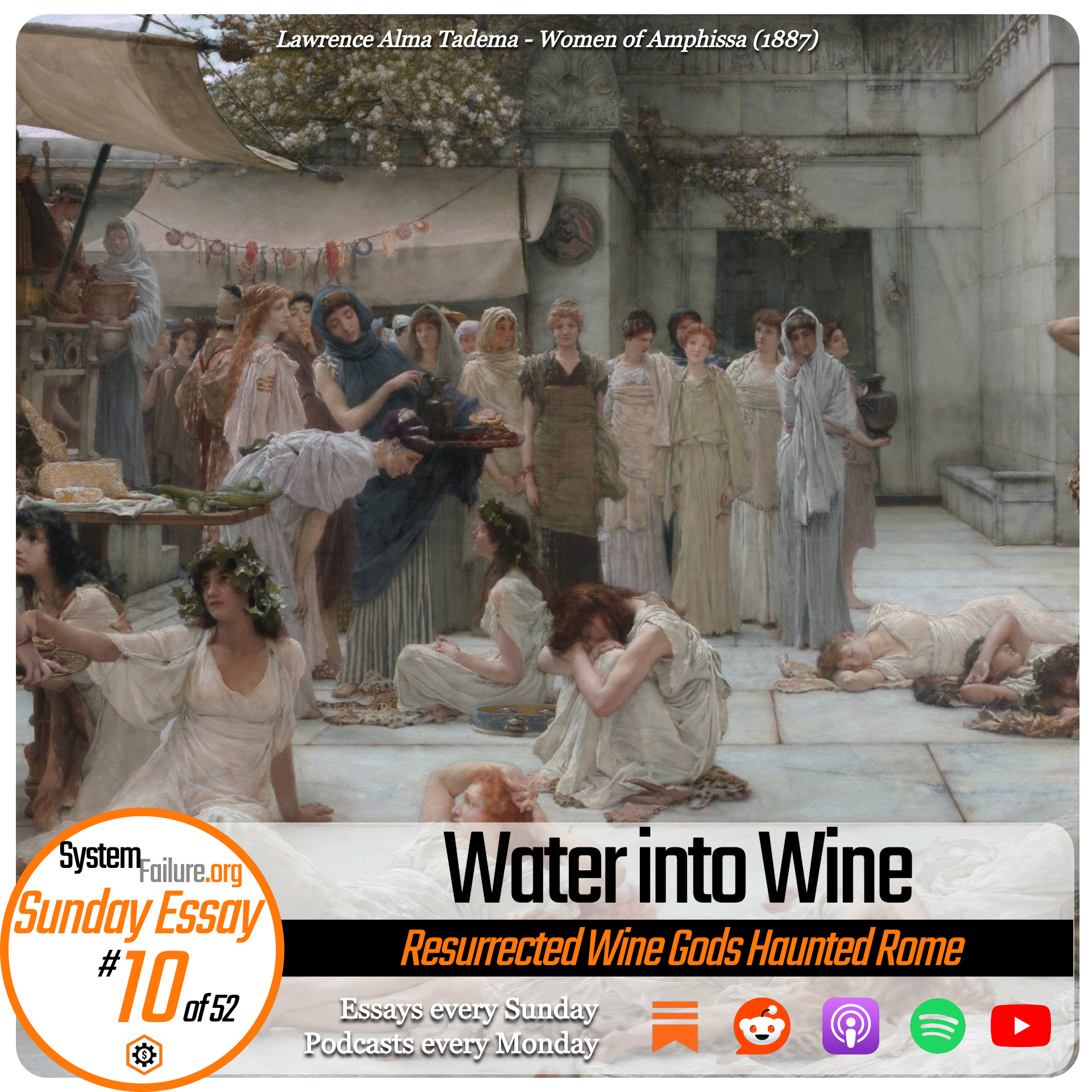
The major theme of this essay is ego death—an experience induced pharmacologically in ancient times that heavily influenced both Greek philosophy and the rise of Christianity.
Key Takeaways:
The Cult of Dionysus was a predecessor to Christianity in which initiates drank wine spiked with psychoactive ingredients.
The Roman government cracked down on the Cult of Dionysus in 186 BC because it threatened the political establishment.
Two hundred years later, Christianity borrowed many symbols from the Cult of Dionysus in its revolt against the cruel economic hierarchy of the Roman Empire.
Psychedelic Wine
During the first century AD, Dioscorides was a Greek physician serving in the Roman army. He wrote De materia medica, a comprehensive five-volume pharmacopeia listing the healing properties of every substance then known to medicine. His landmark work was considered definitive all the way up until the time of the Renaissance.
Dioscorides’ entire fifth volume was dedicated to wine mixed with psychoactive ingredients such as the hallucinogenic—and highly toxic—mandrake root. He carefully recommended doses that induced visionary experiences without poisoning the drinker. The fact that some 20% of his pharmacopeia was dedicated exclusively to such concoctions shows how the ancient Greeks and Romans used wine as a delivery system for other substances.
The story of Alexander’s best friend, Hephaestion, further drives the points home. In observance of the Greek tradition, games were held in his honor after he died. One of those games was a drinking contest at which 41 additional people died, according to the Greek historian Diodorus. Clearly, those Greeks were drinking more than mere cabernet sauvignon from their goblets.
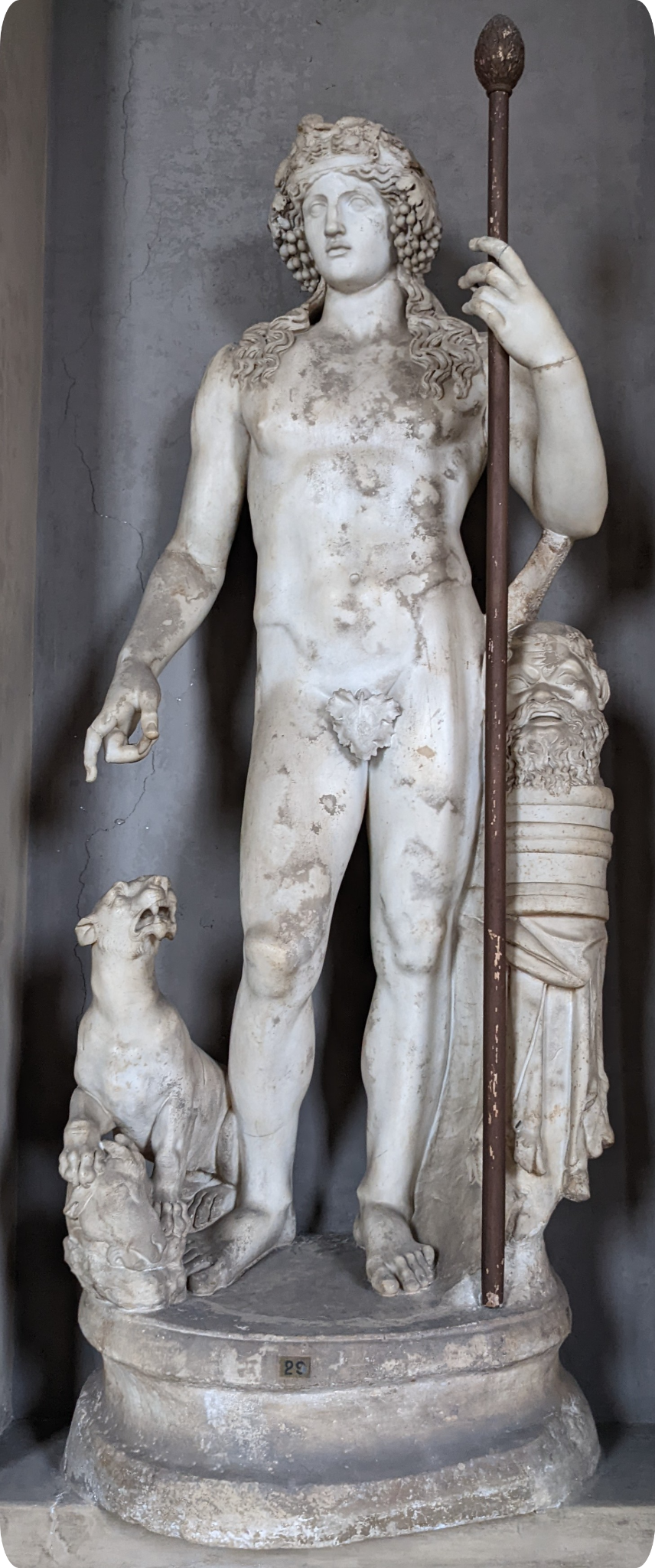
Alexander’s mother, Olympias, was a priestess of the wine god Dionysus. In the Vatican Museum, there are so many mosaics and statues of Dionysus that, on a recent visit, our tour guide felt compelled to explain that Christianity sourced many of its familiar traditions from pre-Christian predecessors.
Our tour guide was referring to the story of Dionysus’ resurrection. He was a late addition to the Greek pantheon; the worship of Dionysus started much later than the Mysteries of Eleusis, which anchored the religions of Greece and Rome for thousands of years. Dionysus’ mythology eventually merged with that of Eleusis, and he became the son of Zeus and Persephone.
There were several variations of the Dionysus myth. He was accidentally killed by his father, or torn apart by monsters. Zeus then brought his dead child back to life either by carrying the corpse within his own body, or by having a mortal girl hold him in her womb until Dionysus was reborn. Dionysus was either the only son physically begotten by Zeus, or he was born of a virgin. Both legends later merged into the familiar story of Jesus.
The Roman Crackdown
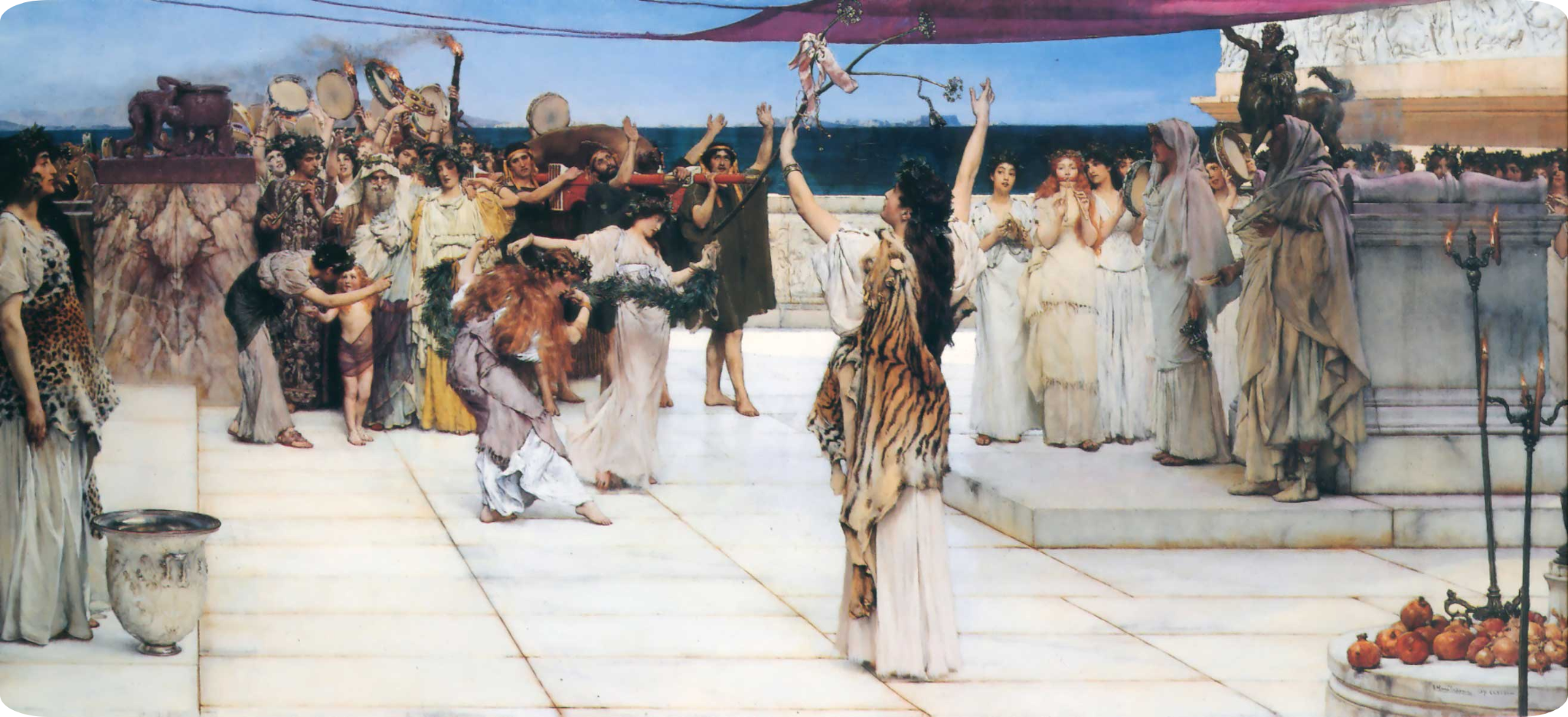
Just as at Eleusis, the Dionysian proceedings were dominated by women. While the drugs consumed at Eleusis were called “kykeon” after the Homeric epics, the psychoactive wine consumed during the Dionysia celebrations was called “pharmakon.” Depending on the context, pharmakon could mean poison, remedy, or scapegoat (i.e the taking on of someone else’s sins, a major Christian theme).
Instead of Dionysus, the Romans referred to the wine god as “Bacchus.” In 186 BC, the Roman government violently suppressed the popular Bacchic cult. The Roman historian Livy left us with a chilling account of its high priestess, Paculla Annia, and the execution of some 6,000 cultists.
According to Livy, the cult functioned as a “state within a state”. Upstart religions are often persecuted by existing authorities, whose power and influence are threatened when citizens organize themselves outside of established political systems. That’s what Livy meant by the Bacchic cult being a state within a state.
Furthermore, the experience of “ego death” amplified the political threat posed by religions centered around psychoactive drugs. The ego is the mental conception of the self: it’s how one knows which mouth to feed at the dinner table. Ego death is a temporary dissolution of that mental artifact. The experience of ego death feels like a death and rebirth of the self. That’s how resurrected gods became symbols for ego-dissolving drugs.
The ego is the only handle by which the authorities can grab us. When people stop identifying as their physical bodies, they can no longer be threatened with prison, torture, or execution. Jesus was so confident that he was NOT his physical body that he consented to a gruesome public execution. The remarkable story of Christ, whether true in the literal sense or not, advertised the limitations of state power as Rome headed into her twilight.
The Gospel of John
The Roman authorities co-opted the Cult of Dionysus after 186 BC and removed the psychedelic element that so threatened them. Two centuries later, Christianity arose as another rebellion against the Roman establishment. Many of its symbols were borrowed directly from the older underground tradition of Dionysus.
While wild grapes are native to Greece, organized viticulture and wine grapes were transplanted there by Semitic Phoenician traders. That’s why the wine god Dionysus was portrayed as a foreigner who arrived from the east. Because the story of Christ was about a resurrected Jew from Palestine who turned water into wine, it was familiar to millions of Greeks living within the Roman Empire. They would have instantly recognized the reference to the ego-dissolving drugs of Dionysus.
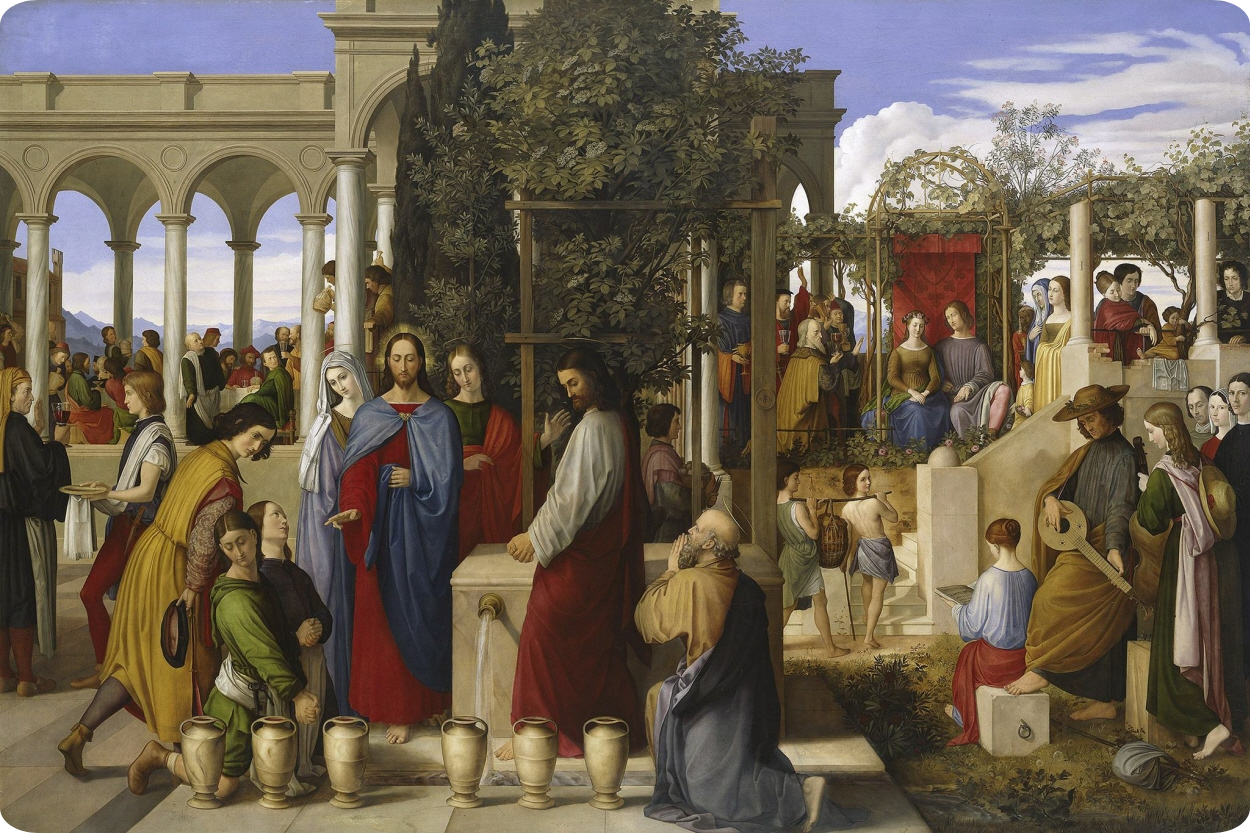
During the Dionysian festival known as the Thyia, priests would place three empty bronze basins inside a building. The doors of the building were then sealed, with witnesses present. The following morning, the seals would be broken, and the basins would be found filled with wine. The trick of turning water into wine would later be attributed to Jesus, who accomplished an identical feat according to the Gospel of John.
The New Testament is a Greek story, originally written in Greek, but set in Palestine. In addition to borrowing the transformation of water into wine, John also used the language of Greek philosophy to portray Jesus as the embodiment of the Logos, a term used by the Greeks to signify reason, divine order, and the principle that governs the universe. Logos is the Greek word for “word”, and it shows up in the first line of John: “In the beginning was the Word”.
The ego-dissolving kykeon of Eleusis and the pharmakon of Dionysus influenced the Greek inventions of democracy and drama, which both de-prioritize the sense of self. Democracy means making decisions collectively rather than individually, while actors discard their identities and adopt whole new personas on stage. It’s no coincidence that these innovations come to us from people who ritualistically dissolved their egos. But the New Testament remains the most significant Greek contribution to modern civilization, and much of its symbology reflects the worship of the wine god Dionysus that came before it.
Conclusion
The bread of Eleusis and the wine of Dionysus went on to become the Christian Eucharist still observed all over the world in modern times. But after Roman authorities co-opted the Christian faith and made it the state religion of their dying Empire, they abandoned psychedelic ingredients and used regular bread and wine as enduring symbols of Christianity’s major theme of death and resurrection. The experience of ego death feels precisely like a personal death and rebirth. That’s why the mystery religions of the ancient Mediterranean Basin used psychedelic compounds to induce it. The experience of ego death and rebirth found a perfect allegory in ancient stories of resurrected gods, and Christianity borrowed heavily from those traditions.
Since you made it this far, patient reader, kindly consider hitting the ❤️ button above or below; it really helps!
Further Materials
Only late in his career was Dionysus received into Olympus. In Thrace, which gave him as a Greek gift to Greece, he was the god of liquor brewed from Barley and was known as “Sabaseus”. In Greece he became a god of wine, the nourisher and guardian of the vine. He began as a goddess of fertility, became a god of intoxication, and ended as a son of god dying to save mankind.
Many figures and legends were mingled to make his myth. The Greeks thought of him as “Zagreus”, the horned child, born to Zeus by his daughter Persphone. He was the best beloved of his father and was seated beside him on the throne of heaven. When the jealous Hera incited the titans to kill him, Zeus, to disguise him, changed him into a goat then a bull. In this form, nevertheless, the Titans captured him, cut his body into pieces, and boiled them in a cauldron. Athena, like another Trelawney, saved the heart and carried it to Zeus. Zeus gave it to Semele, who impregnated with it, gave to the god a second birth under the name of Dionysus.
Mourning for Dionysus’ death, and joyful celebration of his resurrection, formed the basis of a ritual extremely widespread among the Greeks. In springtime, when the vine was bursting into blossom, Greek women went up into the hills to meet the reborn god. For two days they drank without restraint. And, like our less religious bachanlians, considered him witless who would not lose his wits. They marched in wild procession led by maenads, or mad women, devoted to Dionysus. They listened tensely to the story they knew so well of the suffering, death, and resurrection of their god. And as they drank and danced, they fell into a frenzy in which all bonds were loosed. The height and center of their ceremony was to seize upon a goat, a bull, sometimes a man, seeing in them incarnations of the god. To tear the live victim to pieces in commemoration of Dionysus’ dismemberment. Then to drink the blood and eat the flesh in a sacred communion whereby, as they thought, the god would enter them and possess their souls. In that divine enthusiasm they were convinced that they and the god became one in a mystic and triumphant union. They took his name, called themselves after one of his titles, Bacchoi, and knew that now they would never die. Or they termed their state an ecstasis, a going out of their souls to meet and be one with Dionysus. Thus they felt freed from the burden of the flesh, they acquired divine insight, they were able to prophesy, they were gods.
Such was the passionate cult that came down from Thrace into Greece like a medieval epidemic of religion dragging one region after another from the cold and clear Olympians of the state worship into a faith and ritual that satisfied the craving for excitement and release, the longing for enthusiasm and possession, mysticism and mystery.
The priests of Delphi and the rulers of Athens tried to keep the cult at a distance but failed. All they could do was to adopt Dionysus into Olympus, hellenize and humanize him, give him an official festival, and turn the revelry of his worshippers from the mad ecstasy of wine among the hills into the stately processions, the robust songs, and the noble drama of the great Dionysia. For a while they won Dionysus over to Apollo, but in the end Apollo yielded to Dionysus’ heir and conqueror Christ.
Will & Ariel Durant, The Life of Greece, 1939, page 306

Many thoughtful insights arise when more complete histories like these are brought together. The links between ego submersion and spiritual experience keep the latter free from preconceived perspectives. The Bacchoi reminded me of the gardens of Adonis.
How often Priests choose to resort to trickery.
To me it is interesting that so many artists portray historic almost mythic events. That Dionysus standing there looks like David.