


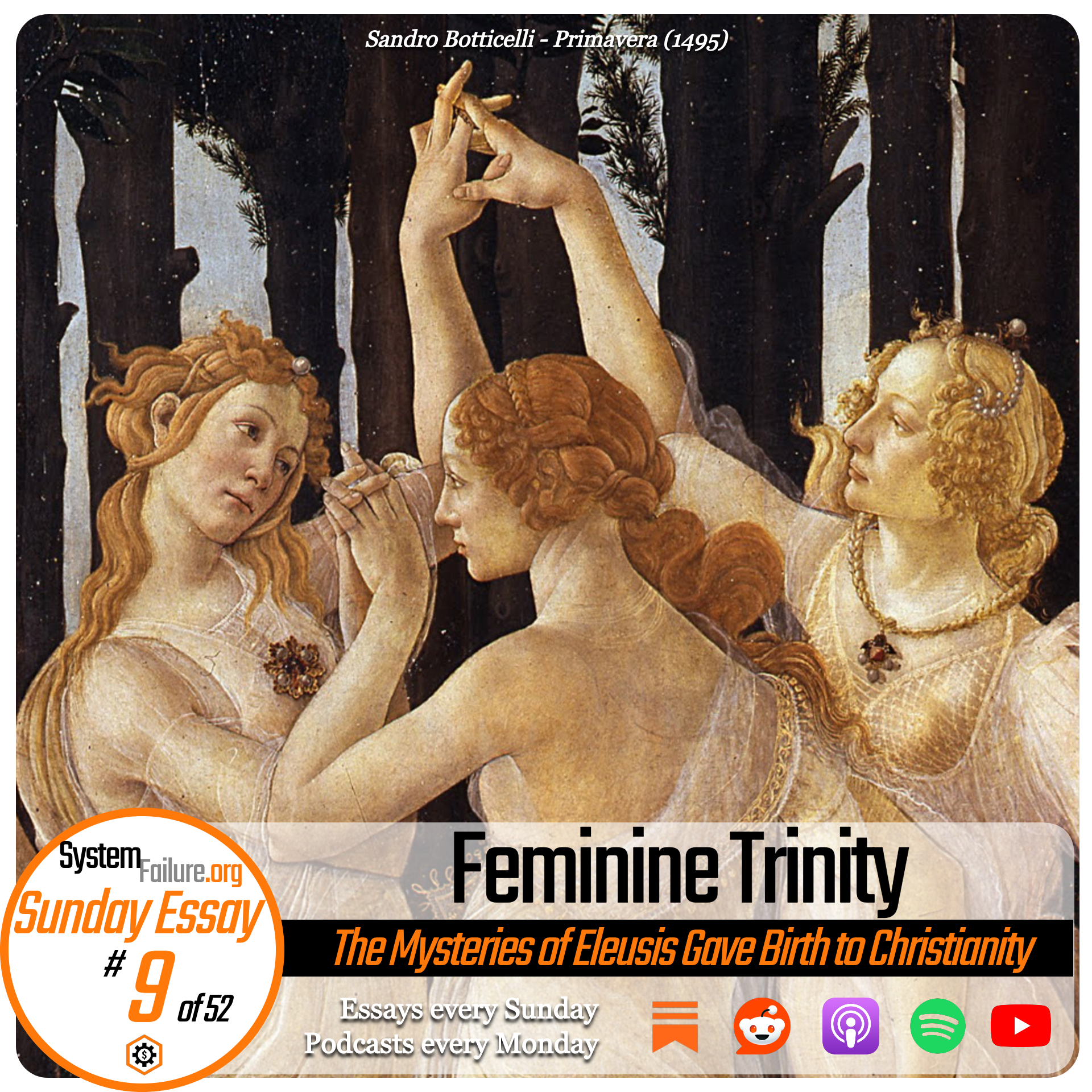
The major theme of this essay is ego death—an experience induced pharmacologically in ancient times that heavily influenced both Greek philosophy and the rise of Christianity.
Key Takeaways:
The epicenter of pre-Christian religion in ancient Greece and Rome was Eleusis, where psychoactive drugs were consumed.
At Eleusis, the psychedelic experience of ego death was a secret symbolized by a celebration of femininity.
The mythological triad of goddesses venerated at Eleusis was partially adopted by Christians as the Virgin Mary.
The Mysteries of Eleusis
The Hymn to Demeter is a Homeric poem from classical Greece. It’s a myth about three goddesses: the mother goddess Demeter, her virginal daughter Persephone, and the wise old woman Hecate. Their story is a mythological allegory for the annual agricultural growing seasons. Demeter was the goddess of agriculture, specifically cereal grains. Her Roman counterpart was Ceres, from whom we derive the word “cereal”.
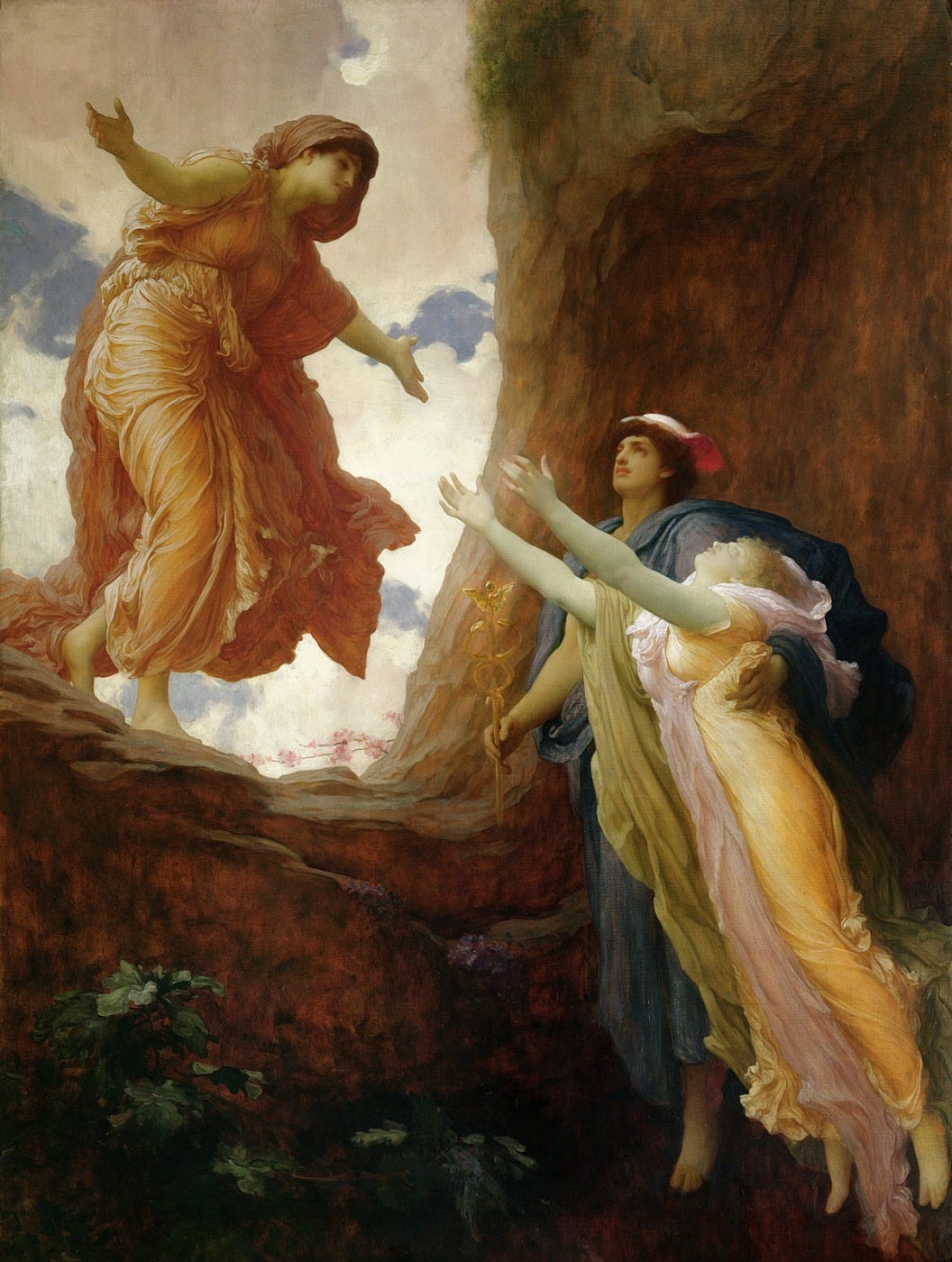
According to the myth, the girl Persephone was kidnapped by the dark god of the underworld. Aided by the illuminating torchlight of the wise Hecate, Demeter rescued her daughter. But Persephone had grown accustomed to her new life as Queen of the Underworld, so she slyly slipped some pomegranate seeds into her mouth before leaving. This act compelled her to return to the underworld for three months out of every year, to the annual sorrow of her mother.
The growing seasons were said to be caused by a despondent Demeter forgetting to make the plants grow while her beautiful daughter is confined to the underworld during the winter.
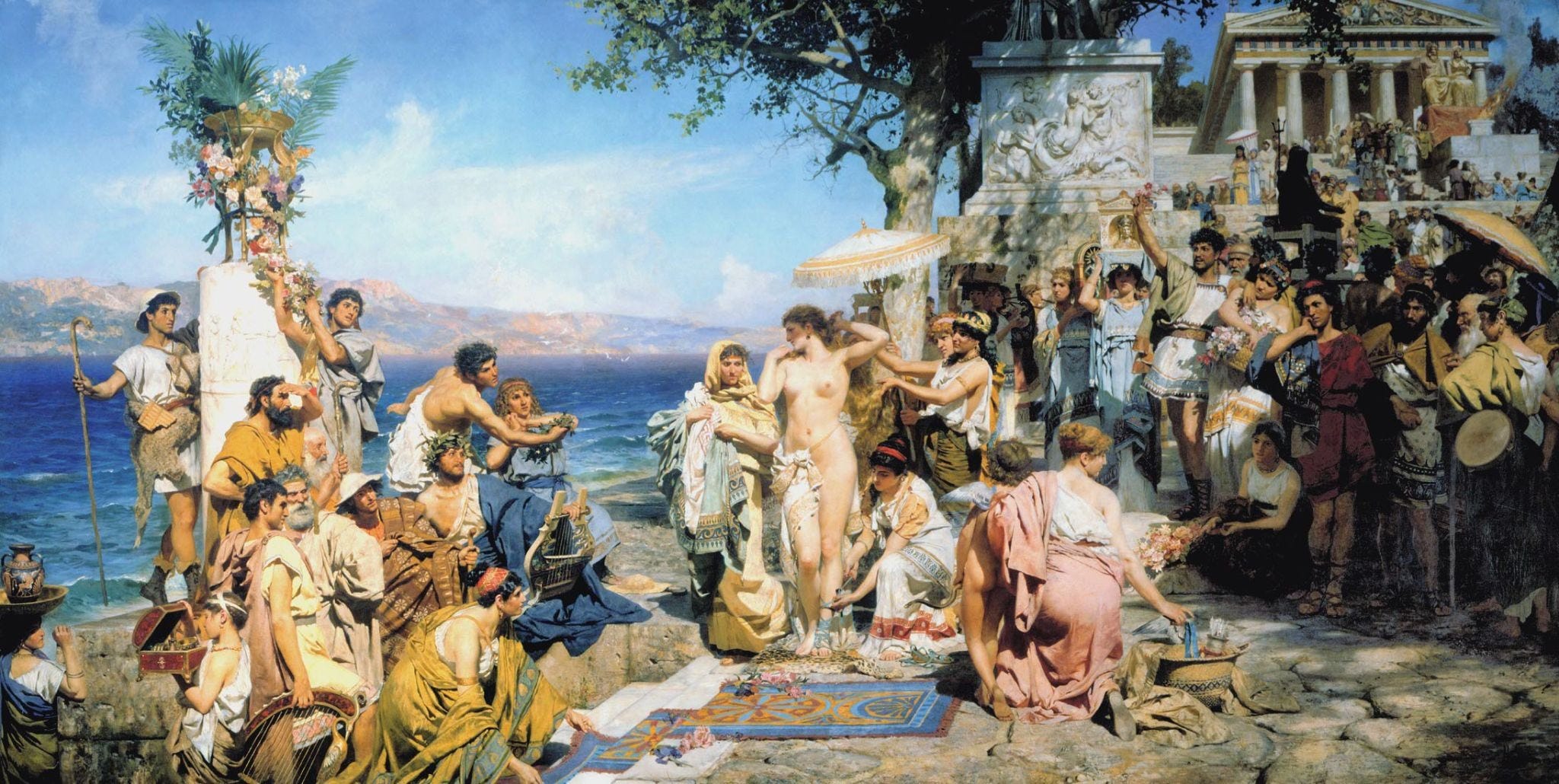
Known as the “Mysteries of Eleusis”, the rites of Demeter were pre-Christian Greece and Rome’s most significant religious observances. For almost two thousand years, initiates from Plato to Julius Caesar made pilgrimages to the Temple of Demeter located at Eleusis, a small village on the edge of a vast plain where the grain that fed Athens was grown.
Inside the temple, initiates drank a mysterious potion called a kykeon from a ceremonial chalice. Afterwards, they described themselves as having been “saved”. The Hymn to Demeter, the Iliad, and the Odyssey all describe this potion as a thin, beer-like substance made from cereal grain. Whispers abounded that this kykeon had the power to confer immortality upon the drinker. But its contents were a closely guarded secret, and revealing that secret was punishable by banishment or even death.
In 392 AD, Theodosius I outlawed the Mysteries. He and the other emperors of the late Roman Empire were determined to forge a future that was exclusively Christian. That meant erasing old pagan practices and consolidating political power under the aegis of Christianity.
A few years later, Alaric the Visigoth razed the Temple of Demeter and the site was abandoned. The Mysteries of Eleusis were forgotten in the new Christian world that rose from the glowing embers of the collapsed Roman Empire. Knowledge of the psychoactive contents of the kykeon was lost to history thereafter.
But in the late 1990s, a ceremonial chalice used in Rites of Demeter tested positive for ergot. At the same site, teeth on a human jawbone also tested positive for the psychoactive fungus that infests cereal grains. These findings were published in 2002 in the Catalan language. But the English-speaking world didn’t get the news until 2020, when Brian Muraresku published his outstanding book The Immortality Key.
The Sacred Feminine
Though ergot is highly psychoactive, the fungus is also very toxic. The kykeon was a piece of biotechnology handed down over many generations of priestesses. Their carefully-guarded recipe allowed them to induce psychedelic experiences without killing or maiming initiates. This trick of separating the groovy properties of ergot from its poisonous effects would not be achieved again until the 1930s, when Albert Hofmann used the same fungus to synthesize LSD.
At heavy doses, psychedelics cause an experience known as “ego death” that explains why the kykeon was said to grant immortality to the drinker. It’s best described as a dissolution of the sensation of being an individual. The experience is that of a death and rebirth of the self.
Initiates to the Mysteries of Eleusis were astonished to find that they could exist without the familiar mental artifact of the self, if only for a short time. The experience showed them that there is much more to each of us than the costumes of identity we habitually wear.
Instead of identifying as a single instance of the human genetic code, they temporarily identified as a never-ending series of such instances. In other words, they identified as the code itself instead of a specific instance of it. Eleusinian priestesses might have suggested that the trick to surviving your own death is to simply change what you conceive of yourself to be.
This flip in perspective was what those initiates meant when they described themselves as having been “saved”. During childbirth, women experience a forking of their individual selves into two or more beings, making femininity an obvious allegory for the illusory nature of personal identity. The “Sacred Feminine” is an ancient religious and spiritual concept emphasizing femininity as a pathway to divinity. The epicenter of this spiritual concept was Eleusis, where a priesthood of women celebrated the Sacred Feminine and kept the secret recipe of the kykeon safe for generations.
The Feminine Trinity
Early Christians adopted many existing symbols and traditions from around the Mediterranean Basin to make Christianity more comprehensible to potential converts. After the Church rose to imperial power in Rome’s twilight, however, it began forcefully erasing those old traditions. The new Roman Catholic Church did not tolerate spiritual competition. It wanted its flock to achieve transcendence exclusively through a holy communion controlled by the Church, not the old pagan kykeon.
The Feminine Trinity of Eleusis is a prime example of an ancient tradition first adopted by the Church, and subsequently outlawed by it. The three main characters in the mythology of Eleusis were Persephone, Demeter, and Hecate. These three archetypal figures formed a trinity that symbolized the three phases in a woman’s life: virginal girl, mother, and finally, crone or old woman.
Christianity adopted only two-thirds of this Feminine Trinity. The virginal girl and the mother figure both coexist in the single person of Mary, who is portrayed to this day as both a virgin and a mother in one of the great contradictions of theology.
The crone, meanwhile, threatened the Church’s spiritual monopoly. The archetype of the wise old woman—who knows the properties of every plant in the forest—was recast as the consort of the devil. Salvation was to be realized exclusively through the Church, not through ergot or any other means outside the Church’s control. Throughout the Middle Ages, the Church bolstered this spiritual monopoly with violence against so-called witches.
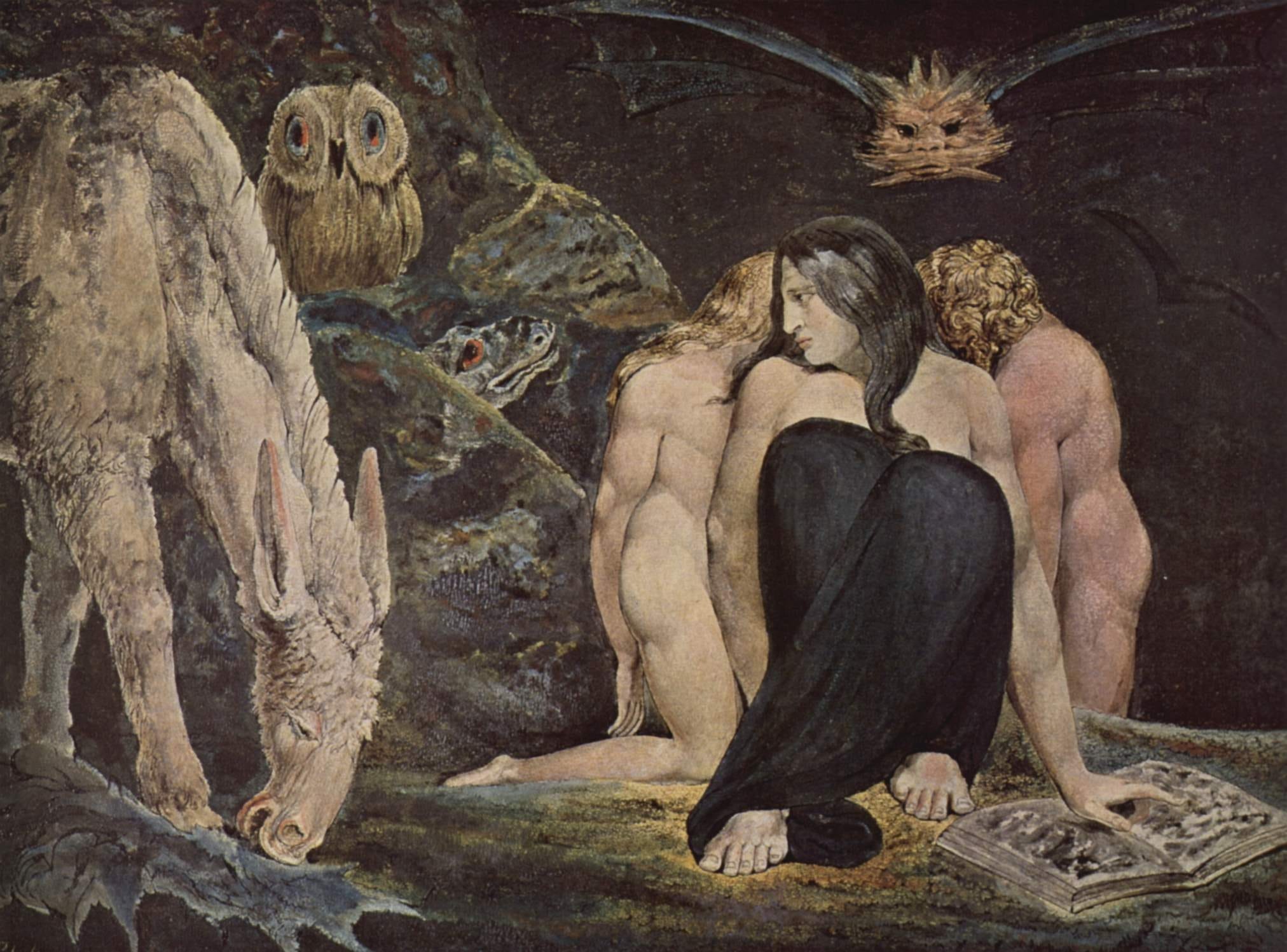
Despite the Church’s best efforts, the Feminine Trinity of Eleusis lives on in the collective subconscious. The Three Graces became a significant theme in the artwork of the Italian Renaissance, which looked backward at classical antiquity. Sandro Botticelli’s masterpiece Primavera features them prominently. William Shakespeare used three witches instead of just one when he needed a supernatural element for his play Macbeth. And finally, when William Blake set out in 1795 to paint Hecate in his The Night of Enitharmon’s Joy, he portrayed her as triune.
Conclusion
The Rites of Demeter observed at Eleusis and their subsequent co-opting into Christianity vividly illustrates the interconnected dynamics of power and belief. As the Roman Empire collapsed, its elite tried to preserve their waning political power by co-opting existing systems of belief into the Roman Catholic Church, which they controlled directly. They rejected the Eleusinian elements of psychoactive drugs and feminine wisdom symbolized by the archetypal figure of the crone. The omission of these elements bolstered a spiritual monopoly that the Church enjoyed throughout the Middle Ages. The fact that Christianity still bears the fingerprints of this power struggle shows how people’s bedrock conceptions of reality are disturbingly subject to the economic and political circumstances of history.
Since you made it this far, patient reader, kindly consider hitting the ❤️ button above or below; it really helps!
Further Materials
One of the most beautiful of Greek myths, skillfully narrated in the Hymn to Demeter once attributed to Homer, tells how Demeter’s daughter Persephone, while gathering flowers, was kidnaped by Pluto, god of the underworld, and snatched down to Hades. The sorrowing mother searched for her everywhere, found her, and persuaded Pluto to let Persephone live on the earth nine months in every year—a pretty symbol for the annual death and rebirth of the soil. Because the people of Eleusis befriended the disguised Demeter as she “sat by the way, grieved in her inmost heart,” she taught them and Attica the secret of agriculture, and sent Triptolemus, son of Eleusis’ king, to spread the art among mankind. Essentially it was the same myth as that of Isis and Osiris in Egypt, Tammuz and Ishtar in Babylonia, Astarte and Adonis in Syria, Cybele and Attis in Phrygia. The cult of motherhood survived through classical times to take new life in the worship of Mary the Mother of God.
Will & Ariel Durant, The Life of Greece, 1939, page 293

Fascinating. I remember once visiting a Catholic nunnery in Salt Lake City whose focus was Mary. They had great success proseltyizing in China because the local Chinese recognized the Bodhisattva Kuan Yin, (Kuan Shr Yin Bu Sa), Avalokiteshvara, as Mother Mary. However, their practice did not conform to Church hierarchy, so they were disbanded. The Church's patriarchal dominance goes on.
There is something else about Hecate, the old crone. In medieval times, the wise women were the nurses, midwives, and healers, knowledgeable about herbs. This let them help women with contraception and abortion, so of course, they were deemed witches and killed.
https://www.southchicagoabc.org/cabc/witches-midwives-and-nurses-a-history-of-women-healers-barbara-ehrenreich-deirdre-english/witches-midwives-and-nurses-a-history-of-women-healers-barbara-ehrenreich-deirdre-english.web.pdf
Caliban and the Witch was also a great read regarding this.
I can't help thinking on all the "fun" us Catholics could be having if we'd stuck to the pagan rituals. haha. It blows my mind how different the world could have been (and still could be).