


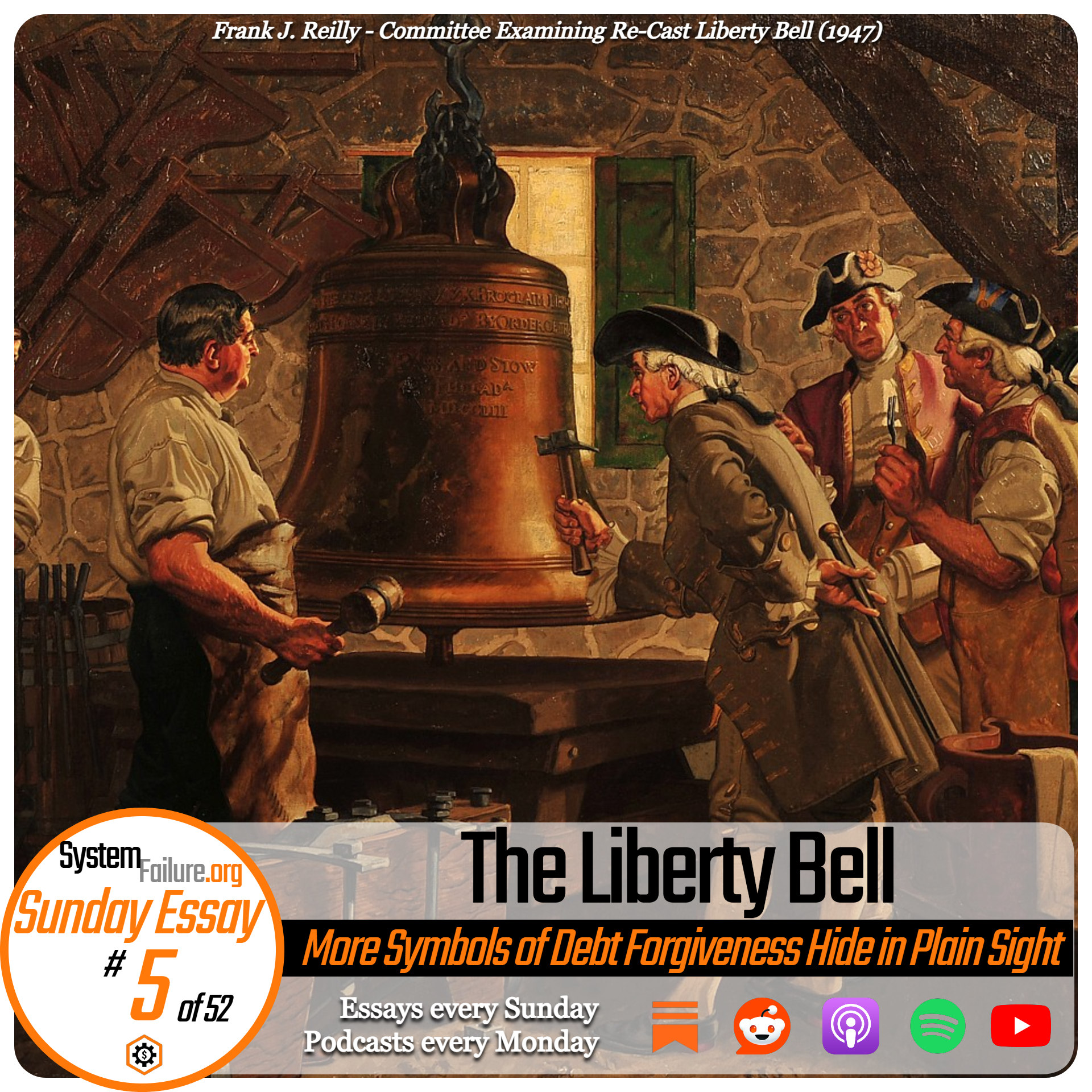
The major theme of this essay is debt forgiveness, a practice widely observed by early agricultural societies—until the Romans forfeited economic sustainability by NOT forgiving debts.
Key Takeaways:
The Babylonians conquered Jerusalem in the 6th century BC, and captured its Jewish inhabitants.
The Jews later copied the Babylonian custom of periodic debt forgiveness and codified it into the Old Testament.
The American city of Philadelphia engraved onto its Liberty Bell one such Old Testament reference to debt forgiveness.
The Babylonian Captivity
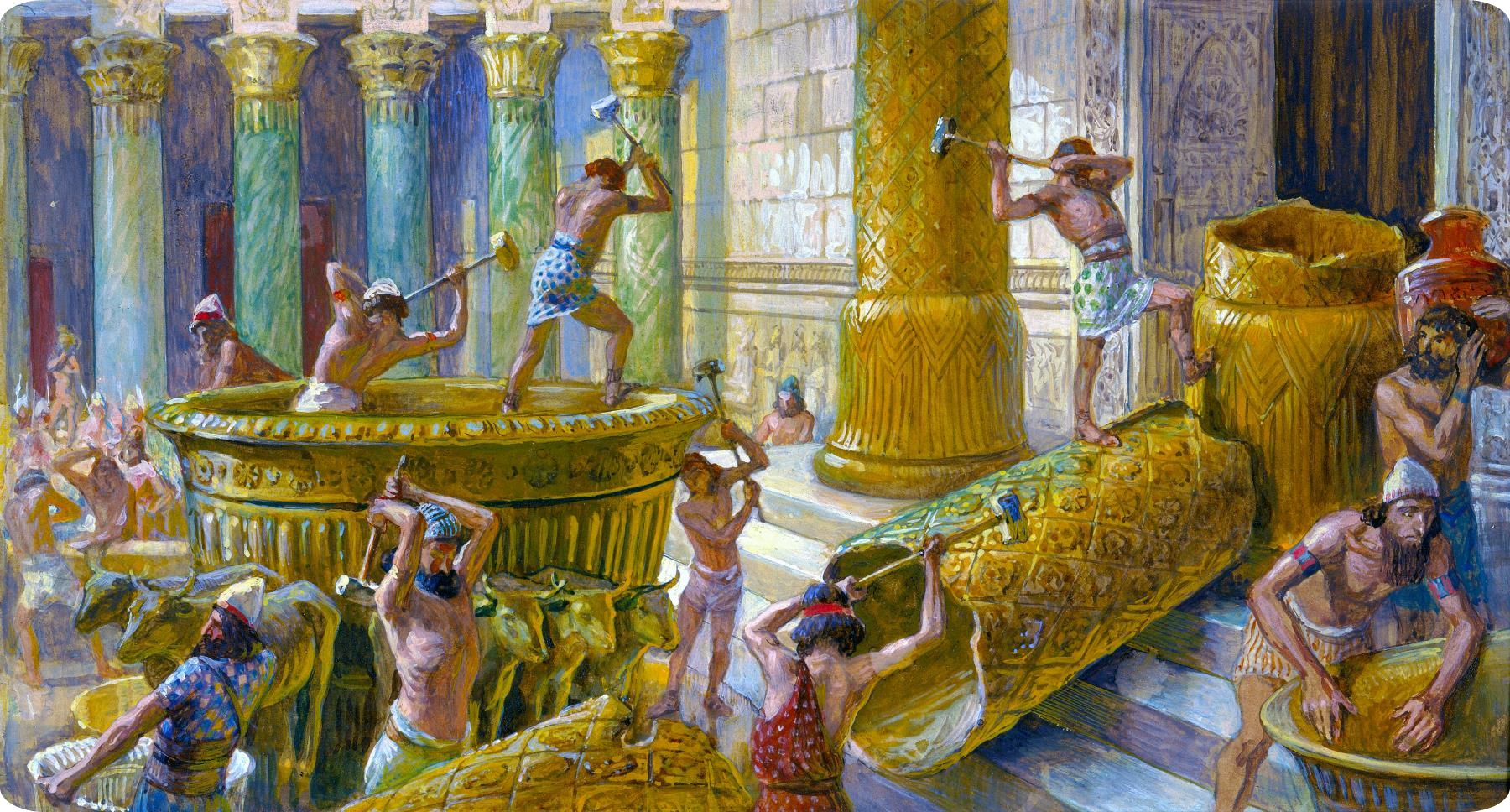
The Babylonian king Nebuchadnezzar laid siege to the city Jerusalem in 597 BC. His conquest of Judea was part of a broader political conflict between Babylon and Egypt, the two great powers of that era. Nebuchadnezzar captured Jerusalem, razed the ancient Temple of Solomon located there, and dragged the Jewish inhabitants of that city back to Babylon as slaves. This episode is known to history as the Babylonian Captivity.
While living in Babylon as slaves, the Jewish captives learned about the Babylonian tradition of debt forgiveness. That custom was a fixture across Mesopotamian societies like Sumer, Assyria and Babylon.
The kings of those Fertile Crescent societies couldn’t afford to let too many of their citizens fall hopelessly into debt. In those days, debtors who couldn’t pay their creditors became enslaved until they worked off their debt. Insolvent debtors lost both the incentive and the ability to fight in the kings’ army. The existence of too many financial losers left those societies vulnerable to conquest.
Furthermore, the Bronze Age kings of Mesopotamia couldn’t afford to let creditors grow too rich. With enough resources, they could become rich enough to challenge the king’s own lineage for power.
But the tendency was for events beyond the control of ordinary citizens to render crops un-harvestable and debts unpayable. In the aftermath of natural disasters or military conflicts, creditors foreclosed en masse on debtor’s land and on debtors themselves. It was out of pure self-interest that Near Eastern kings stepped in to cancel debts during such times, preventing the dangerous consolidation of wealth that was an existential threat.
The Writing on the Wall
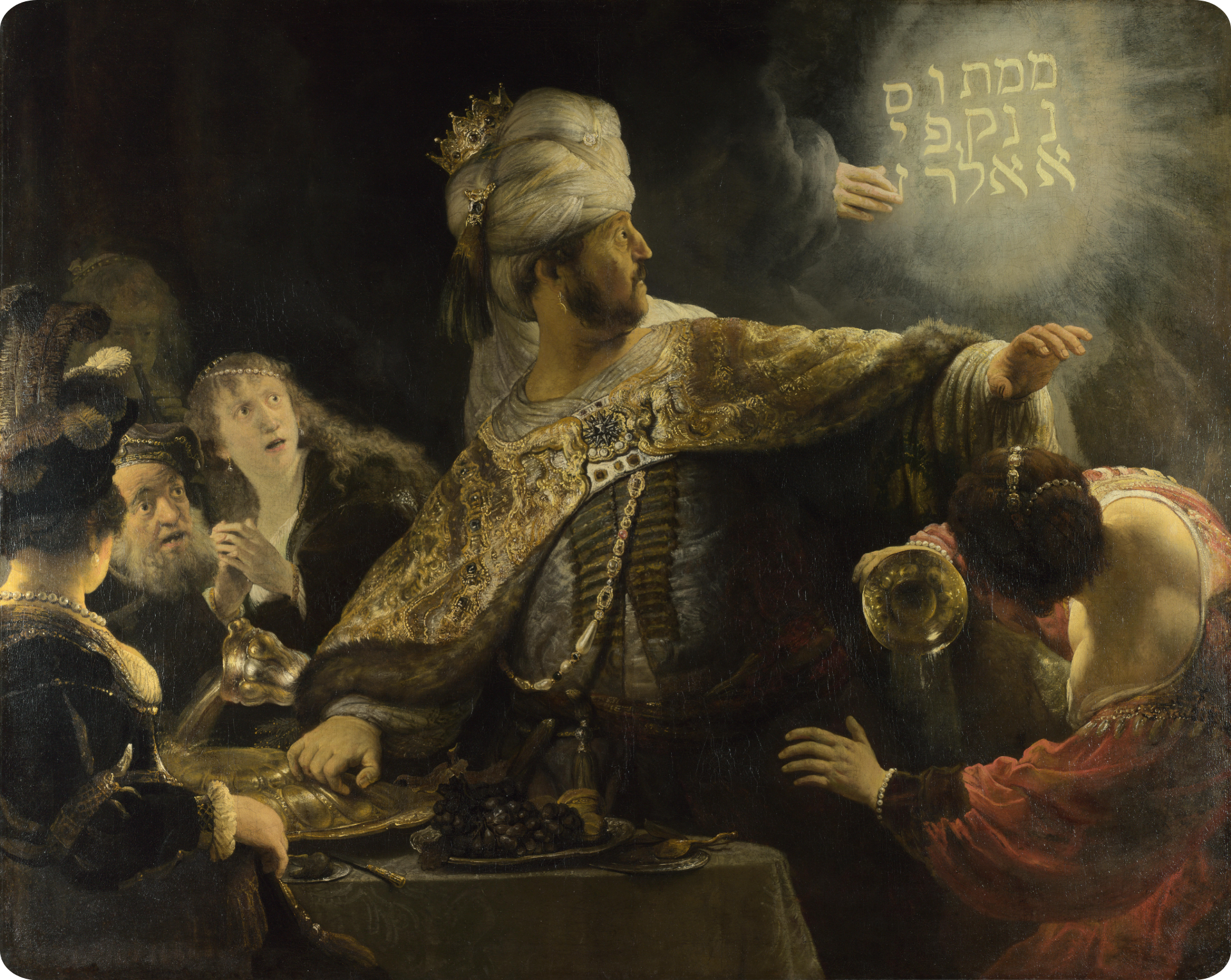
50 years after the conquest of Jerusalem, Babylon was ruled by Nebuchadnezzar’s grandson, Belshazzar. The biblical book of Daniel recounts the story of this king at a feast, when a ghostly hand suddenly appears and scratches on a nearby wall the strange words “mene, mene, tekel, upharsin”.
Daniel 5:9 describes the king soiling himself in terror. Belshazzar then summons the Jewish captive Daniel, who interprets the bizarre text to mean that God has condemned Babylon. The popular saying “the writing is on the wall” is a reference to this biblical ghost story.
As predicted by the ghostly hand, Belshazzar met his fate when the Persian army conquered Babylon in 539 BC. Cyrus the Great demolished that city, just as Nebuchadnezzar had destroyed Jerusalem 50 years before. Cyrus then freed the Jewish captives and sent them back to Jerusalem. The Old Testament book of Nehemiah describes the rebuilding of the walls and of the Temple of Solomon—which would again be razed by the Roman general (and future emperor) Titus five centuries later in 70 AD .
As they rebuilt Jerusalem, the Jews also finalized the Hebrew Bible, a text known to Christians as the Old Testament. They adopted the ancient Babylonian custom of debt forgiveness, and codified this law in any number of places in scripture. Isaiah 61:1 is a prime example:
The Spirit of the Lord God is upon me; because the Lord hath anointed me to preach good tidings unto the meek; he hath sent me to bind up the brokenhearted, to proclaim liberty to the captives, and the opening of the prison to them that are bound;
This passage is a direct commandment to free the debt-enslaved, echoing the similar Babylonian custom. According to the Gospel of Luke in the New Testament, Jesus directly quotes this Old Testament passage during his debut sermon in his hometown of Nazareth. To understand the Babylonian origins of this reference is to realize that the ministry of Jesus was a direct repudiation of the cruel economic hierarchy of the Roman Empire.
The Liberty Bell
City bells were once used to alert the public to important proclamations and to warn them of dangers, like fires or invading armies. William Penn brought such a bell to the city of Philadelphia in 1682. But by 1751, a much larger bell was needed; one that could be heard throughout the rapidly expanding city.
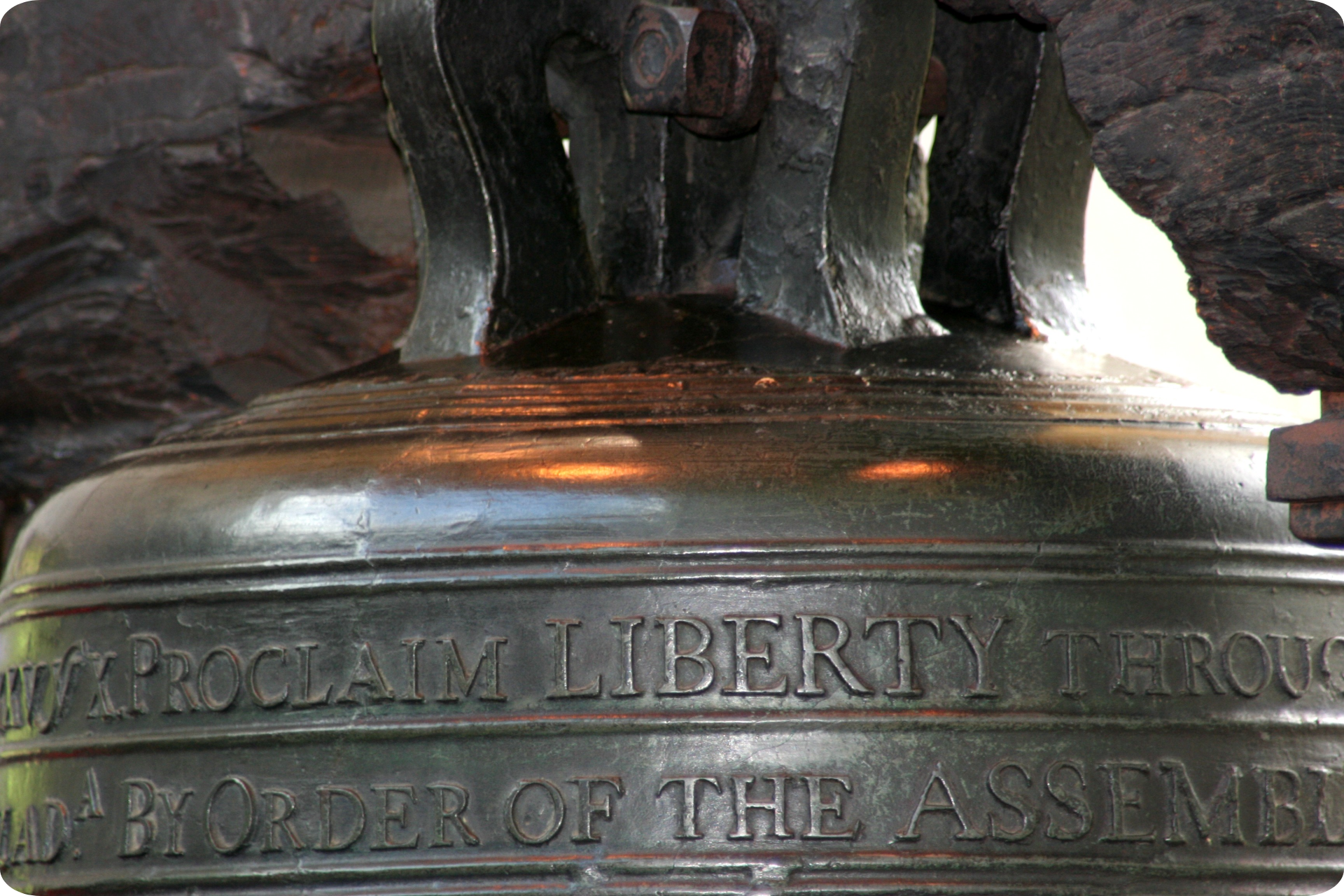
In those days—during the prelude to revolution—liberty and freedom were on everybody’s mind in the American colonies. The speaker of the Pennsylvania Provincial Assembly, a certain Isaac Norris, wanted to ground those ideas in scripture by engraving a bible quote on the new bell. He chose Leviticus 25:10, another Old Testament passage referring to debt forgiveness:
And ye shall hallow the fiftieth year, and proclaim liberty throughout all the land unto all the inhabitants thereof: it shall be a jubile unto you; and ye shall return every man unto his possession, and ye shall return every man unto his family.
The word “jubilee” is the Hebrew word יֹבֵל (yōvēl) filtered though Greek and Latin. It literally means “ram’s horn.” In Leviticus, the blowing of the yōvēl trumpet announces the release of debts, the liberation of slaves, and the return of the land to previous owners.
Whether he knew it or not, Isaac Norris chose for the Liberty Bell a biblical command for debt forgiveness that originated in ancient Babylon. Before the Roman Empire, that practice was so ubiquitous that references to debt forgiveness are still hiding everywhere in plain sight.
Conclusion
The Roman ruling class accepted a version of Christianity in which the forgiveness demanded by Jesus meant forgiveness for immoral behavior. But history and scripture reveal that Christianity originally called for the forgiveness of debts owed by the poor to the rich. But because that practice is so economically inconvenient for wealthy creditors, a different interpretation of the Christian faith emerged as our inheritance from history. And because Western Civilization is directly descended from the Roman Empire, we share their blindness to the economic utility of debt forgiveness. That means we’re likely to share their fate; the apocalypse warned about by Christianity and experienced by the Romans.
Since you made it this far, patient reader, kindly consider hitting the ❤️ button above or below; it really helps!
Further Materials
Should our Babylonian visitor proceed to the Liberty Bell in Philadelphia, he would find further vestiges of the idea of absolution from debt bondage. The bell is inscribed with a quotation from Leviticus 25.10: “Proclaim liberty throughout all the land, and to all the inhabitants thereof.” The full verse refers to freedom from debt bondage when it exhorts the Israelites to “hallow the fiftieth year, and proclaim liberty throughout all the land and to all the inhabitants thereof; it shall be a Jubilee unto you; and ye shall return every man unto his family” (and also every woman, child and house slave who had been pledged). Lands were restored to their traditional holders clear of debt encumbrances. Sounding the ram’s horn on the Day of Atonement of this fiftieth year signaled the renewal of economic order and equity by undoing the corrosive effects of indebtedness that had built up since the last Jubilee.
Michael Hudson, The Collapse of Antiquity, 2023, Page 36

I most like Professor Hudson's analysis of the Christians' swapping 'debt' for 'sin'. He says that sin was easily monetized, such as in the selling of indulgences. Sin also led to Church control because everyone sins, especially when 'sin' equates with 'sex'.