


Key Takeaways:
The Hidden Dimension: Plato believed that the geometry of lines and angles demonstrate that we’re living in an illusionary universe with a Hidden Dimension.
The Illusion of Ego: Like the observable universe, the ego is also an illusion created by the way we perceive lines and angles.
Roman Platonism: Early Christianity was heavily influenced by Platonism; its Hidden Dimension became the Christian conception of heaven.
The Hidden Dimension
Platonism is the notion that the physical world is merely a projection emanating from a Hidden Dimension. Plato was obsessed with the geometry of that projection. He carefully traced lines and measured angles, believing that odd coincidences in the arithmetic of the vertices, edges, and faces of specific 3-D shapes afforded him a glimpse into the hidden structure of the universe.
To Plato, that geometry was like a sand dune sculpted by the wind, where the dune’s shape paints a portrait of unseen air currents swirling above.
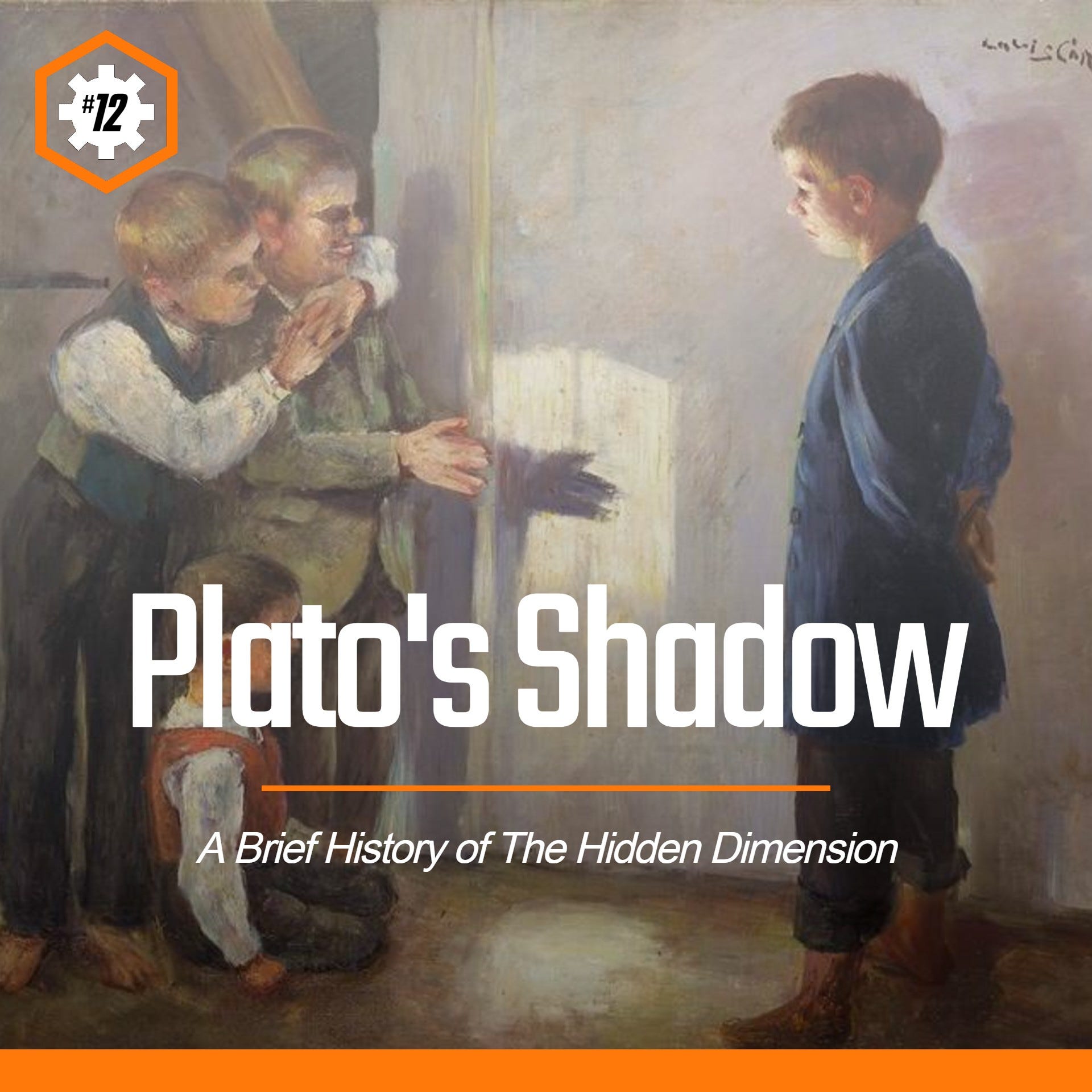
Plato suggested that the observable universe is an illusion by likening it to a shadow-puppet show on a cave wall. Shadows are made of light: they’re warped or distorted versions of the solid objects casting them. Plato invoked dimensionality with his choice of imperfect two-dimensional shadows to allegorize a hidden, extra-dimensional “Realm of Ideals” revealed by geometry.
Plato’s conception of dimensionality can be understood by considering Peter Pan and his famously disobedient shadow. If Peter Pan handed his shadow a three-dimensional apple, Shadow Pan would experience that spherical fruit as a series of circular cross-sections, taken one at a time.
An MRI machine sees the human body in exactly the same way. Shadow Pan is two-dimensional; he has height and width but no depth. That geometry hides all but a thin slice of our 3D world from his narrow 2D view. Because he’s dimensionally disadvantaged in this way, Shadow Pan must experience the third dimension as a sequence of cross-sections.
The fact that we experience the 4th dimension (time) as a similar sequence of cross-sections is a major clue that we’re also dimensionally disadvantaged. Plato went so far as to conclude that, as with Shadow Pan, geometry hides a vast extra-dimensional reality from our limited view. This notion of a Hidden Dimension massively impacted the evolution of ideas during the Fall of the Roman Empire.

The Illusion of Ego
In the centuries before Christianity, so-called mystery religions dominated Greco-Roman culture. These Mystery Schools often used psychoactive plants to temporarily disable egos. Initiates described themselves as being “saved” by the experience, or as having achieved “immortality.” As an initiate in multiple such schools, Plato was heavily influenced by his experiences with egolessness.
In Timaeus, Plato described time as “the moving picture of eternity.” Today, Plato might have conveyed the same point by noting that the beginning and the end of a movie still exist on the reel, even while we’re watching the middle of the film. Those parts of the movie still exist, even though they’re hidden from us around the corner of time.
Our egos arise from this movie-like, sequential way we perceive time. Like Peter Pan’s shadow, we’re stuck viewing one frame of our film at a time. But if we could somehow ascend to a higher-dimensional vantage point, we’d perceive time all at once—as we do with the dimensions of length, width and height. We’d see childhood and deathbed versions of ourselves simultaneously, and every version in between.
But that’s not all. From this hidden, extra-dimensional perspective, we’d also see our ancestors stretching out behind us, and all our descendants fanning out before us. In the full view of all of time, we’d perceive ourselves to be bodily connected to our parents, and they to their parents in just the same way that the branches of a tree are connected to the trunk. Such a lofty perspective would obliterate any sense of individuality. We’d see ourselves as iterations in a contiguous pattern, rather than as discrete individuals. The illusion of ego is wholly dependent on the limited way we perceive time.
Roman Platonism
Centuries after his death, the philosophy of Plato was more popular with the Romans than it had ever been with the Greeks. As their Empire collapsed, Christianity filtered through the lens of Platonism that dominated the Roman mind.
Gnosticism embraced a dark and pessimistic version of Platonism. As they witnessed the decay of Rome, Gnostics concluded that only an evil god would trap humans inside Plato’s shadowy prison. Many avoided procreative sex, because they believed that each child born is a spark of divine light trapped within a universe of woe.
Neoplatonism was a direct reaction to the doom and gloom of Gnosticism. To Neoplatonists, the pain and anguish of the Fall of Rome was not the work of some evil god, but the result of distance from a benevolent god. They considered evil to be the absence of good, as darkness is merely the absence of light. Before he became a Christian, the Neoplatonists counted St. Augustine among their number.
Hermeticism held that the illusory reality we inhabit is a collaboration between God and man. According to this school of thought, observers and gods alike have the power to shape reality with the mind. It would later become the basis of alchemy during the Renaissance.
Christianity was yet another flavor of the popular Platonist intellectual framework that dominated Rome’s last centuries. For Christians like St. Augustine, escape from a flawed universe and ascent into a realm of perfection was to be achieved through acts of morality and repentance for sin. Legendary historians Will and Ariel Durant wrote of St. Augustine that “he was so fascinated by Plato that he called him a ‘demigod’, and did not cease to be a Platonist when he became a Christian.”
Christianity also borrowed heavily from the Greco-Roman Mystery Schools that preceded it. The story of the Crucifixion is the ultimate expression of egolessness. In that tale, Jesus is so confident that he’s NOT his body that he volunteers it for a gruesome public execution. This powerful story took Roman society by storm, spreading rapidly to every corner of the Empire. Christianity became an undeniable political force as Rome entered her twilight.
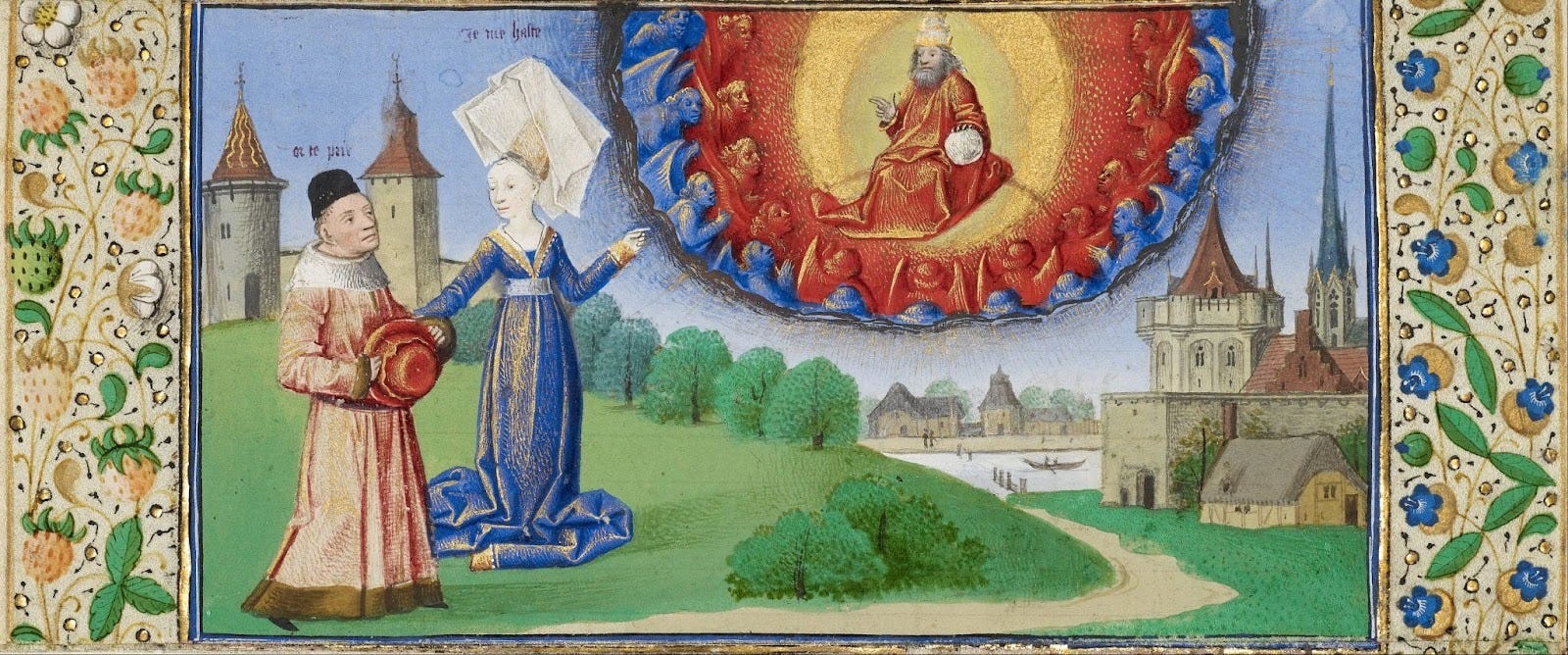
In a bid to consolidate waning political power, the last emperors of Rome embraced Augustine’s version of Christianity as the state religion of their dying Empire. That’s how it became the version of the Christian faith we inherited from history. Because the Christianity bequeathed to us is a flavor of Platonism, Plato’s Hidden Dimension of idealized perfection lives on to this day as the Christian conception of heaven.
Conclusion
Plato cast perhaps the longest intellectual shadow in all of human history. The genealogy of Platonist thought doesn’t end with Christianity. The Christian Emperors of Rome outlawed interpretations of Platonism and Christianity that rivaled the Augustinian version they endorsed. Gnosticism became a heresy, along with Hermeticism. A thousand years later—when the Medieval economic order crumbled and the political power of the Roman Catholic Church collapsed—old Platonic heresies from the chaotic Fall of Rome were revived. The works of Plato were reintroduced to European society during that period as a major part of the Italian Renaissance. Hermeticism gave rise to Alchemy, which was ultimately refined into modern chemistry during the Scientific Revolution. Like Christianity, the sciences have also been influenced by the long shadow of Plato.
Since you’ve made it this far, charitable reader, kindly consider hitting the ❤️ button above or below; it really helps!
Further Materials
Fourth-century paganism took many forms: Mithraism, Neoplatonism, Stoicism, Cynicism, and the local cults of municipal or rustic gods. Mithraism had lost ground, but Neoplatonism was still a power in religion and philosophy. Those doctrines to which Plotinus had given a shadowy form—of a triune spirit binding all reality, of a Logos or intermediary deity who had done the work of creation, of soul as divine and matter as flesh and evil, of spheres of existence along whose invisible stairs the soul had fallen from God to man and might ascend from man to God—these mystic ideas left their mark on the apostles Paul and John, had many imitators among the Christians, and molded many Christian heresies.
Will & Ariel Durant, The Age of Faith, 1950, page 9

Very thought provoking