


Key Takeaways:
Centuries after the Fall of Rome, the Pope crowned Charlemagne as a Roman Emperor.
By crowning Charlemagne, the Pope established himself and his successors as the kingmakers of Medieval Europe.
Church corruption ultimately brought an end to the political supremacy of the papacy.
The Christmas Surprise of AD 800
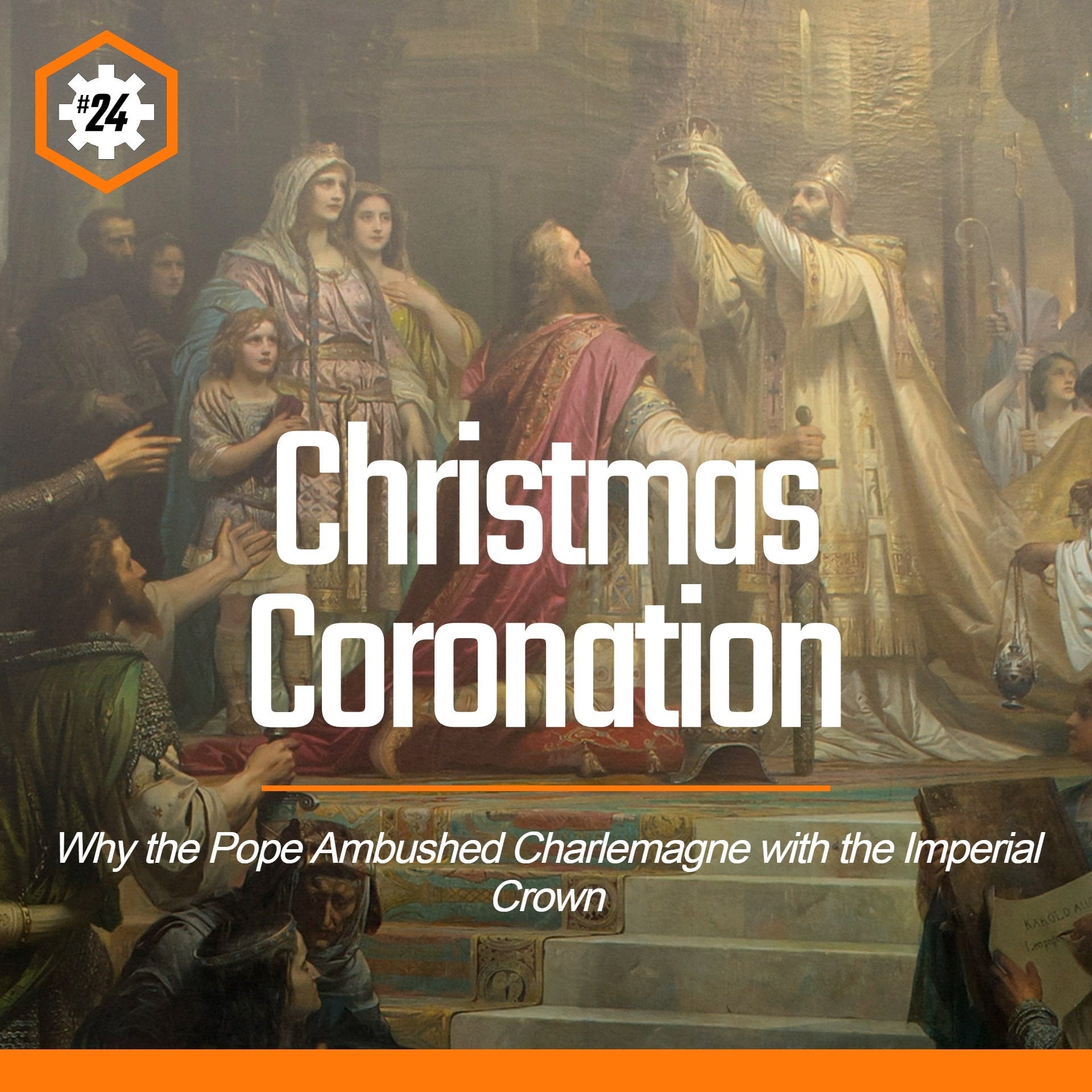
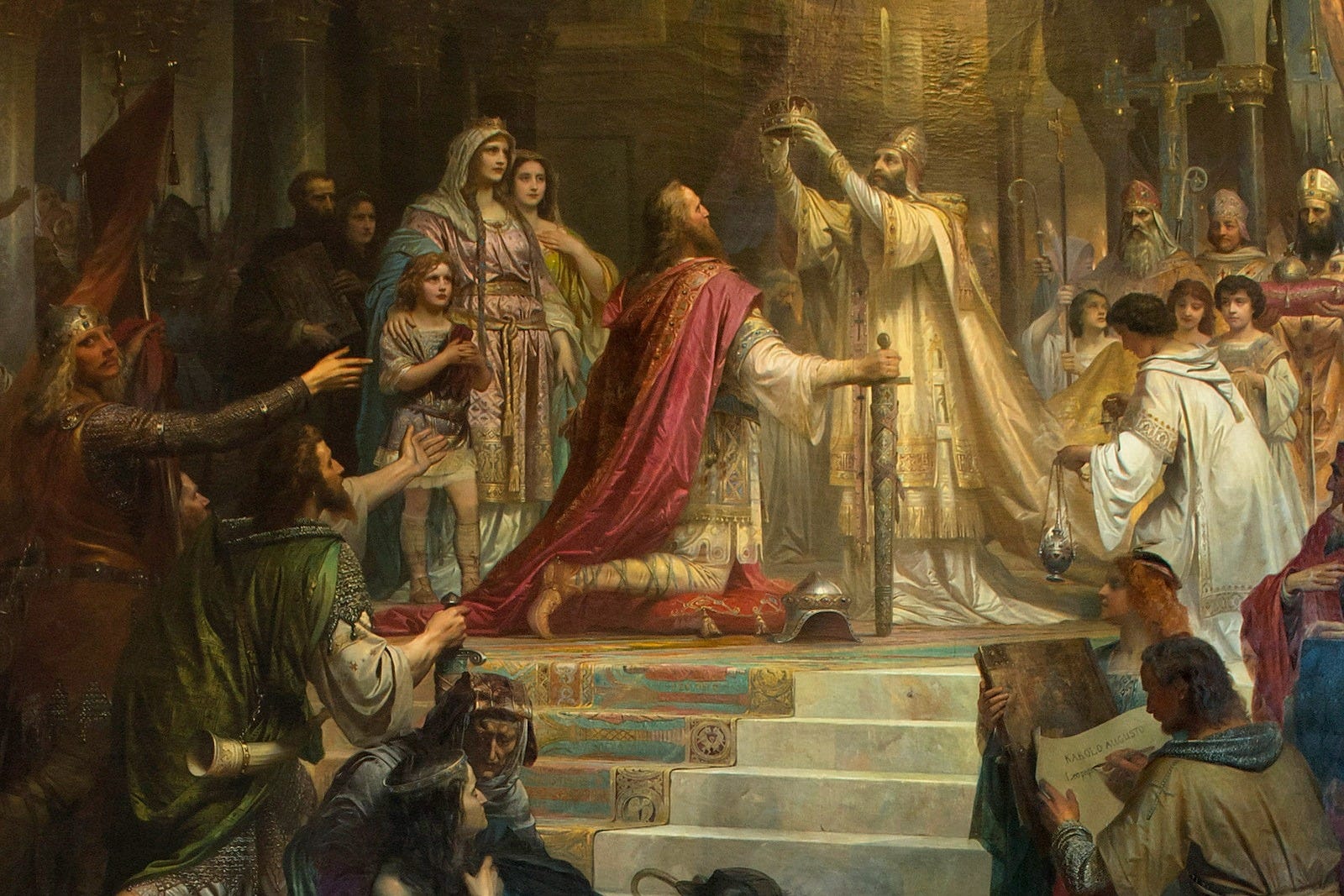
The coronation of Charlemagne is one of those crucial historical moments everyone should have learned about in school. Over the centuries, the story has been garnished by legend. But the classic tale has Pope Leo III ambushing Charlemagne with an imperial crown on Christmas Day in the year 800.
Centuries earlier, Roman civilization had ebbed from the Italian peninsula like the tide retreating back out to sea. The Roman Catholic Church was left behind without a military to protect it. But during the 700s, Charlemagne stepped up to fill that void.
He defended the Papal States from the Lombards (or the “long beards”) of Northern Italy, and then set to work converting great masses of Germanic pagans—at sword-point—to Christianity. Charlemagne made himself the military arm of the papacy. Meanwhile, a delighted Pope Leo III hatched a plot to lock this convenient relationship into place indefinitely.
According to legend, the Pope crept up behind Charlemagne as he knelt to say his Christmas prayers at St. Peter’s Basilica in Rome. Leo suddenly placed a crown on his unsuspecting head, and then led startled onlookers in the same chant used centuries before during the coronations of Roman emperors.
The legend of Charlemagne’s Christmas coronation comes down to us from his contemporary biographer, Einhard. Modern historians remain skeptical of his version of events. But the traditional story of a surprise coronation captures the rise of a Medieval political hierarchy where the crowned heads of Christendom were generally subordinate to the Pope.
To this day, the declaration made when a new pope accepts the papal tiara still reflects that political hierarchy, “take the tiara, and know that thou art the father of princes and kings, the ruler of the world, the vicar on earth of our savior, Jesus Christ.”
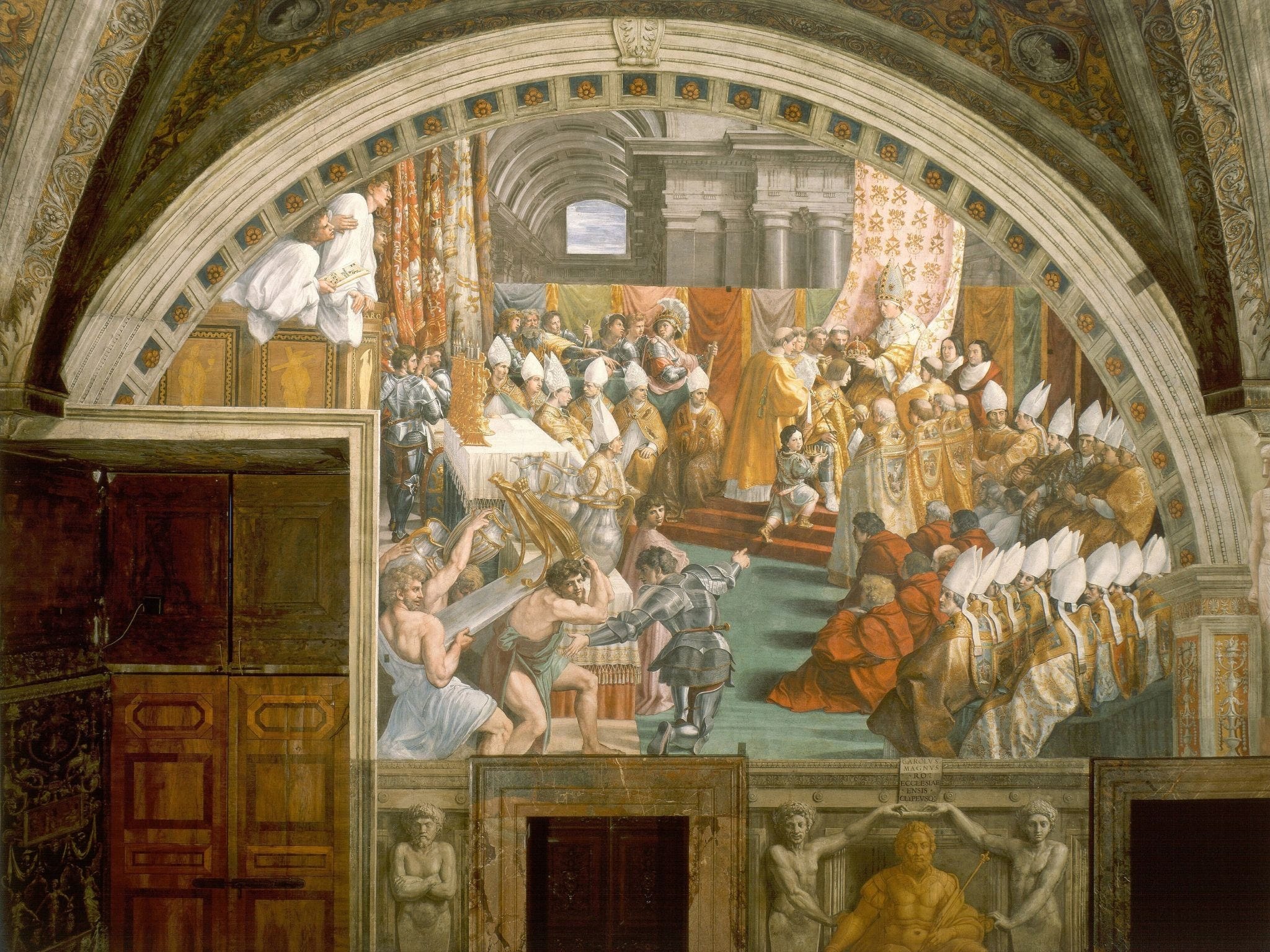
By elevating Charlemagne to the status of emperor, the pope asserted his own authority over the Frankish king. Leo cleverly established his office as the kingmaker of Europe, setting the stage for the ensuing Middle Ages.
Continuity with Rome
Other eyewitnesses to the coronation claim that Leo assembled the Roman nobility and Frankish warriors beforehand, and that they saluted Charlemagne as the Roman Emperor with the words: “To Charles Augustus, crowned by God, the great and peace-giving Emperor of the Romans, life and victory.”
This detail is a major reason that modern historians question Einhard’s testimony. With all those people pre-assembled, the coronation couldn’t have been the surprise that Einhard emphasized. It’s more likely that, for political reasons, Charlemagne wished to be portrayed as a reluctant emperor.
What’s for certain is that the pope invoked the Roman Empire to give his new arrangement with Charlemagne an air of permanence. By making Charlemagne the leader of a new Roman Empire, Pope Leo III created a sense of timelessness and legitimacy that made the new political hierarchy endure for centuries.
The coronation took place in St. Peter’s Basilica, which was already five centuries old on that chilly Christmas morning in the year 800. The St. Peter’s that now stands on Vatican Square in Rome was designed by Michelangelo during the Italian Renaissance, when the basilica known to Charlemagne was finally torn down to make way for the building we see today.
The original was built in the 4th century by the Christian Roman Emperor Constantine. During Roman times, the Vatican was a hillside cemetery outside the city gates, where Christians were massacred and St. Peter himself was crucified upside-down. Constantine filled in that hillside with earth to create a foundation for his basilica. Some of the columns laid by him are still visible in the grotto beneath the present basilica.
Another legendary detail of the coronation is that Charlemagne knelt on a large, circular slab of red porphyry stone set into the floor in front of the main altar. This stone is called the Rota Porphyretica, and it became the site where all subsequent Holy Roman Emperors were crowned. When old St. Peter’s was demolished to make way for the new basilica in the 1500s, this precious red stone was built into the floor of the new structure. It can still be seen today, directly inside the main entrance. Most tourists step right over it, having no idea of its significance.
The Sale of Indulgences
Following Leo’s clever maneuver, the popes maintained their dominance over European politics for the next 500 years. But a universal human tendency toward wealth addiction eventually undermined the Church’s reputation and shattered the Medieval political order Leo established.
Leo’s distant successor, Pope Boniface VIII, hatched another plot in the year 1299. He declared the Jubilee of year 1300 would celebrate the turn of the century by accepting money from pilgrims to Rome in exchange for remission of their sins.
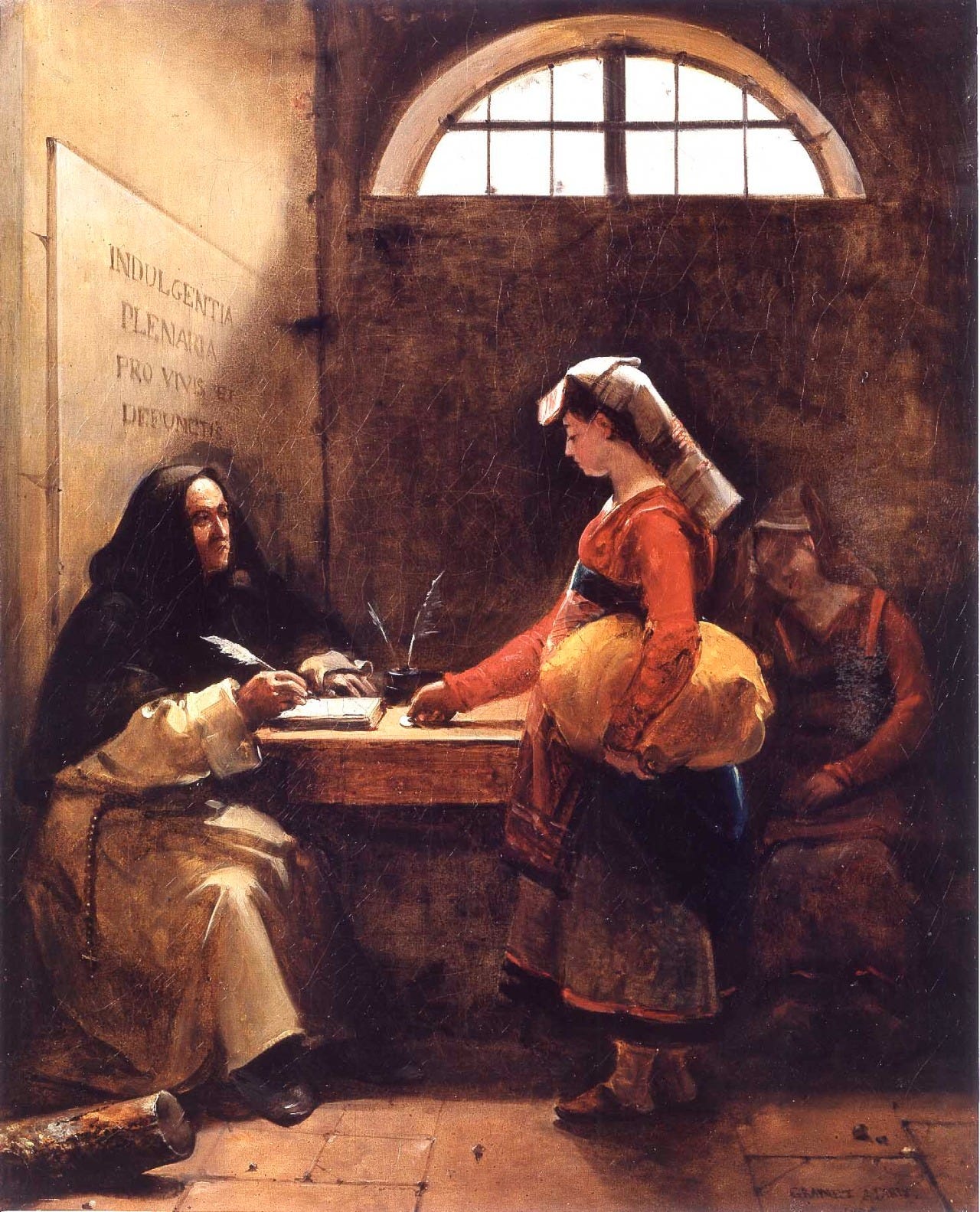
Dante Alighieri was recorded among the pilgrims of that first jubilee. But several centuries after Dante’s time, this infamous “Sale of Indulgences” became a major flashpoint in the violent fracture of Christendom that was the Protestant Reformation.
Having no idea how severe the fallout eventually would be, Boniface rejoiced at the revenue generated by his jubilee. He donned the dress and insignia of the ancient Roman emperors and paraded through the streets of Rome. Boniface held two swords high in front of him, which symbolized his dominance over both the spiritual and secular realms. Heralds preceded him, crying out, “Behold! I am Caesar!”.
The way Popes ruled over kings during the Middle Ages was reminiscent of the way the Caesars once ruled over the kings of their client kingdoms. Like the Caesars, the Popes exacted economic tribute. But they didn’t rely on pure military might to do so. Instead, they took advantage of the fact that Christians like Charlemagne believed the Pope was their exclusive connection to God. The Church was perceived to hold a monopoly on access to the divine, and Boniface shamelessly set up a toll booth on that route.
Conclusion
Pope Leo III deliberately invoked the customs of imperial Rome to legitimize a new political order. But the parallels between the Roman Empire of Antiquity and the Holy Roman Empire of the Middle Ages don’t end there. The great irony of the Roman Catholic Church is that Christianity began as a group of outlaw radicals rejecting the corrupt economic hierarchy of the Roman Empire. But Christianity became the state religion of Rome during its fall, then adopted Roman symbolism as the Church gradually calcified into a corrupt authority very much like the one early Christians rebelled against. By succumbing to wealth addiction, Pope Boniface VIII and the Roman Catholic Church completed the same tragic, wealth-addicted narrative arc as the Roman Empire.
Since you made it this far, indefatigable reader, kindly consider hitting the ❤️ button above or below; it really helps!
Further Materials
On Christmas Day, as Charlemagne, in the chlamys and sandals of a patricius Romanus, knelt before St. Peter’s altar in prayer, Leo suddenly produced a jeweled crown, and set it upon the King’s head. The congregation, perhaps instructed beforehand to act according to ancient ritual as the senatus populusque Romanus confirming a coronation, thrice cried out: “Hail to Charles the Augustus, crowned by God the great and peace-bringing Emperor of the Romans!” The royal head was anointed with holy oil, the Pope saluted Charlemagne as Emperor and Augustus, and offered him the act of homage reserved since 476 for the Eastern emperor.
The coronation had results for a thousand years. It strengthened the papacy and the bishops by making civil authority derive from ecclesiastical conferment; Gregory VII and Innocent III would build a mightier Church on the events of 800 in Rome. It strengthened Charlemagne against baronial and other disaffection by making him a very vicar of God; it vastly advanced the theory of the divine right of kings. It contributed to the schism of Greek from Latin Christianity; the Greek Church did not relish subordination to a Roman Church allied with an empire rival to Byzantium. The fact that Charlemagne (as the Pope desired) continued to make Aachen, not Rome, his capital, underlined the passage of political power from the Mediterranean to northern Europe, from the Latin peoples to the Teutons. Above all, the coronation established the Holy Roman Empire in fact, though not in theory. Charlemagne and his advisers conceived of his new authority as a revival of the old imperial power; only with Otto I was the distinctively new character of the regime recognized; and it became “holy” only when Frederick Barbarossa introduced the word sacrum into his title in 1155. All in all, despite its threat to the liberty of the mind and the citizen, the Holy Roman Empire was a noble conception, a dream of security and peace, order and civilization restored in a world heroically won from barbarism, violence, and ignorance.
Will & Ariel Durant, The Age of Faith, 1950, page 469

I notice that the Roman church's Jubilee was a celebration of forgiveness of 'sins', which would be carnal sins, not financial debt. Michael Hudson often writes and speaks how the Roman Church altered the Jubilee from debt forgiveness to the sale of indulgences. Doubtlessly, all humans are subject to sex; therefore all are sinners. What a money maker!