


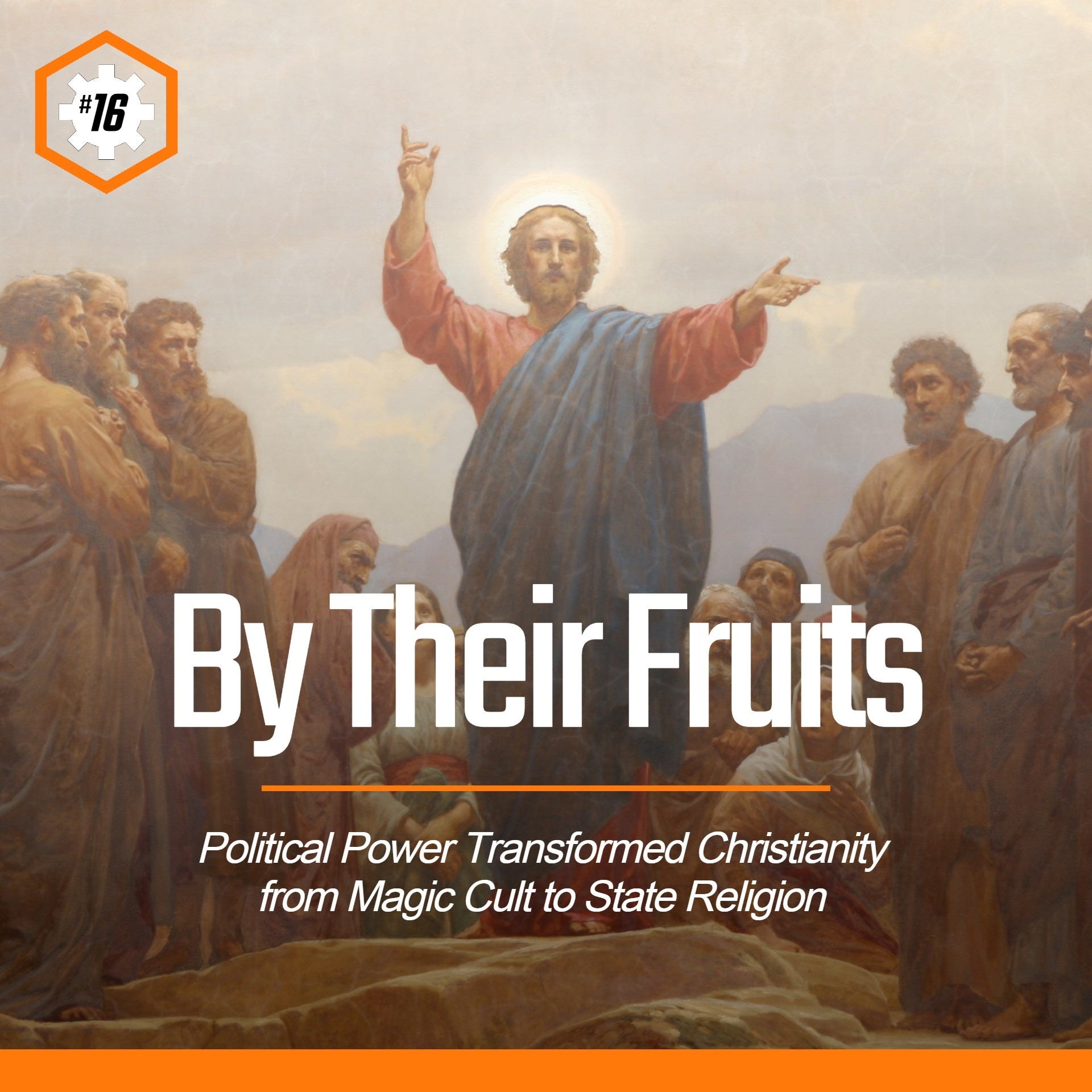
Quick Summary
Early Christianity involved stereotypical magical elements like magic books and wands.
Early Christian artwork depicts the use of hallucinogenic drugs in magical potions.
Jesus said false prophets are known by their fruit, a possible allegory for magic mushrooms.
Magical Christianity
Early Christians read from magic books and waved magic wands, both of which we recognize today as classic magical implements. One need look no further than the Harry Potter franchise to see them in action.
The bound book was the principal weapon used by early Christians in their spiritual conquest of the Roman Empire. The coronation of the first Roman emperor and the birth of Jesus took place less than 30 years apart, and the book was invented during that same era.
Before the advent of bound books, writing was done on scrolls. Slicing these scrolls into numbered pages and then adding Tables of Contents allowed readers to skip directly to any passage without having to parse an entire scroll.
Christians were early adopters of this technology. The ability to instantly jump to any chapter and verse made scriptural reference instantaneous, and having the Bible as a common reference point allowed Christians scattered across an Empire to present a coordinated challenge to power.
The Bible is still treated as a sacred object by secular people when they swear on it in the courtroom. In liturgical practice, modern Christians still elevate, kiss and treat the Bible as a magical object imbued with supernatural power.
While the sacred book remains a staple of modern Christianity, the Church long ago abandoned the use of magic wands. Yet these curious accessories appear prominently in early Christian artwork. The Resurrection of Lazarus fresco in the Catacombs of Via Latina in Rome is a prominent example. There, Jesus is depicted holding a long stick as he performs a miracle.
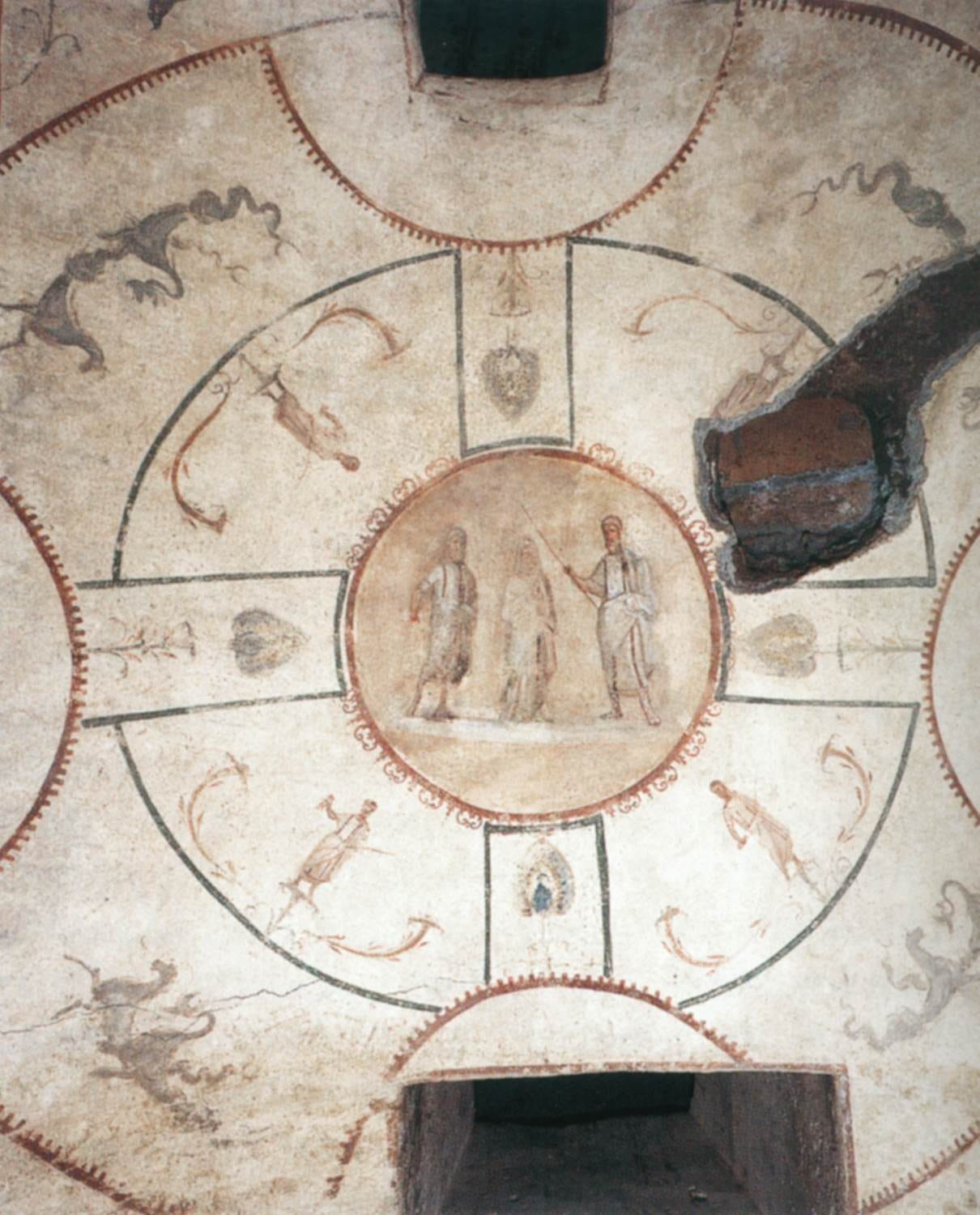
The Hypogeum of the Aurelii is another example. Because this 3rd-century underground burial chamber wasn’t discovered under Rome until 1919, its frescoes are unusually well-preserved. A large zodiacal circle split into quadrants adorns the ceiling, forming the pattern of the Greek cross. At the center, a man waves a long stick over a female initiate dressed in white.
The frescoes in the Hypogeum are a syncretic blend of Christian and pagan motifs dating back to the 3rd century AD, when Christianity was completing its conquest of Roman society. The magic wand depicted may be a holdover from the old Cult of Dionysus, the wine god who traditionally carried a thyrsus wand tipped with a pinecone.
A 13-foot pinecone stands today in the Cortile della Pigna, or Pinecone Courtyard at the Vatican. The huge bronze statue is flanked by two peacocks, whose feathers appear within the four arms of the Greek cross depicted on the ceiling of the Hypogeum of the Aurelii. This rich blend of symbology illustrates a magical heritage shared across multiple spiritual traditions, up to and including Christianity.
Magical Potions
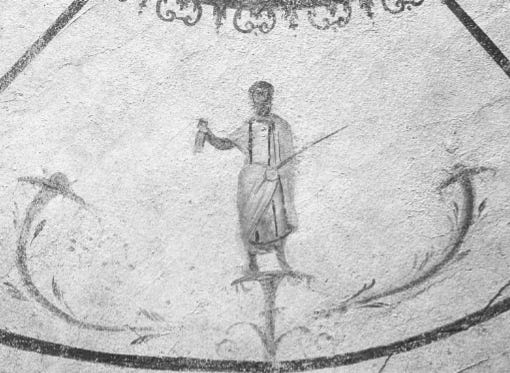
The fresco on the ceiling of the Hypogeum of the Aurelii also depicts four smaller figures holding magic wands and bottles. Each figure stands atop a giant mushroom, hinting at the contents of their bottles. Like wands and books, potions are quintessential elements in our modern understanding of magic.
Early Christians borrowed many such elements from existing religions of the ancient Mediterranean Basin. The Christian Eucharist continued an older tradition of god-eating ceremonies in which psychedelic potions were consumed as religious observances. The kykeon of the grain goddess Demeter and the wine of Dionysus were combined to make the bread and wine of the Christian Communion.
References to psychoactive ingredients abound in Christianity. Dr. Jerry Brown and his wife, Julie Brown published The Psychedelic Gospels in 2016. They provide numerous photographs of Medieval Christian artwork portraying Jesus as a mushroom. The Browns suggest the Church’s psychedelic origins were not controversial until the time of the Inquisition:
Roman authorities frequently accused Christians of practicing sorcery through the use of hallucinogens. In addition, Irenaeus (130–200), the bishop of Lyon, argued that only the heretical churches, including the Gnostic churches, made use of hallucinogens in their secret rites. However, with the coming of the Inquisition, we see a dramatic decline in entheogenic images in Christian art after the High Middle Ages (1000–1200).
In 1970, Dead Sea Scrolls scholar John Marco Allegro published a book entitled The Sacred Mushroom and the Cross, where he presented a painstaking linguistic argument that the story of the New Testament is really a veiled allegory for a specific species of magic mushroom. He proposed that the authors of that document referred to mushrooms allegorically to prevent the Roman authorities from cracking down on them.
The Sermon on the Mount
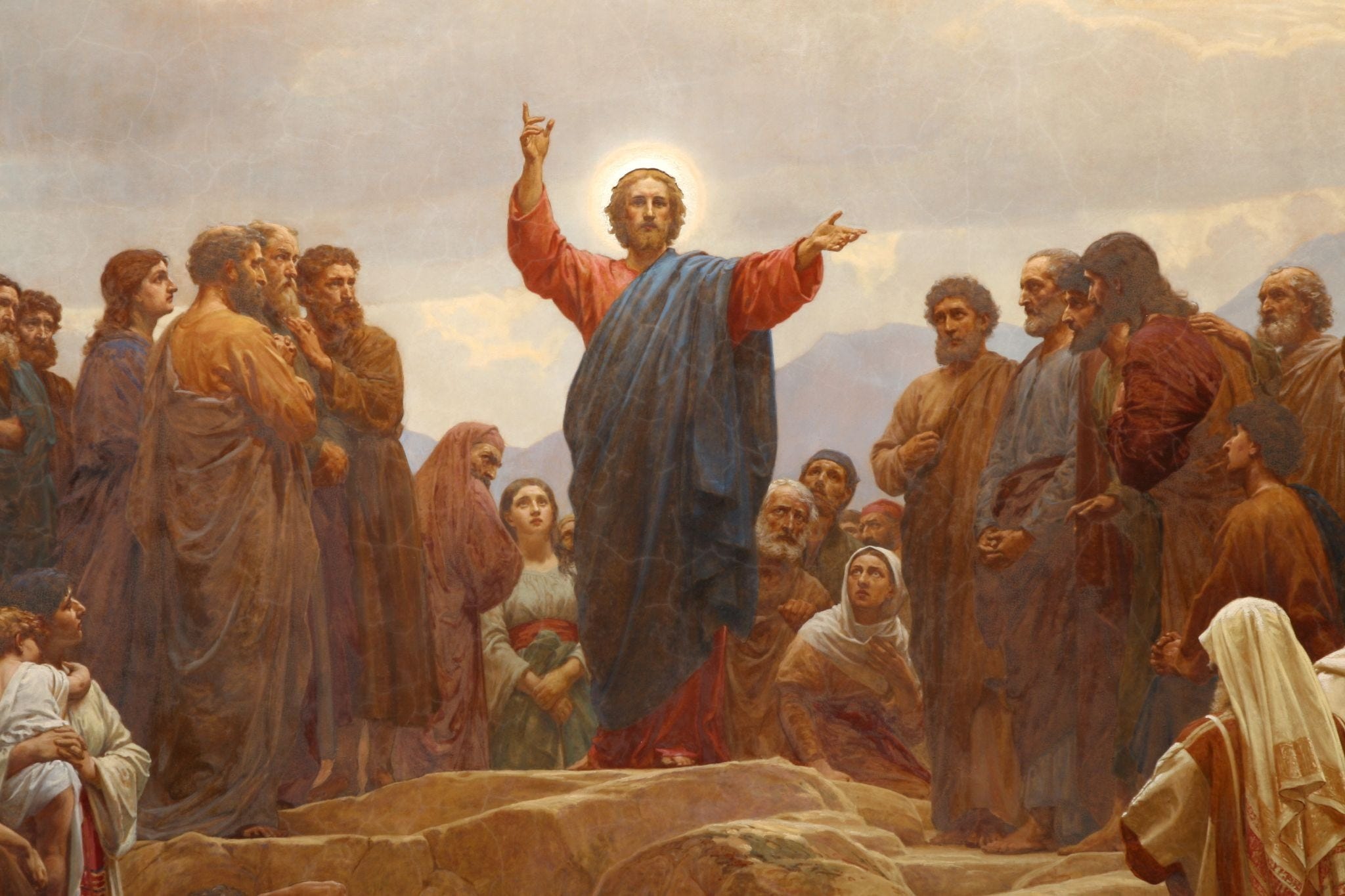
John Marco Allegro implies that Bible passages like Matthew 7:16, “Ye shall know them by their fruits,” refer to literal fruit in the form of a mushroom. As part of the famous Sermon on the Mount, that verse warns against following false prophets. A true prophet, in this sense, might mean someone bearing hallucinogenic mushrooms, since conventional fruit lacks the hallucinogenic properties of the genuine article.
Allegro’s notion that early Christians used an elaborate allegory to evade the authorities matches a similar dynamic in modern times, where visionary substances are still broadly illegal. The ruling classes of all societies want their employees showing up to work to generate revenue. But psychedelic drug use promotes the idea that reality is an illusion, and people who believe their job is illusory tend to make unreliable workers. For this reason, the wealthy elite in all times and places tend to view visionary substances as an economic inconvenience.
During the late stages of the Roman Empire, its ruling class switched from persecuting Christians to adopting their faith as the new state religion. Inevitably, the psychoactive ingredients vanished from the Christian Eucharist, leaving behind only the conventional bread and wine used today. The ruling elite gradually transformed Christianity, bending it to their interests and eventually rendering it downright lucrative.
By making Christianity the exclusive, state-sanctioned brand of magic, the Roman elite established a spiritual monopoly that endured through the Middle Ages. During that period, the Church began charging people for the remission of their sin with the infamous Sale of Indulgences.
Looking back at history, we’re left to reconcile two very different versions of Christianity. The original faith was openly contemptuous of the rich, glorified the poor, and involved hallucinogenic drug use. Meanwhile, the sanitized, state-sponsored version we’ve received from history emphasizes sobriety and is much more forgiving of immense wealth. John Marco Allegro might have bitterly opined that these are the fruits of false prophets.
Conclusion
Jesus’ warning against false prophets is part of the renowned Sermon on the Mount, the most frequently quoted text in the New Testament. It spans chapters 5-7 of the Gospel of Matthew, and chapter 6 contains the Lord’s Prayer. Verse 12 is rendered in the King James Bible as, “And forgive us our debts, as we forgive our debtors.” Forgiving debts means a transfer of wealth from rich to poor, as the rich write off debts they previously expected to collect. But conveniently for Rome’s wealthy oligarchy, St. Augustine reinterpreted forgiveness to mean forgiveness for chiefly sexual misdeeds, rather than financial forgiveness. Thereafter, the poor began making the Church fabulously wealthy by donating what little they had to get their sins forgiven. Like the removal of psychoactive substances from Christian observances, this change in the meaning of “forgiveness” is another example of Christianity being tailored to the interests of the ruling class. Furthermore, it shows how REALITY itself is largely projected by the authority of the economic elite. That’s why economic collapses come with jarring paradigm shifts, where conceptions of reality self-servingly projected by elites crumble in tandem with decaying systems. That’s why the mass conversion of Roman society from polytheism to monotheism coincided with the Fall of Rome itself.
Since you’ve made it this far, noble reader, kindly consider hitting the ❤️ button above or below; it really helps!
Further Materials
As the presence of psychoactive mushroom images in Aquileia indicates, we know that early Christians consumed hallucinogens. This is confirmed by historical documents as well. Roman authorities frequently accused Christians of practicing sorcery through the use of hallucinogens. In addition, Irenaeus (130–200), the bishop of Lyon, argued that only the heretical churches, including the Gnostic churches, made use of hallucinogens in their secret rites.
However, with the coming of the Inquisition, we see a dramatic decline in entheogenic images in Christian art after the High Middle Ages (1000–1200). This is understandable, as the influence of the Inquisition expanded across Europe, receiving formal sanction for wider witch hunts in the fifteenth century when Pope Innocent VIII issued a papal bull (Summis desiderantes affectibus, 1484) authorizing the “correcting, imprisoning, punishing, and chastising” of devil worshippers. He did so at the urging of Inquisitors Heinrich Kramer and Jacob Sprenger, who published the notorious Malleus Maleficarum (The Hammer of Witches), which became highly influential in secular witchcraft trials.
Jerry B. Brown, Julie M. Brown, The Psychedelic Gospels: The Secret History of Hallucinogens in Christianity, 2016, page 179

This KI generated text summarizes what I think about the interconnection between soft spiritual reasoning and hard wealth related struggle for freedom. Its not all about psychedelic substances but more of a diplomatic shield against a direct confrontation with authorities.
---------------
The teaching “By their fruits you will recognize them” in Matthew 7 refers not only to individual acts of piety, but also to the visible social and economic consequences of religious doctrine: “them” are primarily false prophets or religious authorities who use the language of faith to legitimize power and exploitation, and “you” are the disciples or the faith community, who are called upon to examine and discern. The fruit metaphor points to concrete effects: not only personal virtues or moral hypocrisy, but also political and economic consequences such as the reproduction of poverty, debt, and exclusion versus the practice of care, justice, and liberation. True doctrine is revealed through consistent works of mercy and structures that help the poor, while mere rhetoric or charismatic signs without ethical consistency can be exposed as “empty fruit.”
The episode of the cleansing of the Temple, in which Jesus drove out the money changers, connects this ethical and social critique with concrete action: it makes clear that his claim was not purely spiritual or internal, but directly attacked the economics of religious practice. By defending the sacred space against economic instrumentalization, liturgical purity is linked to social justice; the act is both a prophetic protest and an indictment of systems that misuse religious legitimacy for economic enrichment. Against this backdrop, it is plausible to define the “false prophets” more broadly as actors and institutions that use religion to glorify wealth and stabilize unjust economic orders—a more modern equivalent to the critique of the golden calf, which in Hebrew Scripture is understood as the misdirection of desire and idolatry.
The interconnected tradition of the Sabbath and Jubilee year (with debt forgiveness, return of land, and liberation from bondage) provides the theological resources for that liberation ethic: Jubilee motifs signify institutionalized social redress and regular corrections of debt. Because such practices were not enshrined in the Roman-influenced legal system, persistent inequalities and legitimizations of guilt arose, which provoked prophetic critique. Jesus' reference to such imagery—as he quotes it, according to Luke, in Isaiah 61 and proclaims the "year of the Lord's favor"—reads as a claim to a liberating, restorative reign that has both spiritual and social effects.
Isaiah 61 provides the thematic cornerstones: a messenger, anointed by the Spirit, brings good news to the poor, lifts up the broken, proclaims freedom for prisoners, and announces the Jubilee year of restoration. This language can encode socially radical demands by framing liberation, debt forgiveness, and restoration in religious terms. Luke uses precisely these passages as a programmatic self-designation for Jesus, having him declare that Scripture is fulfilled in his presence. Such prophetic-religious formulations allow for the articulation of demands for social redistribution and liberation within familiar liturgical categories.
Nevertheless, this linguistic coding offers only limited protection against political consequences. Rhetorical or ethical obfuscation—the formulation of social demands in religious-prophetic language—can be tactically advantageous because it anchors the message within Jewish discourse and thus avoids open calls for rebellion; however, it does not preclude being perceived as politically subversive. Jesus' concrete, provocative actions, such as the cleansing of the Temple, demonstrate that his program did not rely solely on diplomatic veiling but was also publicly confrontational; such actions heightened tensions with religious elites and contributed to intervention by authorities. In short, religious coding offered leeway to avoid or mitigate violence, but could not provide lasting protection from persecution when practice and symbolism directly challenged existing economic and power structures.
In its entirety, this means that Matthew 7, the Temple Act, and the reference to Isaiah 61 form a coherent hermeneutical field in which the fruit-testing, Jubilee motifs, and Temple critique establish an ethic that inextricably links personal holiness and social justice. The fruit by which this is recognized is therefore both personal-moral and structural-social: it manifests itself in the liberation of those marginalized by debt, economic exploitation, or religious-economic institutions, and simultaneously exposes those who instrumentalized religion to glorify wealth and stabilize unjust systems. The use of prophetic and ritualized language could tactically contribute to de-escalation with Roman power, but the seriousness of social reforms inevitably led to confrontations with established interests.