


Key Takeaways:
Before electricity, people paid rapt attention to the night sky.
The 12 constellations of the zodiac track the Great Year.
Jesus’ biography allegorizes the zodiac.
The Night Sky
In today’s era of smartphones and giant flat-panel TVs, it’s easy to forget that the night sky was once the greatest show on Earth. Before electric lights drowned out the heavens, people paid very close attention to celestial comings and goings in the night sky.
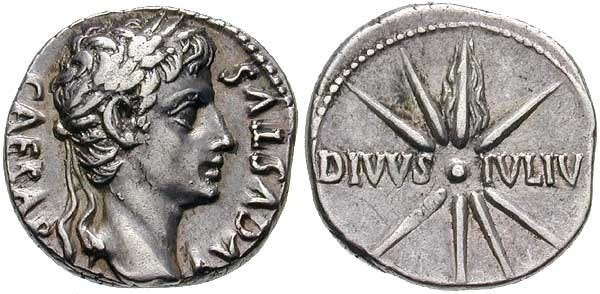
Comets, for example, once terrified entire populaces. Since other animals seem to ignore the sky, people assumed that unfamiliar objects were hung there by the gods to warn them of a looming disaster. Coincidences cemented this notion in the popular mind. A classic example is the comet that appeared in the skies over Rome in 44 BC, the year of Julius Caesar’s assassination. This celestial visitation had such a profound impact on the Romans that they minted coins with images of the comet on the “tails” side.
It wasn’t until 1758 that Sir Edmund Halley finally rescued humanity from periodic astronomical terror by predicting the return of the comet that still bears his name. Though Halley had already been dead for 20 years by the time it reappeared, he proved that the comet was actually governed by ordinary laws of physics, and was not some dire warning from the gods.
Since then, the advent of electric lights and highly compelling screens has divorced us from what beat poet Allen Ginsberg referred to as “the starry dynamo in the machinery of night.” Some 83% of the U.S. population lives in urban or suburban environments, where light pollution cuts us off from the night sky.
The stars used to provide a nightly dose of awe and humility, bringing us into regular contact with the profound mystery at the core of the human experience. However, modern people have lost the ability to orient themselves in the celestial sphere. And that’s a tragedy.
The Zodiac
The daily rising and setting of the sun—and the annual change of seasons—are such obvious phenomena that no amount of light pollution could possibly obscure them. But there is a third astronomical cycle that takes 25,800 years to complete. That time scale is so long, relative to a single human lifespan, that we tend to overlook it. But it didn’t escape the careful attention of ancient astronomers.
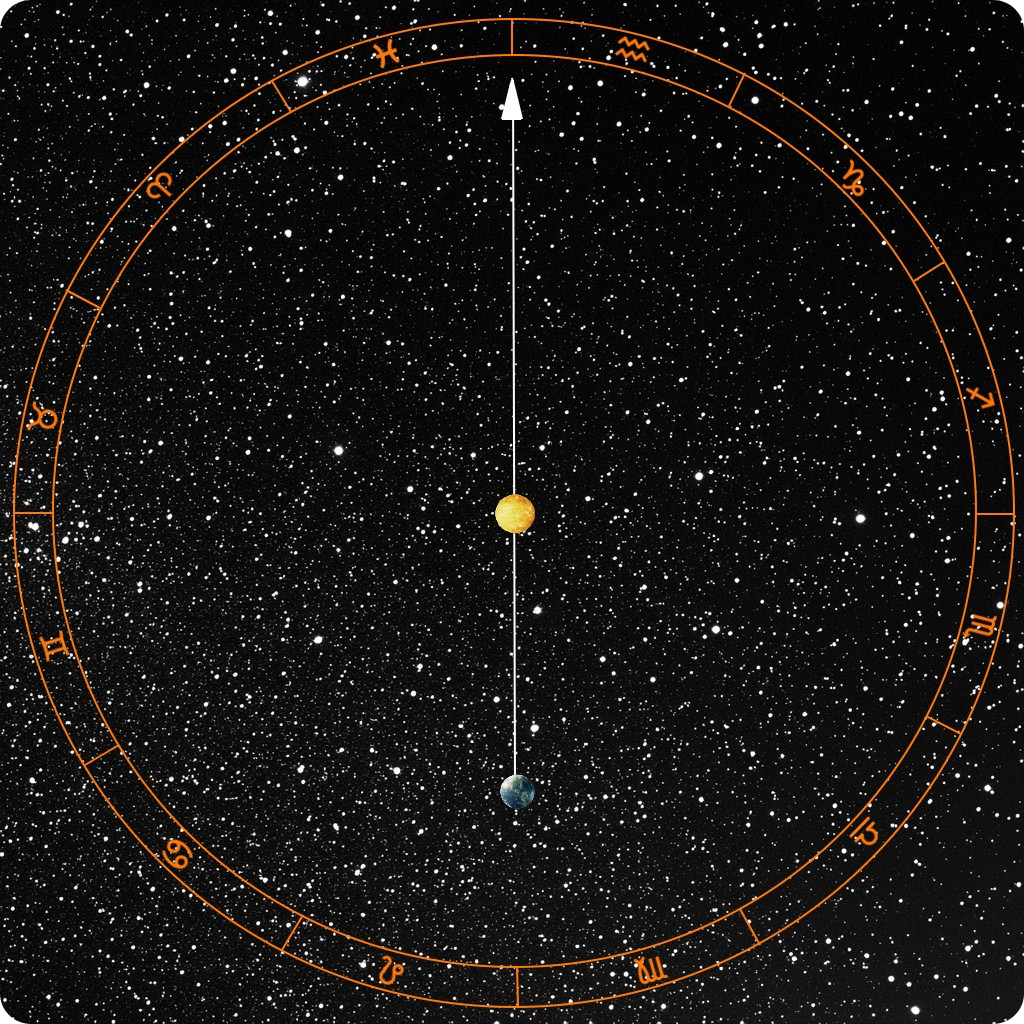
From our vantage point here on Earth, the sun appears to confine itself to a narrow strip of sky that rings the earth. One edge of this road marks the sun’s path on the shortest day of the year, and the other edge is defined by the sun’s path on the longest day of the year. During the spring and fall equinoxes, the sun travels right down the center of this imaginary highway in our sky.
Without flat-panel TVs and cell phones to distract them, the ancients marked the sun’s progress along that celestial road according to the constellations of stars that appear behind it. Because stars are invisible during the daytime, they took note of which constellation the sun rises in front of on the first day of spring.
They discovered that the sun does not make it all the way back to its original starting point each year. Over the course of about two thousand years, that annual slippage places the sun in an entirely new constellation at sunrise on the first day of spring. And after 25,800 years, the sun slips all the way back to its original starting position. This is the Great Year.
The zodiac itself comes from the ancient Babylonians, who used a base-60 numbering system (as opposed to our base-10 system). Their convention is where we get the 60 seconds in a minute and the 60 minutes to an hour. The Babylonians divided the ring-like celestial road of solar travel into 12 houses of 30° each, for a total of 360°, thereby inventing the zodiac. Each house is themed according to the constellation of stars contained within it, and the 12 houses of the zodiac correspond to the 12 hours on a clockface.
Whichever of these constellations the sun appears to rise in front of on the first day of spring is considered to be the current astrological age. That sunrise lingers on each zodiac sign for approximately 2,000 years. It’s currently somewhere between the constellations of Pisces and Aquarius. That’s why the 1967 hit musical Hair refers to the “dawning of the Age of Aquarius”.
Christianity
In 274 AD, the Roman emperor Aurelian established Sol Invictus (or the Unconquered Sun) as the chief god of the Roman Empire. He dedicated a new temple to that deity on December 25th, and that date became the god’s birthday (Dies Natalis Solis Invicti). A century later, Theodosius I replaced the cult of Sol Invictus when he declared Christianity the new state religion of the Empire.
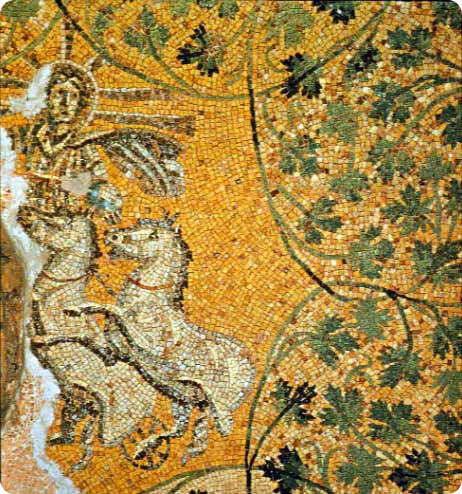
In the 1940s, workmen at the Vatican discovered the Tomb of the Julii in the old necropolis beneath St. Peter’s Basilica. This crypt is an early Christian burial site. A tile mosaic on the ceiling depicts Jesus as Sol Invictus, riding his chariot across the sky with sunrays emanating from his head. This mosaic is a clear illustration of early Christians associating Jesus with the sun god. This syncretism explains why he shares so many biographical details with the sun gods who preceded him. His inherited story is an allegory for the Babylonian zodiac.
In the centuries after his death, Jesus’ biography evolved to incorporate many familiar elements of sun worship. He had 12 disciples and 12 apostles, which correspond to the 12 signs of the Babylonian Zodiac, the 12 months of the year, and the 12 hours of the day. Jesus declared his ministry at age 30, matching the 30° in each house of the Zodiac.
Furthermore, Jesus’ biography became a solar allegory for the Great Year and the changing of the astrological age from Aries to Pisces. As the Age of Pisces draws to a close in our own time, the ichthys, or “Jesus fish,” has become a popular automotive accessory. Unbeknownst to most who affix that symbol to their car bumper, the fish represents the 2,000-year age of Pisces that began with the coming of Christ.
Conclusion
The Babylonian Zodiac is so old and so ubiquitous that we don’t realize how many of our familiar conventions are derived from it. The 12 houses of the zodiac match the 12 hours of the day and the 12 disciples of Jesus. The 60 seconds in a minute and the 60 minutes in the hour match the 360° of a circular clock face, derived from Babylonian sundials. These numbers relate directly to the Great Year, as measured against the zodiac. That’s why Christianity has been associated with the astrological sign of Pisces since its inception. Ancient attention to the night sky shaped many elements of modern culture—from measurement conventions to religious symbology. But we are so cut off from the skies today that most are blind to these layers of astronomical references. It’s just one of the many consequences of humankind’s modern divorce from the night sky.

Further Materials
The fifth element in civilization is science—clear seeing, exact recording, impartial testing, and the slow accumulation of a knowledge objective enough to generate prediction and control. Egypt develops arithmetic and geometry, and establishes the calendar; Egyptian priests and physicians practise medicine, explore diseases enematically, perform a hundred varieties of surgical operation, and anticipate something of the Hippocratic oath. Babylonia studies the stars, charts the zodiac, and gives us our division of the month into four weeks, of the clock into twelve hours, of the hour into sixty minutes, of the minute into sixty seconds. India transmits through the Arabs her simple numerals and magical decimals, and teaches Europe the subtleties of hypnotism and the technique of vaccination.
Will & Ariel Durant, Our Oriental Heritage, 1935, page 935

Learned so much from this, as always!
But then I came to the Saturn's black hexagon comment and I'm like... this guy's nuts,... how come my girls haven't told me about this one?? They had their kid's solar system book out at dinner last night, asking how many planets humans had been to, and when we told our youngest that there were waaaay more solar systems than just this one, as she had thought, her mind was blown (maybe a little like stepping out of the cave!). So I'm like hexagon shape on Saturn.... no way, ...search... holy heck. Thanks Nathan, this one will blow their mind again.
I was pretty lucky to grow up in wheatbelt Western Australia, we were 30km from the closest town and about 200km from the city. The whole family, after dinner on clear nights (of which there were many, about 300 days of clear skies a year), would lie out on the trampoline in the backyard with all the lights out and spot satellites and shooting stars. The Milky Way, from the boondocks in Australia, is like a bright cloud at night, it's really something.
Now in the Philippines we can't see jack.
Thanks for all the writing Nathan!
I usually read your essays in my mail program, but I am very glad I clicked to the web. Thank you, Nathan, for this stimulating essay!