


Key Takeaways:
World War I began with the assassination of the heir to the Austro-Hungarian empire by a Serbian nationalist terrorist organization
300 years earlier, the Thirty Years War began with the Defenestration of Prague, another act of rebellion by Slavic malcontents against a Germanic Empire.
WW1 surpassed the Thirty Years War as the worst tragedy in European history up until that time.
1914: Trouble in the Balkans
On a sunny June morning in 1914, Gavrilo Princip stepped out of a cafe and onto the cobblestoned streets of Sarajevo. The 19-year-old was a political extremist who had arrived in Bosnia with nefarious intent; he planned to assassinate the heir to the throne of the Austro-Hungarian Empire.
The Holy Roman Empire had been formally dissolved after its defeat by Napoleon at Austerlitz, and the Austro-Hungarian Empire was its successor state. It was ruled from Vienna by the same Habsburg family.
In 1908, the Habsburgs infuriated the Kingdom of Serbia by annexing the territories of Bosnia and Herzegovina. Like Serbia, these territories were ethnically Slavic. Gavrilo Princip was backed by the Black Hand terrorist network, who sought to avenge the annexation by gunning down Archduke Franz Ferdinand on the streets of Bosnia’s capital.
But Princip’s planned ambush had been foiled when the Archduke altered the route of his motorcade after an earlier disturbance. Thinking he had failed in his mission, a dejected Princip ducked into a nearby cafe.
When he remerged from the cafe, Princip was stunned to find the Archduke’s motorcade stalled out front. It had taken a wrong turn, a minor mistake that had enormous historical consequences. Princip quickly produced a .380 caliber pistol, stepped up to the open-top car, and fired two fatal shots at point-blank range. Franz Ferdinand and his wife, Sophie, died bloody deaths within minutes—and the world was never the same again.
The assassination of the Archduke caused a chain reaction. One-by-one, the nations of Europe declared war on each other according to a tangled web of political alliances. By August, World War I had begun. By the time it was over 4 years later, the Great War proved to be the worst disaster ever to stain the pages of history up until that moment.
1618: Trouble in Bohemia
The Austro-Hungarian Empire did not survive World War I. A rebellious act of violence by a Slavic dissident turned out to be the beginning of the end for that Germanic Empire. In this respect, the assassination of the Austrian Archduke mirrored exactly the events that transpired in Prague some 300 years before.
In 1618, the Holy Roman Empire was going through a succession crisis. The outgoing emperor had been tolerant of Protestantism, but the incoming emperor Ferdinand II was loyal to the Pope, and he made no secret of his intention to crack down on Protestants. A bitter civil war was brewing. The northern half of the Holy Roman Empire–where Prague is located—wanted to adopt Protestantism, while the southern factions remained loyal to the Pope and Catholicism.
The German word “fenster” means “window”. It’s the root of the English word “defenestration”, which means throwing somebody out of a window. Over the centuries, defenestrations became something of a tradition in the city of Prague.
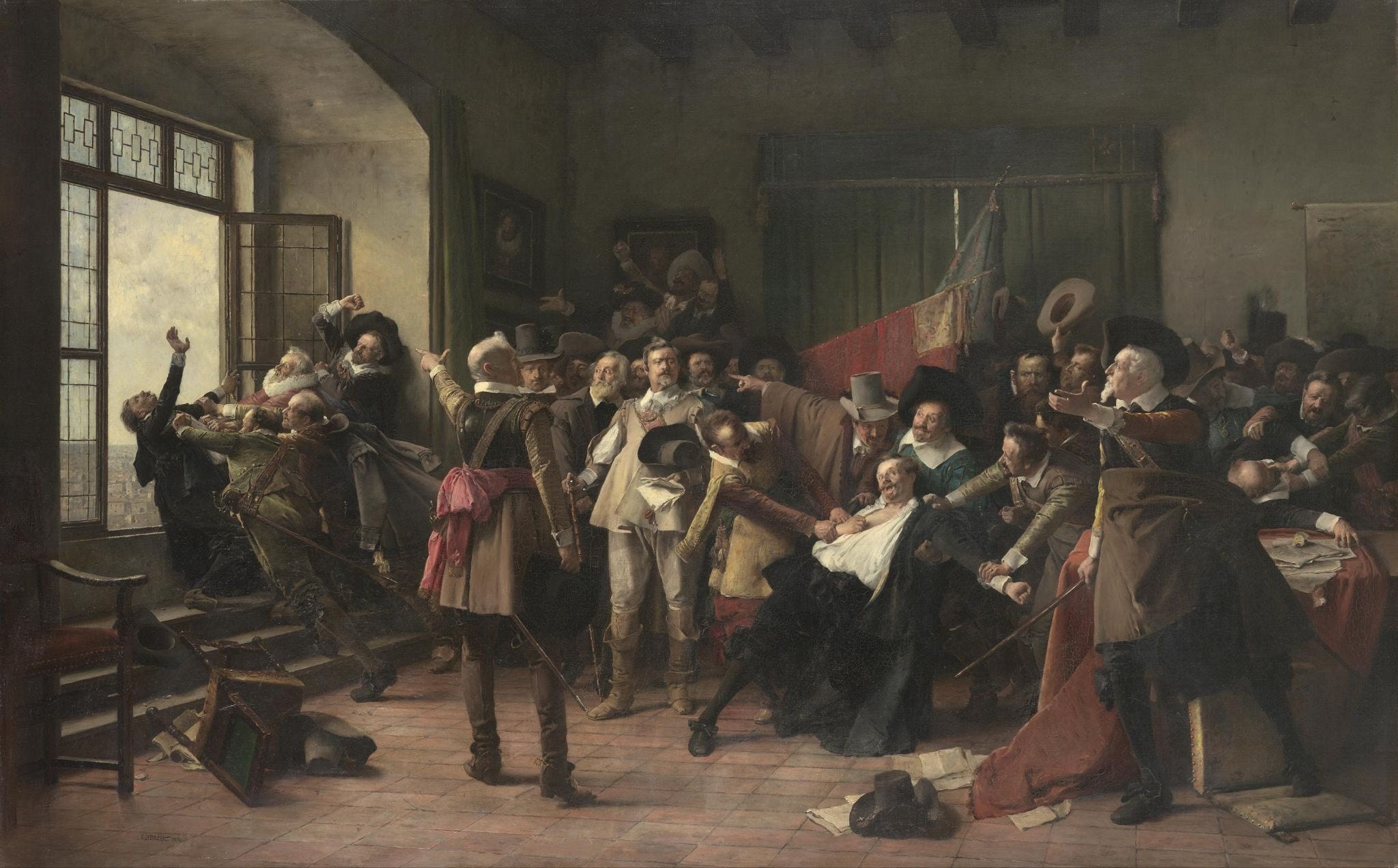
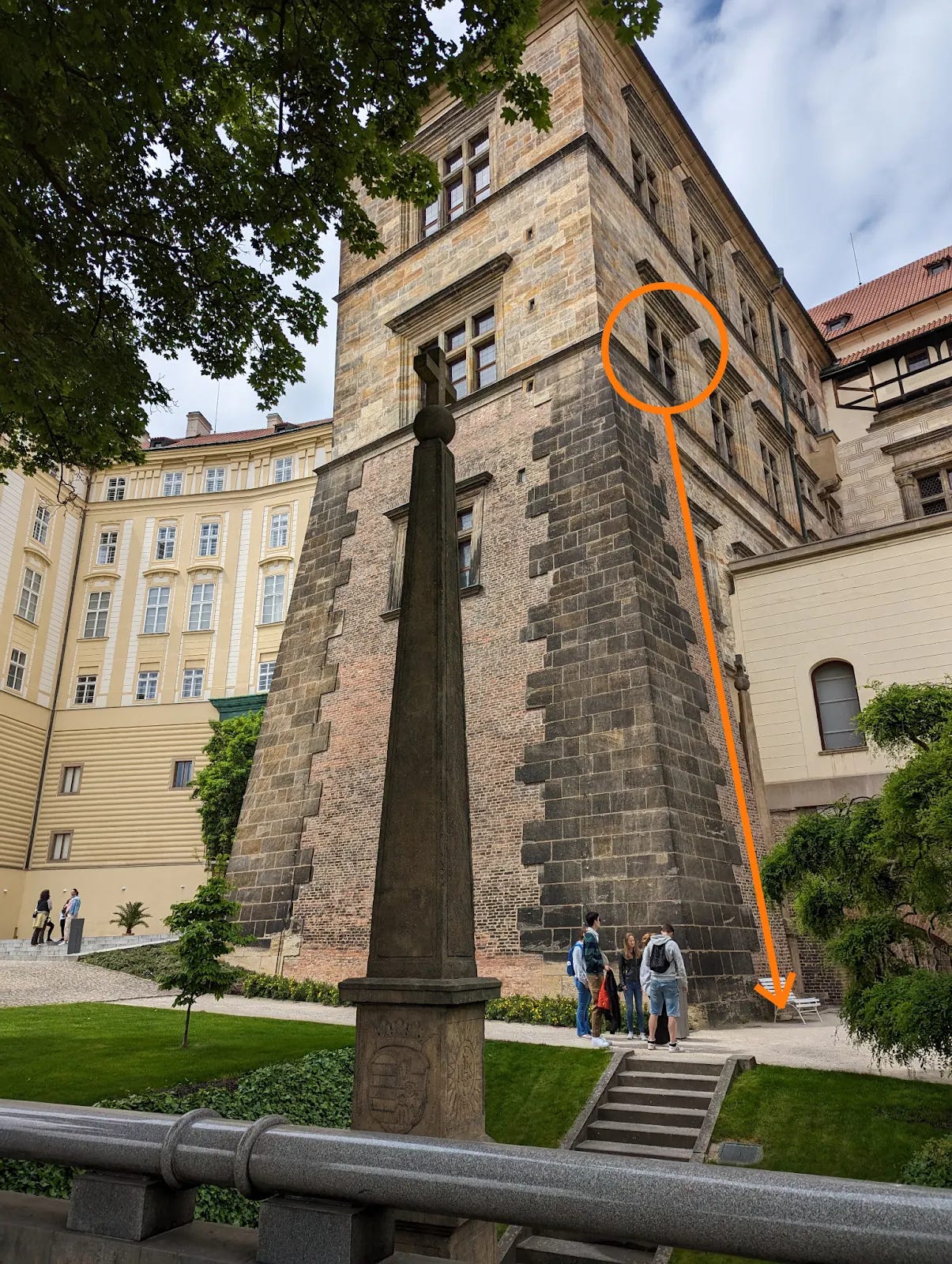
The spark that ignited the Thirty Years’ War came when enraged Protestants marched into Prague Castle, seized two Catholic governors, and threw them out of a second-story window. A clerk who got swept up in the frenzy was defenestrated along with them.
Amazingly, all three men survived the fall, with only a broken leg among them. They tumbled fifty feet into a pile of horse manure. In the aftermath, printing presses saturated Europe with propaganda pamphlets. Catholic propaganda represented the cushioning feces as God’s salvation, while Protestant sources represented the same as the only treatment fit for Catholics.
The Thirty Years’ War
Jokes soon soured, and the mood in Europe darkened as war clouds gathered on the horizon, just as in 1914. The Pope marshaled his political allies to support the emperor, while Protestant powers like Sweden dispatched troops to support Protestant factions within the Holy Roman Empire.
Virtually every polity in Europe was eventually dragged into the fighting. Because it considered the Holy Roman Empire an enemy, Catholic France entered the war on the side of the German Protestants. What started as a conflict over religious freedom descended into a bitter struggle for power as the entire Medieval political paradigm descended into chaos. These falling dominoes were eerily similar to the mutual declarations of war that electrified the public in the summer of 1914, after the assassination of the Archduke.
Like WWI, the Thirty Years’ War caused significant loss of life, with estimates of casualties ranging from 4.5 to 8 million people. Many regions experienced extreme violence, famine, and disease. Cities and villages were looted and destroyed, leading to economic collapse and population displacement. The brutality of the war left deep scars on the European landscape and psyche. Up until the outbreak of WWI, the Thirty Years’ War was the most brutal tragedy Europe had ever endured.
Conclusion
J.R.R. Tolkien recalled the horrors of World War I he’d witnessed first-hand when he later described the desolation of Mordor. The events of WWI supplanted the Thirty Years War as the worst thing that ever happened to Europe. Beyond the sheer loss of life, the two conflicts were remarkably similar in their genesis. Like the Serbs, the Czechs are a Slavic people. Both populations were subjugated to German Empires, and both turned to violence in their desperation to throw off rule from Vienna. American President John F. Kennedy encapsulated these events with his phrase, “those who make peaceful reform impossible make violent revolution inevitable.” But perhaps Mark Twain best summed up the bizarre similarities between the Thirty Years War and World War I with his classic quote, “History doesn’t repeat itself, but it often rhymes.”
Since you made it this far, patient reader, kindly consider hitting the ❤️ button above or below; it really helps!
Further Materials
But in Prague Count Heinrich von Thurn pleaded with the Protestant leaders to prevent the ardently Catholic Archduke Ferdinand from taking the throne of Bohemia. Emperor Matthias had left five deputy governors to administer the country during his absence. The governors overruled the Protestants in disputes about church building at Klostergrab, and sent the objectors to jail. On May 23, 1618, Thurn led a crowd of irate Protestants into Hradschin Castle, climbed to the rooms where two of the governors sat, and threw them out the window, along with a pleading secretary. All three fell fifty feet, but they landed in a heap of filth and escaped more soiled than injured. That famous ‘defenestration’ was a dramatic challenge to the Emperor, to the Archduke, and to the Catholic League. Thurn expelled the Archbishop and the Jesuits and formed a revolutionary Directory. He could hardly have realized that he had let loose the dogs of war.
Will & Ariel Durant, The Age of Reason Begins, 1961, page 556

Nathan,
To understand the avalanche/earthquake, it is not so much the precipitating event, but the stresses built up in the system being released at that point of circumstance.
The primary social, economic stress built up in the West, if not the entire world, is mistaking capitalism, rule by finance, for a market economy.
As I keep pointing, to little effect, in that as states function as social super organisms, government, executive and regulatory, is the nervous system, while money and banking are blood and the circulation system.
We have evolved enough to understand that as government has to serve the entire society, if only to prevent civil wars and revolutions, that it works best as a public utility. Much as our mind is referee of the desires and needs, government has to sort among all the factions and needs.
We haven’t yet come to understand the same principle applies to banking.
When the medium enabling markets is a player and not a utility, the rest are tenant farmers.
In a market economy, money is the medium. In a capitalist economy, money is the message. One is a tool, the other is a god.
As linear, goal oriented creatures in this cyclical, circular, reciprocal, feedback generated reality, people see money as signal to save and store, while markets need it to circulate. Consequently Econ 101 refers to money as both medium of exchange and store of value.
Roads are a medium, parking lots are a store. If we treated roads like we treat money, everything would be paved over, but we would still be fighting over who has the biggest lots.
In your body, blood is the medium, fat is the store. Mix them up and you are dead. Try telling a doctor that medium and store are interchangeable and he will look at you like you are really stupid, but to an economist, it would be common knowledge. Consequently the entire financial accounting system of society has been turned into a giant casino.
So rather than resources being allocated where they would have the greatest benefit, much is siphoned off to feed large egos, leaving the rest to fight over the scraps. It would be like the heart telling the hands and feet to go suck dirt, as it is keeping the blood for itself.
When greed is the primary motivating factor, strategy is basically bacteria racing across the petri dish. Infinite growth economics and moving onto Mars is not really a viable long term plan.
In fact, the advantage of multicellular organisms is being able to sense and navigate their surroundings.
So as a medium, you own money like you own the section of road you are on, or the air and water flowing through your body. It doesn't have your picture on it, you don't hold the copyrights and, most importantly, are not directly responsible for its value, like a personal check.
While we might think of it as a commodity to mine from the economy, like we mine gold from the ground, or bitcoin from computer processing, it functions as a contract, between the holder and the rest of society.
As a contract, storing the asset side of the ledger requires a debt on the other side, so much economic, social and political activity is designed to generate debt, to store the illusion of wealth. Such as indebting younger generations, rather than investing in them.
That the flunkies allowed in DC are best at running up debt and the financial sector needs this debt to grow metastatically is not coincidence. The secret sauce of capitalism is public debt backing private wealth.
“The real money is in bonds.”
The banks are having their, "Let them eat cake." moment.
We are seriously getting to the pitchforks and torches moment, as all the "divide and conquer" is starting to wear thin.
Here is interesting commentary on the state of play with "private equity," ie, asset stripping;
https://mispricedassets.substack.com/p/the-smart-money-is-the-subprime-this
China experienced an epoch of war and destruction, The Warring States Period, over 2000 years ago. I figure she learned something and henceforth was a peaceful nation, only interrupted by the occasional revolutionary turmoil caused by, as Pearl Bucks wrote in THE GOOD EARTH, "When the rich get too rich." Of course, there were several invasions, but even then the invaders quickly became Chinese themselves.
However, it seems the Europeans failed to learn anything from these wars as they are still up to warmongering.