


Quick Summary
The ARK OF THE COVENANT Was Lost to History when Jewish Captives Discovered Babylonian Debt Forgiveness
The HOLY GRAIL Comes From The Crucifixion When Jesus was Punished for Demanding Debt Forgiveness
The KNIGHTS TEMPLAR Supposedly Found The Holy Grail as They Introduced England to Banking
The ARK OF THE COVENANT Was Lost to History when Jewish Captives Discovered Babylonian Debt Forgiveness
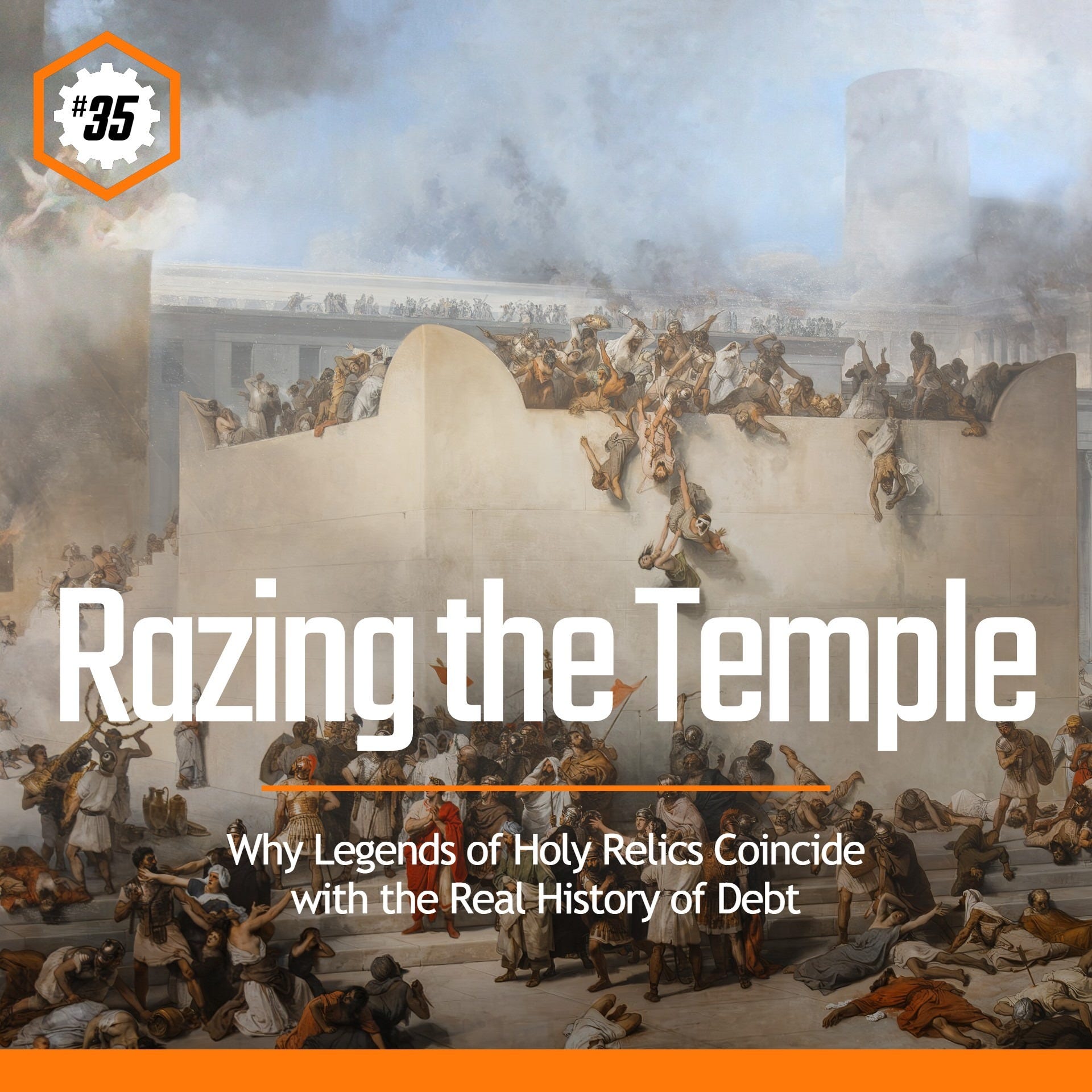
As a flashpoint in Middle Eastern politics, Jerusalem still dominates the modern news cycle. But back in 586 BC, the Holy City was little more than a smoldering ruin. In that year, the Babylonian king Nebuchadnezzar besieged it and razed the Temple of Solomon.
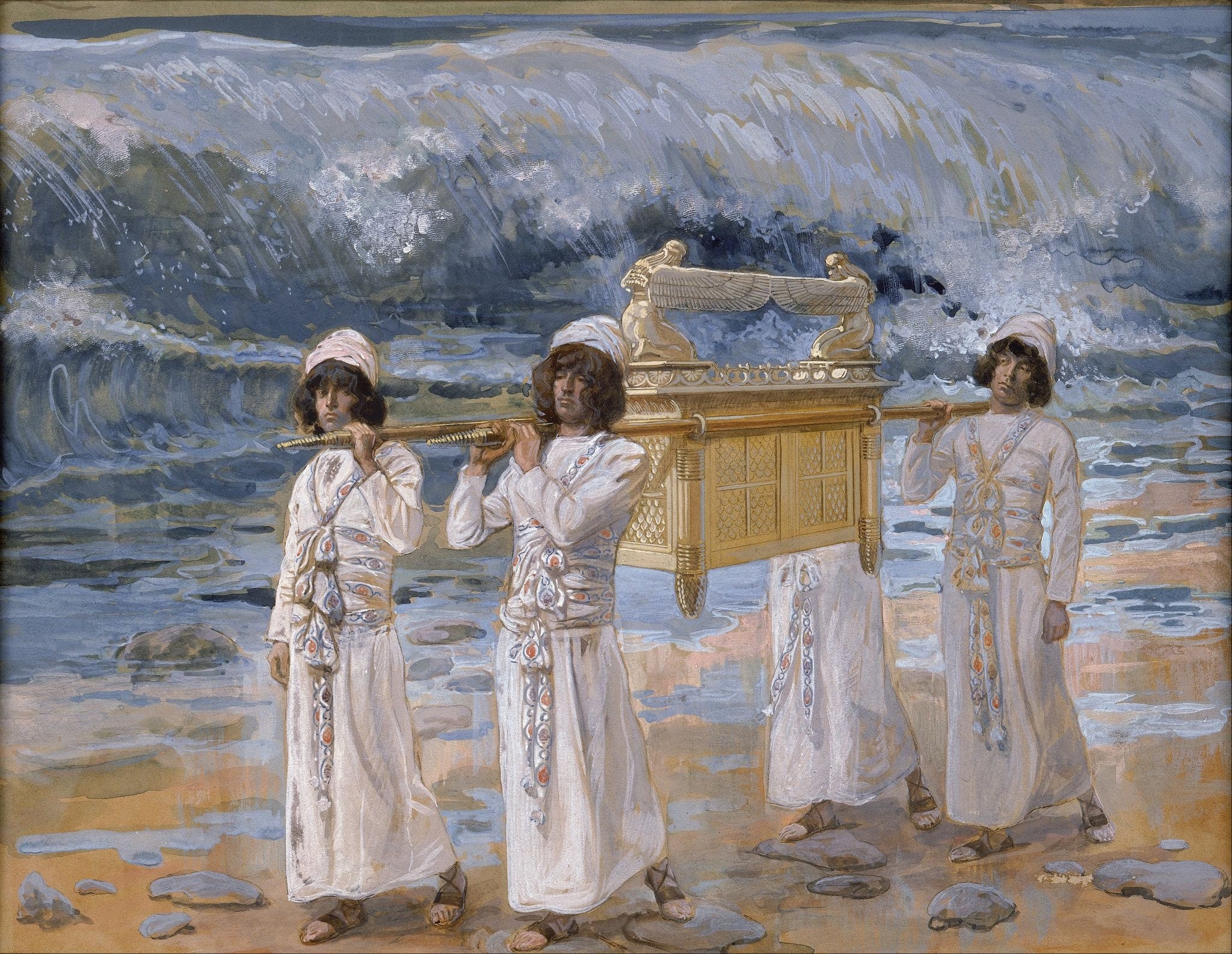
Prior to Nebuchadnezzar’s demolition, the Temple had been central to the lives of Jerusalem’s Jewish population. That was where they stored the Ark of the Covenant, a golden box containing the remains of the original Ten Commandments smashed by Moses. The 1980 film Raiders of the Lost Ark cemented this holy relic into the popular imagination.
The Ark was also supposed to contain the Staff of Aaron. Aaron was Moses’ brother, whose rod turned into a serpent and flowered miraculously during the Exodus story.
According to legend, Nebuchadnezzar’s siege of Jerusalem was the last time anyone saw the Ark of the Covenant. During the chaos, it vanished without a trace. Some suggest that the Ark ended up among the Tewahedo Christians of Ethiopia. Others believe Nebuchadnezzar seized the Ark.
But with or without the Ark, Nebuchadnezzar dragged the Jewish population of Jerusalem back to Babylon as war captives. That makes his siege of Jerusalem highly significant to the history of debt, in addition to being the moment when the Ark of the Covenant was lost.
As slaves in Babylon, the Jews learned about the Babylonian tradition of debt forgiveness. This practice was a fixture of Bronze Age Mesopotamia. A thousand years before Nebuchadnezzar’s time, the ancient Babylonian king Hammurabi commanded periodic debt forgiveness in his famous Code of written laws.
The Jewish captives recognized the immense value of the societal stability afforded by regular debt forgiveness before the Persian king Cyrus destroyed Babylon and liberated them from captivity. The Jews returned to Jerusalem and consecrated a Second Temple to replace the one destroyed by Nebuchadnezzar.
It was at this time the Jews formalized the Hebrew Bible and—in numerous passages—incorporated commands for debt forgiveness copied from the old Babylonian tradition. Five centuries later, during Roman times, Jesus directly referenced these Old Testament passages when he announced that “forgiveness” was the only hope of salvation.
Without the episode of the Babylonian Captivity where the Ark of the Covenant disappeared, there would have been no ministry of Jesus.
The HOLY GRAIL Comes From The Crucifixion When Jesus was Punished for Demanding Debt Forgiveness
In almost the same year that Nebuchadnezzar laid waste to Jerusalem, the stabilizing power of debt forgiveness reached Greece. That’s when Solon of Athens laid the groundwork for his city’s golden age with a widespread forgiveness of mortgage debts.
Later that century, the King of Rome considered copying Solon and stabilizing his own society by “cutting the heads off the tall poppies,” as the Roman historian Livy put it. But his wealthiest subjects ran him out of town before he could act. They convened the Roman Senate to rule in his stead as an oligarchy and established a powerful taboo against kingship. Here, the economic fates of Greece and Rome diverged dramatically.
Five hundred years later, Rome had exploded into the largest empire the world had ever seen. Because the expansion was largely accomplished through merciless exploitation of its working class, popular revolts and labor strikes roiled Roman society. This was the economic stage onto which Jesus of Nazareth stepped. His debut sermon was a reading of the scroll of Isaiah, one of the many places in Jewish scripture that called for Babylonian-style debt forgiveness.
Jesus’ advocacy for economic justice famously landed him in hot water with the Roman authorities. He suffered through a gruesome public execution for the crime of violating the Roman taboo against kingship. Augustine of Hippo went on to reinterpret Jesus’ demands for forgiveness as forgiveness for personal moral failings, instead of forgiveness for debts owed to the oligarchy. But telltale signs of Christianity’s original meaning can still be found in the 1611 King James version of the Bible, which renders the Lord’s Prayer as, “and forgive us our debts, as we forgive our debtors.”
Despite St. Augustine’s reinterpretation, the ministry of Jesus was a significant inflection point in the history of finance. For the duration of the Middle Ages, the Roman Catholic Church banned interest-bearing loans. The morality of debt went on to become a major factor in the politics of the Protestant Reformation.
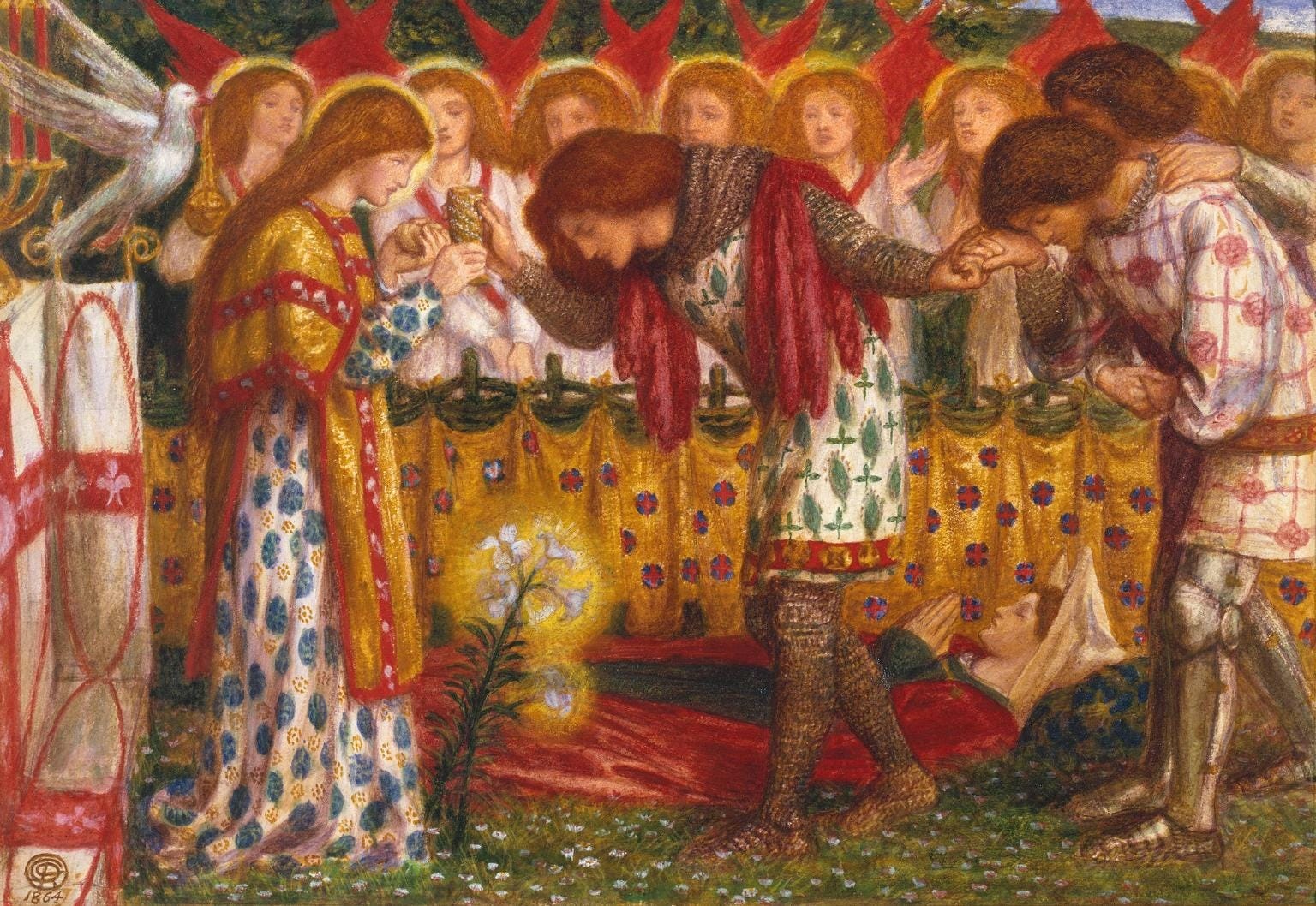
As with the Babylonian Captivity and the Ark of the Covenant, this history of debt coincides with a legend about another magical artifact: the Holy Grail. Indiana Jones also sought this holy relic in the 1989 film The Last Crusade. According to its lore, the Grail was the cup used at the Last Supper before Jesus’ execution, and by Joseph of Arimathea to catch the blood of Christ at the Crucifixion.
Joseph was the owner of the plot of land on which Jesus’ tomb was located, and he’s supposed to have brought the Grail to England. He’s believed to have arrived at Glastonbury with a flowering staff, eerily similar to the Staff of Aaron contained within the Ark of the Covenant. From there, the Grail became a focal point in the tale of King Arthur, who was said to have been buried at Glastonbury after his death. Sprigs of flowering Glastonbury hawthorn are still cut twice a year and presented to the British Monarch in acknowledgement of this Grail legend.
The KNIGHTS TEMPLAR Supposedly Found The Holy Grail as They Introduced England to Banking
A generation after Jesus’ lifetime, the Roman military drove the Jews from their homeland. They fled to Eastern Europe, Spain, and the Netherlands. Just like Nebuchadnezzar five centuries before, the Roman general and future emperor Titus laid siege to Jerusalem and demolished the Second Temple of Solomon that had replaced the original. Only a portion of the western wall remains today, and it stands as the holiest site in modern Judaism.
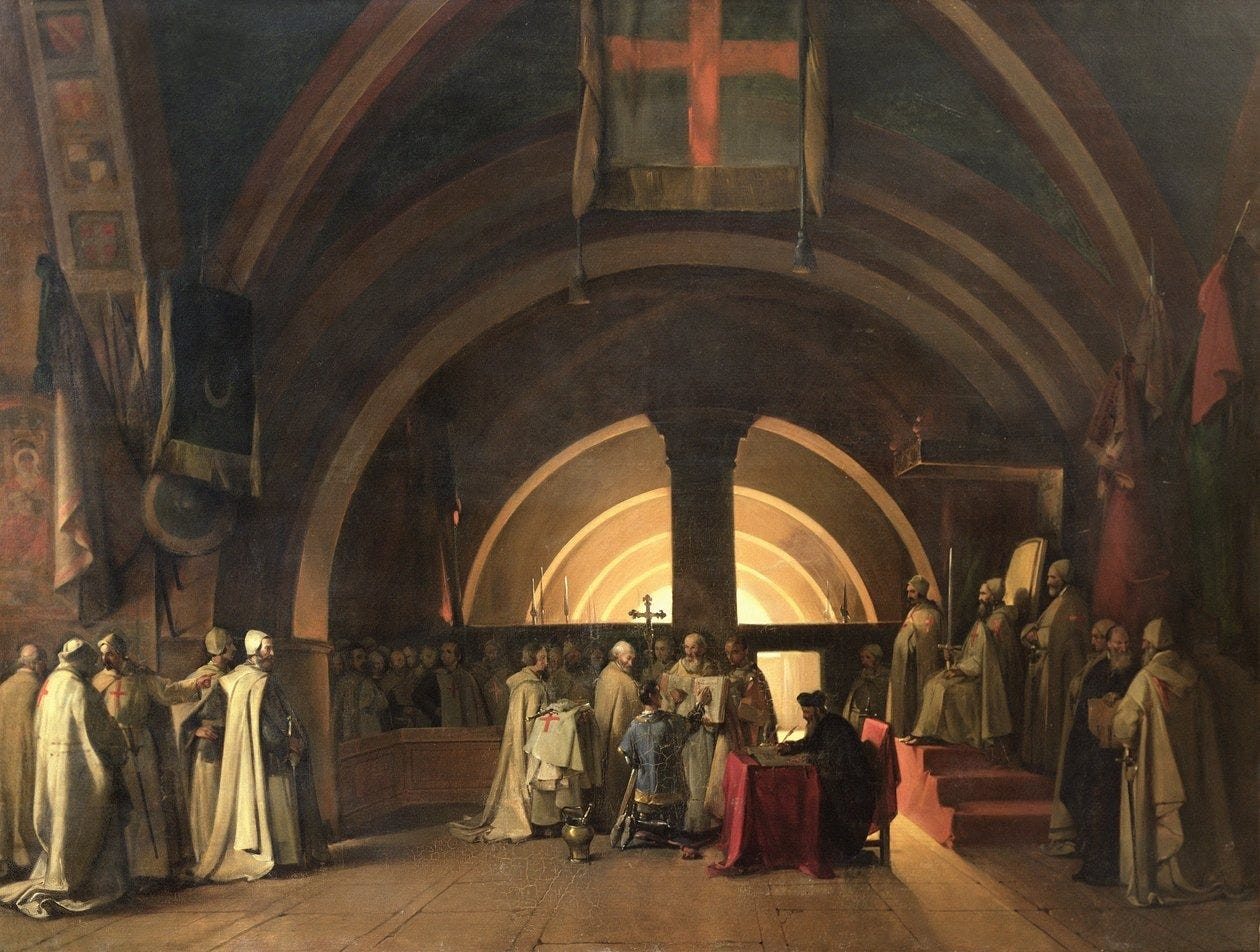
During the Crusades, the Knights Templar arrived in Jerusalem and established their headquarters on the Temple Mount, situated over the ruins of the Second Temple. Their name “Templar” comes from this location. Rumors began to circulate that the Knights had located a mysterious object of immense power while excavating the ruins. Possibilities included both the Ark of the Covenant and the Holy Grail.
In the real-life history of finance, the Knights Templar actually did accumulate immense power. They accomplished this not by discovering some holy relic, but by skirting the Church’s ban on interest-bearing debt. During the Crusades, the road to the Holy Land was rife with bandits. For safety’s sake, pilgrims began trading in their coins for letters of credit at Templar Churches, like the one you can still visit today on Fleet Street in London.
Unlike coins, letters of credit were worthless to thieves and cutpurses on the pilgrim trail. And upon arrival in Jerusalem, pilgrims could swap these letters for coins again. The Knights charged a fee for this service that was built into the exchange rates they offered. This practice was mathematically identical to charging interest on a loan, but it didn’t immediately arouse the suspicion of Church authorities. Another significant moment in the history of finance comes with strange stories about magical artifacts.
Conclusion
Albert Einstein once quipped, “Compound interest is the most powerful force in the universe.” He was remarking on the exponential power of interest-bearing debt, which isn’t intuitively obvious to the human mind. This lack of intuition makes debt a convenient mathematical rationale for the rich to claim the meager possessions of the poor. On the other hand, spiritualist traditions view our apparent confinement inside individual bodies as an illusion—and the accumulation of wealth to glorify individual egos as a dangerous trap. But history is not driven not by spiritualists. It’s driven by materialists who control the physical resources necessary to dominate others. Most of us live out our lives under somebody else’s economic regime with a festering sense that something is terribly wrong. On some level, we understand that we’re temporary nodes in a grander network. We should be sacrificing on behalf of future generations, not hoarding wealth to dominate our neighbors. That’s why major inflection points in the history of debt come accompanied by whispers of holy relics with immense magical power. It’s a subconscious recognition of our grand existence as a collective whole.
Since you made it this far, intrepid reader, kindly consider hitting the ❤️ button above or below; it really helps!
Further Materials
If a man has a debt lodged against him, and the storm-god Adad devastates his field or a flood sweeps away the crops, or there is no grain grown in the field due to insufficient water—in that year he will not repay grain to his creditor.
The Code of Hammurabi, Law 26–k

About part the second: I barely remember my grandfather intoning the Lord's Prayer with this strange word 'trespasses' that we want forgiven. Later in Sunday School, there was more. But I couldn't say that word 'trespasses'—too many 's' sounds. 'debt' makes more sense and is easier to say.
Nathan,
Compounding interest is a feedback loop. Given the degree to which financial interests control every aspect of society, focusing on this particular doom loop might not be the best strategy.
What would be more effective is a conversation of the basic thermodynamic physics driving activity on the surface of this little orb, in which wealth and power leveraging ever more wealth and power in a compounding curve is like heat sucking up moisture from the surface, then with these enormous vortices, such as endless wars, as the storms developing.
So the most basic crack in the dominant paradigm is our narrative, past to future view of time being a perceptual construct of mobile organisms with a sequential process of perception, rather than the more basic physical dynamic of activity and the resulting change turning future to past. Potential to residual.
Then exploring those underlaying thermodynamics would be a necessity. Especially as the financial AI based bubble bursts and all those people involved and invested in studying the nature of information and knowledge can't simply be stuffed back in the box and will seek ways to further the conceptual awareness.
You can't hemlock or crucify a couple million Socrates, or Jesuses.