



Key Takeaways:
Karl Marx Prophesied That Labor-Saving Technology Dooms Capitalism
Marx’s Predicted Inflection Point Occurred in the 1970s
Karl Marx Saw Democracy as the Cure for Technological Unemployment
Karl Marx Prophesied That Labor-Saving Technology Dooms Capitalism
The tendency of economics to revert to a winner-take-all game is an ancient problem that besets every human economy. In the 4th century BC, the Greek philosopher Plato implicated wealth addiction—or greed—as the principal driver in the rise and fall of civilizations.
Because wealth begets more wealth, the universal tendency is for it to concentrate into fewer and fewer hands over time. All hell breaks loose once too many people lose their economic incentive to participate in society. “There should exist among the citizens neither extreme poverty nor again excessive wealth,” Plato wrote, “for both are productive of great evil.”
Plato was proven correct hundreds of years after his death, when the Roman oligarchy cannibalized its own society. He was again vindicated a thousand years later, after the Black Death killed half of Europe. Feudal aristocracies refused to accept the wage demands of the surviving peasantry, and instead attempted to fix their economic privilege through legislation.
Instead, massive peasant uprisings won for workers the right to sell their labor to the highest bidder rather than swearing fealty to any particular feudal lord. The capitalist economic system was born. And though it’s far more far more vibrant and dynamic than feudalism, it’s not immune to the devastating effects of wealth addiction cited by Plato thousands of years ago.
In the 1800s, Karl Marx detailed how the same wondrous technological improvements driven by capitalism would ultimately be its downfall. His prophecy of doom is that labor-saving technology must eventually replace so many workers that remaining employees will lack the bargaining power to negotiate for sufficient wages to purchase the products churned out by automated factories.
Marx echoed Plato by identifying the insatiable drive for ever-greater profits as the key liability embedded within capitalism— logically guaranteeing its ultimate collapse. For 150 years, his analysis was dismissed as quaint or even dangerous. But today in the 21st century, Plato and Marx are being proven correct as political chaos accompanies deteriorating conditions for workers all over the world.

Marx’s Predicted Inflection Point Occurred in the 1970s
In the second half of the 1800s, Karl Marx predicted that labor-saving technology would inevitably replace enough workers to collapse demand for consumer goods. To the extent workers aren’t being paid, he reasoned, they cannot afford to consume.
Every business owner is incentivized to pay the lowest wages possible. But when technology permits the slashing of wages across the board, the same actions that make sense at an individual level become collectively catastrophic. Marx identified this as a fatal contradiction embedded within capitalism.
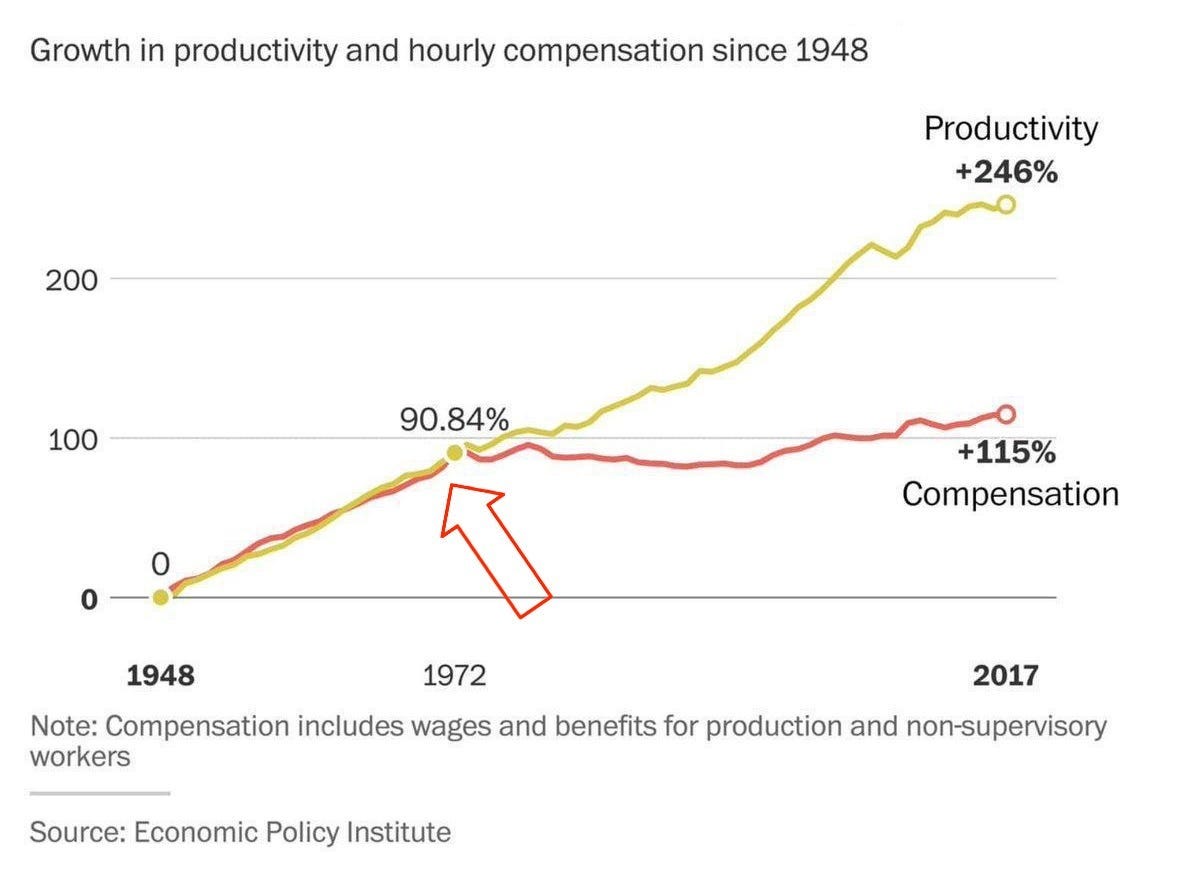
In the United States, his prophecy of doom began coming true during the 1970s. During that decade, technological improvements in air travel and telecommunications facilitated the offshoring of vast swathes of the US economy.
Meanwhile, a computer revolution greatly amplified the productivity of each individual worker. Spreadsheet software, for example, allows a single worker to replace an entire team. Combined with offshoring, this enhanced productivity severely constrained the overall demand for labor.
Also in the 1970s, a women’s liberation movement in the West encouraged women to join the workforce alongside their male counterparts. The arrival of women at work effectively doubled the supply of labor while technological innovation collapsed demand.
Ever since, we’ve been living with the predictable impact of these supply-and-demand dynamics on the price of labor. In real terms, wages have stagnated since the 70s—even as worker productivity continues to be enhanced by new technological innovations.
The 1980s ushered in the neoliberal economic policies of Reagan and Thatcher. Deregulation of corporations, the demolition of labor unions, and tax breaks for the wealthy were sold to the working classes as “trickle down” economics. These policies culminated in the financial crisis of 2008, and the subsequent bail-out of banking houses with public funds.
Today, we live in an era of massive political discontent driven by sharply diverging wealth inequality. For self-interested reasons, Western financial elites have treated Marx’s analysis as an irrelevant heresy. But he is coming back into vogue as working classes wake up to the salient fact that we are living through his prophecy of doom.

Karl Marx Saw Democracy as the Cure for Technological Unemployment
Karl Marx’s contribution to economics boils down to a realization that while business owners are critical to the formation of new firms, they become parasitic middlemen when those firms scale up in size. In the titanic factories of the Industrial Revolution, he saw the capitalist class of business owners as middlemen who collected a toll on a virtuous cycle of workers producing and then consuming goods and services.
The Walton family of Bentonville, Arkansas provides a striking example. The massive Walmart corporation could never have existed without the efforts of the family patriarch, Sam Walton. But today, his descendants own a controlling stake in that company–despite having no role in the daily labor that runs the stores.
The concentration of power that results from the private ownership of the means of the production is the lynchpin of Marx’s analysis. Under capitalism, firms themselves are bought and sold on markets alongside goods and services. That means that businesses tend to be acquired by those looking solely to enhance their valuations.
This incentive drives corporations to minimize labor costs without regard to the broader societal consequences. One might expect workers to rejoice when labor-saving technology cuts their workday in half. But under capitalism, half of those workers are laid off while the other half continue to work full days.
Marx saw democracy as the antidote to this fatal flaw in capitalism. If firms were run democratically, he reasoned, workers would vote to chop the workday in half instead of voting to lay themselves off. The trouble with capitalism, in other words, is the concentration of decision-making power in the hands of tiny minorities.
Karl Marx made few predictions about what might happen once capitalism reaches a key inflection point, when so many workers are technologically unemployed that consumer markets collapse. But he did point out the historical trajectory that carried Western civilization from the outright exploitation of the Roman slave economy, through the intermediate centuries of Medieval feudalism, and finally into modern capitalism.
Marx noted that each of these major economic transitions led to a more equitable arrangement between ruling and working classes. He extrapolated that trend into the future by suggesting that whatever system eventually replaces capitalism is likely to be more democratic—and therefore less exploitative—than past economic systems.
But democratic oversight over the means of production is anathema to the private entities who control it. Particularly in America, the ruling class has always been suspiciously dismissive of Karl Marx’s analysis. Private control over the means of production equates to a lot of power and influence for the minority who own them.
But it was Marx’s considered opinion that if business decisions were made democratically, profit would be one among many variables to be optimized—instead of the sole consideration for absent owners. Marx essentially argued for a trade-off between profitability and sustainability to replace our current arrangement that sacrifices long-term sustainability on the altar of profit.
Conclusion
A looming AI revolution is setting the stage for a stunning reconsideration of Karl Marx’s 19th-century analysis. The inflection point he predicted passed us by some 50 years ago. Today, the situation has devolved considerably as giant corporations replace vast swathes of their workforce with AI systems. By 2030, Amazon anticipates letting their workforce shrink by some 600,000 jobs—a significant chunk of the entire US labor market. Dozens of other firms have boosted their stock valuations with similar announcements. The financial elite would prefer that we ignore the looming threat by continuing to bury our heads in the sand. But if we’re going to avoid Karl Marx’s most terrifying predictions, we have no choice but to revive his eerily prophetic analysis
Since you made it this far, venerable reader, kindly consider hitting the ❤️ button above or below; it really helps!

Further Materials
It is an undoubted fact that machinery, as such, is not responsible for “setting free” the workman from the means of subsistence. It cheapens and increases production in that branch which it seizes on, and at first makes no change in the mass of the means of subsistence produced in other branches. Hence, after its introduction, the society possesses as much, if not more, of the necessaries of life than before, for the labourers thrown out of work; and that quite apart from the enormous share of the annual produce wasted by the non-workers. And this is the point relied on by our apologists! The contradictions and antagonisms inseparable from the capitalist employment of machinery, do not exist, they say, since they do not arise out of machinery, as such, but out of its capitalist employment! Since therefore machinery, considered alone, shortens the hours of labour, but, when in the service of capital, lengthens them; since in itself it lightens labour, but when employed by capital, heightens the intensity of labour; since in itself it is a victory of man over the forces of Nature, but in the hands of capital, makes man the slave of those forces; since in itself it increases the wealth of the producers, but in the hands of capital, makes them paupers.
Karl Marx, Capital: A Critique of Political Economy, 1867, Chapter 15