


Key Takeaways:
Plato’s Philosophy Massively Influenced Christianity
The Renaissance was a Revival of Platonism
Renaissance Magic Evolved into Science
Plato’s Philosophy Massively Influenced Christianity
Around 375 BC, the Greek philosopher Plato fundamentally altered the course of history with a single idea. He claimed that although the world we experience with our senses seems like bedrock reality, it’s actually just an illusion.
Plato famously compared the material world to a shadow-puppet show flickering across a cave wall. He argued that the observable universe is merely a distortion emanating from a hidden realm—analogous to the handiwork of unseen puppeteers.
When you walk into a restaurant, you compare objects in your visual field to a timeless ideal of a perfect chair floating around inside your mind. Comparison with such an ideal is how we recognize objects in the observable universe. Though the ideal chair doesn’t exist anywhere in the material world, Plato argued that an understanding of that ideal is how we know where to sit down.
Plato’s dualist philosophy became far more popular five centuries after his death than it had ever been during his life. At that time, a horrified Roman populace was watching their society decay around them. Plato’s assertion that the observable universe is flawed and transient perfectly matched their lived experience.
Furthermore, Plato’s hidden realm of eternal perfection gave Romans a reason to hope during one of history’s darkest periods. This realm was adopted by early Christians as their concept of heaven. Though the story of the New Testament is set in Palestine, it was originally written in Greek and heavily influenced by Greek philosophers like Plato. Historian Will Durant noted that St. Augustine “did not cease to be a Platonist when he became a Christian.”
Christianity is but one branch of the Platonic family tree. It competed with other branches like Gnosticism, Neoplatonism, and Hermeticism during the chaotic Fall of Rome. When the Roman government violently persecuted early Christians, it established a historical pattern of authoritative opposition to the Platonism that arises during times of economic crisis.
The Renaissance was a Revival of Platonism
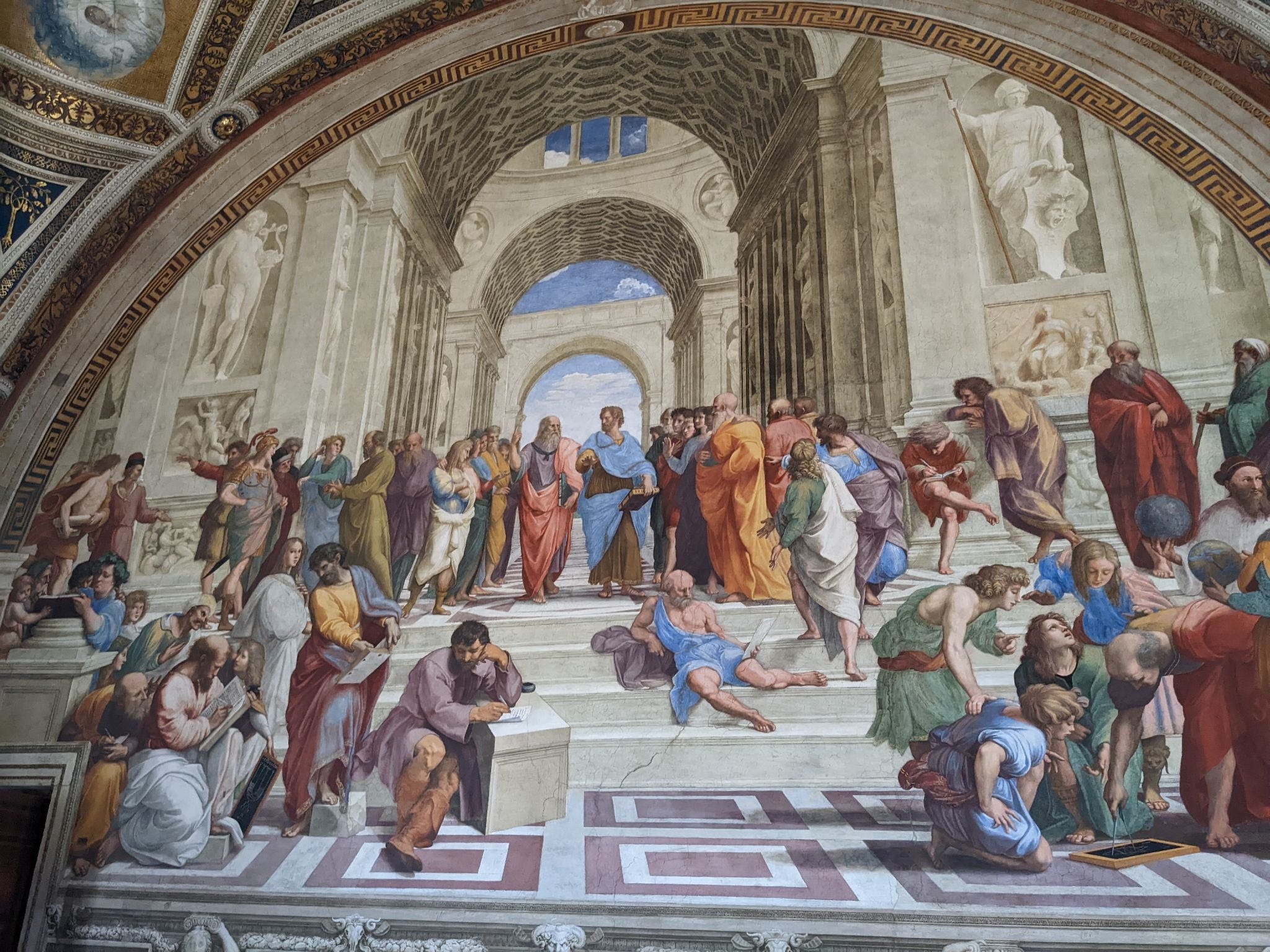
Empiricism is the exact opposite of Platonism. It’s the idea that all knowledge is derived from sensory experience, and it’s generally associated with Plato’s protégé, Aristotle. The tension between those two philosophies was dramatically captured by the Renaissance master Raphael in his landmark fresco, The School of Athens. At its focal point, Plato and Aristotle walk side-by-side. Plato’s finger points upward to emphasize his hidden, ideal realm. Meanwhile, Aristotle holds out an overturned palm to insist on the primacy of the observable, material realm.
Raphael’s patrons, the Medici of Florence, were obsessed with Plato. They funded expeditions to recover and translate the works of that Greek philosopher, lost to Christendom during the Fall of Rome. The Medici also bankrolled artists like Raphael and Michaelangelo as they strove to represent Platonic ideals through the painstaking refinement of artistic technique.
The Italian Renaissance was nothing less than a revival of Platonism manifested in art and literature. This revival also gave rise to Renaissance magic.
At the core of all magic lurks the Platonic notion that perceived reality is an illusion, akin to the dreamscapes that our minds simultaneously conjure and experience during sleep. Renaissance magicians sought to alter that reality in the same way a lucid dreamer might seek to alter their dreams.
The Corpus Hermeticum is an ancient text rediscovered by the Medici during the Renaissance. Just like the New Testament, it was informed by Plato’s philosophy and written in Greek during the late Roman Empire.
Unlike the New Testament, it contained empowering passages such as, “If then you do not make yourself equal to God, you cannot apprehend God; for like is known by like.” For a thousand years, Europeans obediently accepted the Roman Catholic Church’s teaching that aspiration to godliness was the most abject of heresies.
But the Corpus Hermiticum proved to be an irresistible alternative to the New Testament. As the feudal economic system collapsed and Church authority waned, Europeans became increasingly fascinated by magic. Like Raphael’s brilliant fresco, the popularity of the Corpus Hermeticum reveals that a revival of Platonism was the intellectual force behind the Italian Renaissance.
Renaissance Magic Evolved into Science
Hermeticism went on to become the basis of Renaissance alchemy. Later generations of Medici remained wholly fascinated by this magical art. Where St. Augustine had taught that moral improvement was the gateway to the hidden kingdom of heaven, alchemists believed that a great work, or “magnum opus”, would allow them to transcend the observable universe.
The idea of the magnum opus was not only reflected in the great works of Renaissance artists, but also in the intricate experiments of the alchemists. Their bubbling alembics were supposed to reveal as much about the observer as they were about the material world that Plato took to be an illusion.
But as the European economy stabilized during the transition from Medieval feudalism to modern capitalism, Platonic dualism reverted back to Aristotelian empiricism. Alchemy gave way to chemistry, while astrology developed into astronomy. White lab coats replaced wizard’s robes as science was born of Renaissance magic. Today, scientists rather than priests differentiate heresy from gospel on behalf of the masses.
During the Fall of Rome and during the Renaissance, the decay of existing economic systems made various forms of Platonism an attractive philosophical perspective. Conversely, times of relative economic stability tend to promote the opposite, empirical view of reality.
Christianity began during an economic collapse as a Platonic revolt against Roman authority. But by the time feudalism reached its maturity, Christianity had calcified into an authority similar to the one it had displaced in Rome a thousand years before.
As feudalism collapsed, Platonism once again challenged authority under the guise of the Italian Renaissance. Just as early Christianity gelled into the Medieval Church, Renaissance magic surrendered to the empiricism of modern science.
If this fascinating historical pattern holds, our modern scientific authorities should expect another revival of Platonism once the capitalist economic system reaches its expiration date. From beyond the grave, Plato patiently plots his revenge.

Conclusion
Church opposition to the Platonism of the late Middle Ages was a redux of the political repression of Christians during the late Roman Empire. The screams of heretics in the dungeons of the Inquisition mirrored the throwing of Christians to lions in the Colosseum. In both cases, the powerful responded violently to strains of Platonism threatening their intellectual authority. These episodes reveal that popular assumptions about bedrock reality often reflect the interests of authorities rather than any actual state of the cosmos. That’s why—during times of economic crisis—the philosophy of Plato has emerged from hibernation to undermine established intellectual monopolies. It’s at those moments that people take a long, hard look at their emperor to see if he’s wearing any clothes. That’s when Plato’s notion that reality is an illusion is at its most obvious.
Since you made it this far, noble reader, kindly consider hitting the ❤️ button above or below; it really helps!
Further Materials
If then you not make yourself equal to God, you cannot apprehend God; for like is known by like. Leap clear of all that is corporeal, and make yourself grow to a like expanse with that greatness which is beyond all measure; rise above all time, and become eternal; then you will apprehend God. Think that for you too nothing is impossible; deem that you too are immortal, and that you are able to grasp all things in your thought, to know every craft and every science; find your home in the haunts of every living creature; make yourself higher than all heights, and lower than all depths; bring together in yourself all opposites of quality, heat and cold, dryness and fluidity; think that you are everywhere at once, on land, at sea, in heaven; think that you are not yet begotten, that you are in the womb, that you are young, that you are old, that you have died, that you are in the world beyond the grave; grasp in your thought all this at once, all times and places, all substances and qualities and magnitudes together; then you can apprehend God.
Corpus Hermeticum 11:20

Platonism remains embedded in science. The notion that the abstractions of mathematical formalism underlay the processes generating the patterns being abstracted.
1+1=2 does not apply in the void, as not only does it require distinct objects, but a process of addition.
Spacetime as the basis of General Relativity, or quantum super position as the basis of Quantum Mechanics are premises based on this belief.
We should have learned the lesson from modeling a geocentric cosmology. Epicycles were brilliant math. Crystalline spheres were lousy physics.
The problem goes to the basic nature of reality, that structure is recursive, while energy is expansive. Galaxies are energy radiating out, as structure coalesces in.
So our knowledge builds on priors, like rings of a tree. Yet the grain of sand at the center of the pearl, be it God, mathematical formalism, truth, money, is necessarily subjective, not objective. The force of gravity, that centripetal dynamic, might be universal, but any particular center of gravity is local.
Meanwhile the ambient energy is traded around, creating overall equilibrium.
As multicellular organisms, it is our nervous system that coordinates all the cells and organs into one fairly coherent entity.
It's just that our digestive system processes the energy, while our nervous system sorts the patterns, signals from noise, that there is this cognitive focus on the patterns and attempts to reverse engineer from what is effect. Thus getting caught up in these cognitive feedback loops and spiraling down the innumerable rabbit holes.