To the ancient Egyptians, the words of children held mystical significance—that’s why their sun god Horus the Child (Har-pa-khered) always pointed to his own mouth. After the Greeks adopted Harpocrates as their God of Silence, they misunderstood the gesture to mean “hush.” Aphrodite created roses as a gift to this god, persuading him to keep secret her many amorous indiscretions. The Romans hung roses in banquet halls to remind revelers that utterances made “under the rose” (sub rosa) were strictly confidential. During the Middle Ages, roses were carved into the ceilings of council chambers, government meeting rooms, and Christian confessionals for the same reason.
Belgrade Fortress
The Danube is Europe’s second-longest river. It flows eastward from Germany’s Black Forest to the Black Sea, passing through 10 countries and four capital cities, including Vienna and Budapest. At its confluence with the Sava River, the Danube also flows through the Serbian capital of Belgrade.
Kalemegdan Fortress stands on a hill overlooking this confluence. For much of its history, this fort WAS the city of Belgrade. It wasn’t until the 19th century that the city expanded meaningfully beyond the walls that protected it from a dozen centuries of sieges and invasions.
Belgrade Fortress began as the Roman settlement of Singidunum in 86 AD. The Roman Empire broke in half during its death throes, and the most famous of the Eastern Roman Emperors—Justinian—was a locally-born. He rebuilt the city after it was sacked by Attila the Hun in 441 AD. According to one legend, Attila would be buried in or around the Fortress after his sudden death a decade later.
After the lights of Rome blinked out and it withdrew from its borders, the site was settled by Slavic peoples in the 6th century AD. Belgrade went on to become the capital city of the Medieval Serbian Kingdom until its conquest by Ottoman Turks in the 14th century.
Between 1521 and 1867, Belgrade was dominated by foreign powers. The Turkish Sultan and the Austrian Habsburgs took turns laying to siege to Belgrade fortress and then defending it from the other.
After a brief interlude during which another Serbian Kingdom was founded in 1867, the Austrians again conquered the city during the first World War. Once the Austro-Hungarian Empire collapsed at the end of that war, Belgrade became the capital of the Kingdom of Yugoslavia. But during World War II, Belgrade was again conquered by the Nazis. Post-liberation, the city was restored as the capital of the Communist state of Yugoslavia.
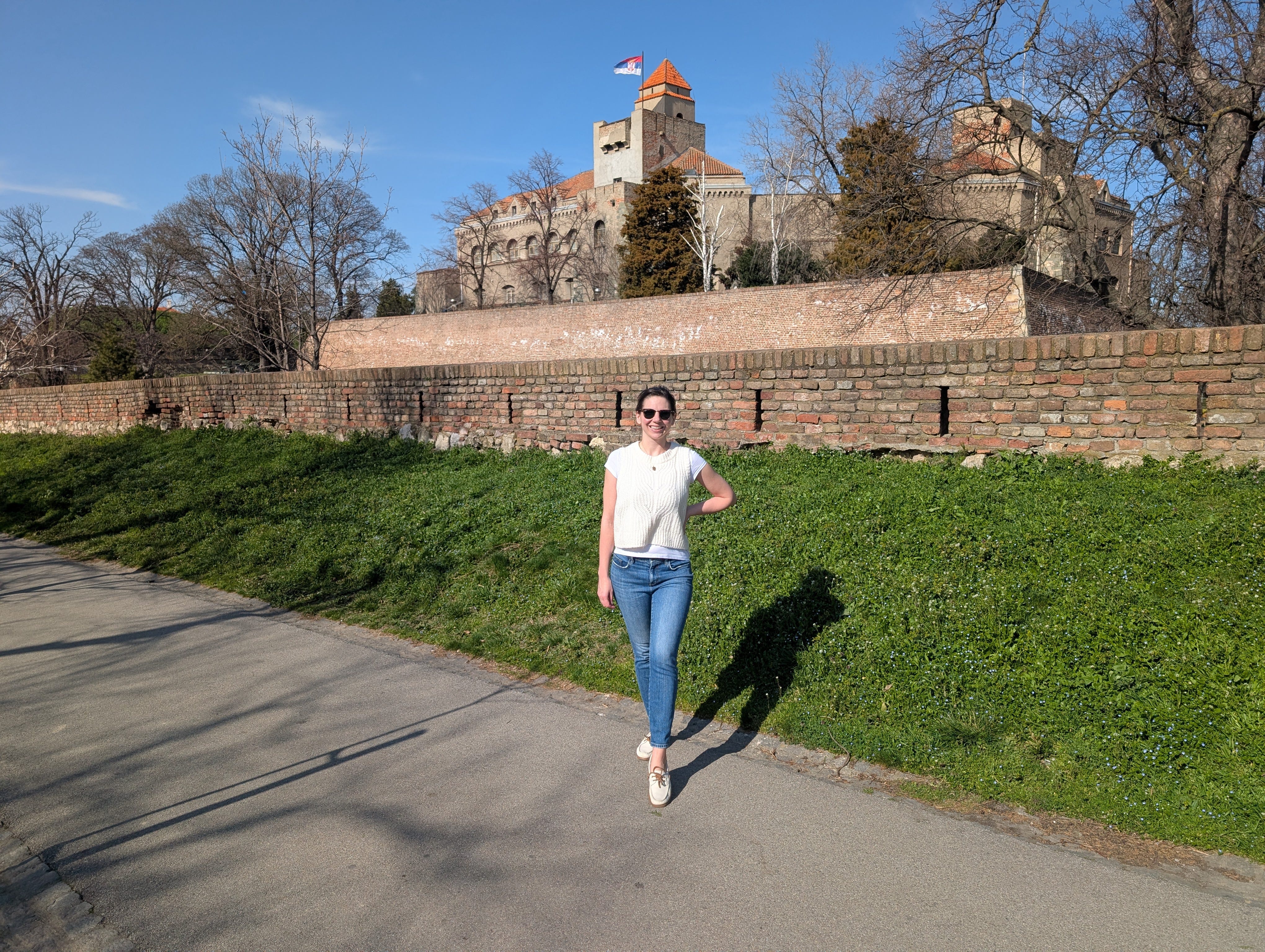
In the photograph below, my fiancée stands before the inner keep of the fortress. This complex is now a military museum, with real 20th century tanks and artillery from a variety of countries standing outside for visitors to admire. The fort also contains a museum full of grisly Medieval torture of devices that’s not for the faint-of-heart.
Kalemegdon Fortress is central to the lore of Belgrade and a must-see for anyone visiting the city. From here, the gleaming buildings of Belgrade’s New City district rise above sweeping views of the confluence of the Sava and Danube rivers.