


Introduction
The eternal notion of the Platonic Ascent—in which the journey itself is the destination—takes its most shocking form in Dante’s Divine Comedy. In that epic poem, Dante connected Medieval Italy to the Roman Empire by using himself as a main character, along with the ghost of the Roman poet Virgil.
In life, Virgil had connected the Roman Empire to Greek mythology with his own epic poem. Dante, in turn, connected the late Middle Ages with Rome by exploring the ancient idea of a mythic journey out of Plato’s Cave and bringing it into the late Middle Ages…and beyond.
Key Points
The Roman poet Virgil linked Rome to the Greek Odyssey and Iliad by writing an epic poem in the style of Homer.
During the late Middle Ages, Dante linked Florence back to ancient Rome by using Virgil as a character in The Divine Comedy, an epic poem of his very own.
Dante’s disturbing poetry reflects a Medieval cosmology derived from the Greek philosopher Plato.
Epic Poetry
Whether passed along by word-of-mouth or written down, epic poetry has historically linked together the great civilizations of history with layers of reference.
The Iliad and The Odyssey are the most famous poems in history. Each consists of 24 books and tens of thousands of lines of poetry in dactylic hexameter. While The Iliad recounts the brutal final year of the Greek war against Troy, The Odyssey follows a Greek hero on his long and arduous journey home from that war. Though they have a long and complex history of oral tradition shrouded in mystery, authorship of these epic poems is traditionally attributed to a quasi-historical figure called Homer.
Roman society borrowed much from earlier Greek culture. To forge a national identity for Rome, the poet Virgil welded an origin myth for the Roman Empire onto The Iliad and The Odyssey. He wrote his own epic poem in Latin, and copied the same meter used by Homer. In Virgil’s Aeneid, the Trojan prince Aeneas escapes the fall of Troy and arrives in Italy, where his bloodline eventually begets Romulus and Remus, the mythical twin founders of Rome.
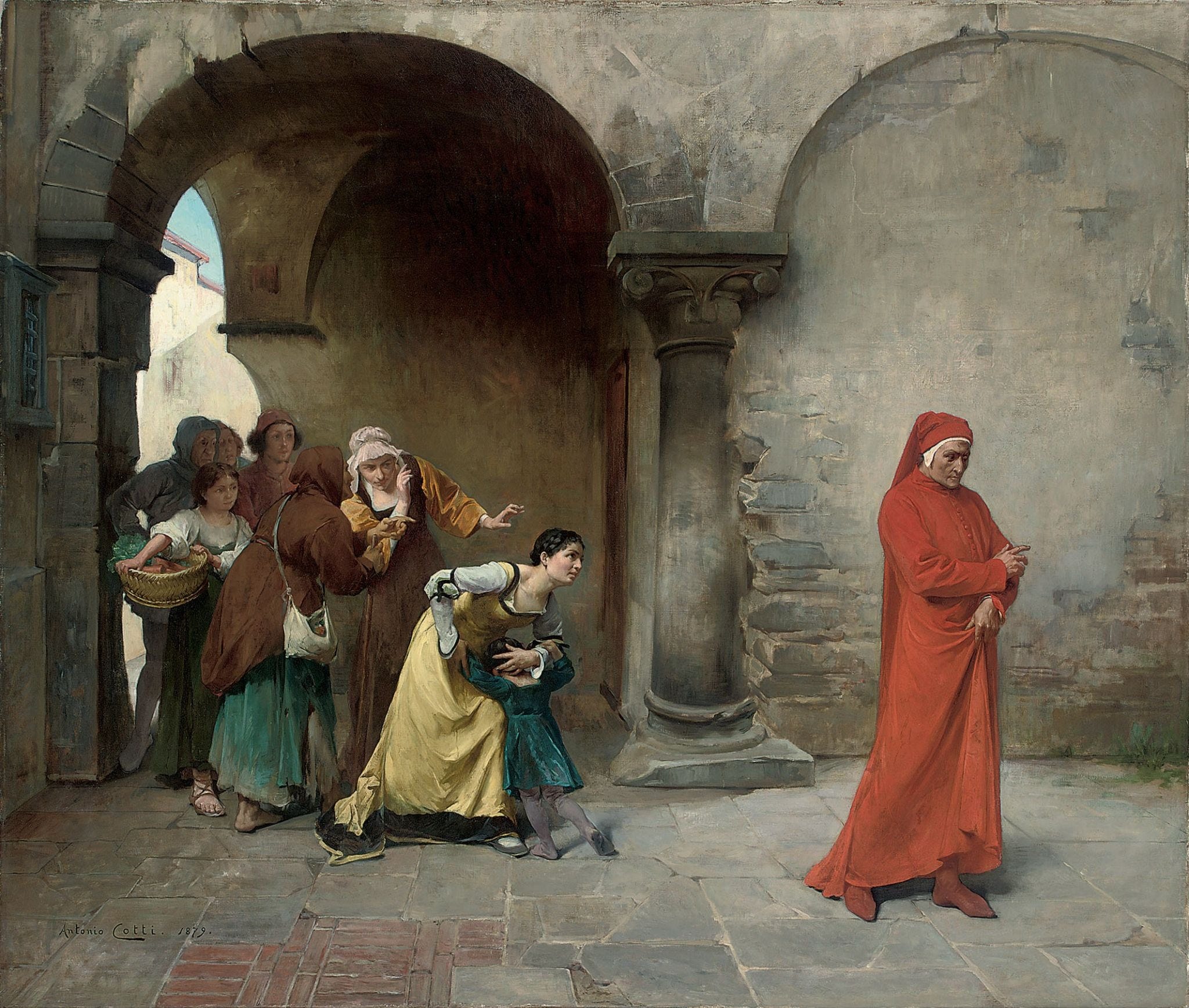
Dante Alighieri was born in 1265 in Florence, Italy. It was a city racked by political intrigue in Dante’s time. Much of the fighting was over how much influence the nearby papacy in Rome should have over Florentine politics. Rival factions fought to the death in the streets. Dante unwisely took sides in the conflict and found himself banished from his beloved hometown, never to return.
His bitterness inspired him to write an epic poem that—still to this day—deliciously haunts the imaginations of Christians and non-Christians alike.
The Descent into Hell
Over the course of 100 cantos (or verses), Dante wrote The Divine Comedy in the first person, as if recounting experiences that actually happened to him. It was called a “comedy” because he wrote it in Italian, rather than Latin. He described a grand tour of Medieval cosmology starting in hell, and ascending through purgatory into heaven. 33 cantos are devoted to each of these realms, with a single canto serving as the introduction to the notorious Inferno, which brings the grand total to 100.
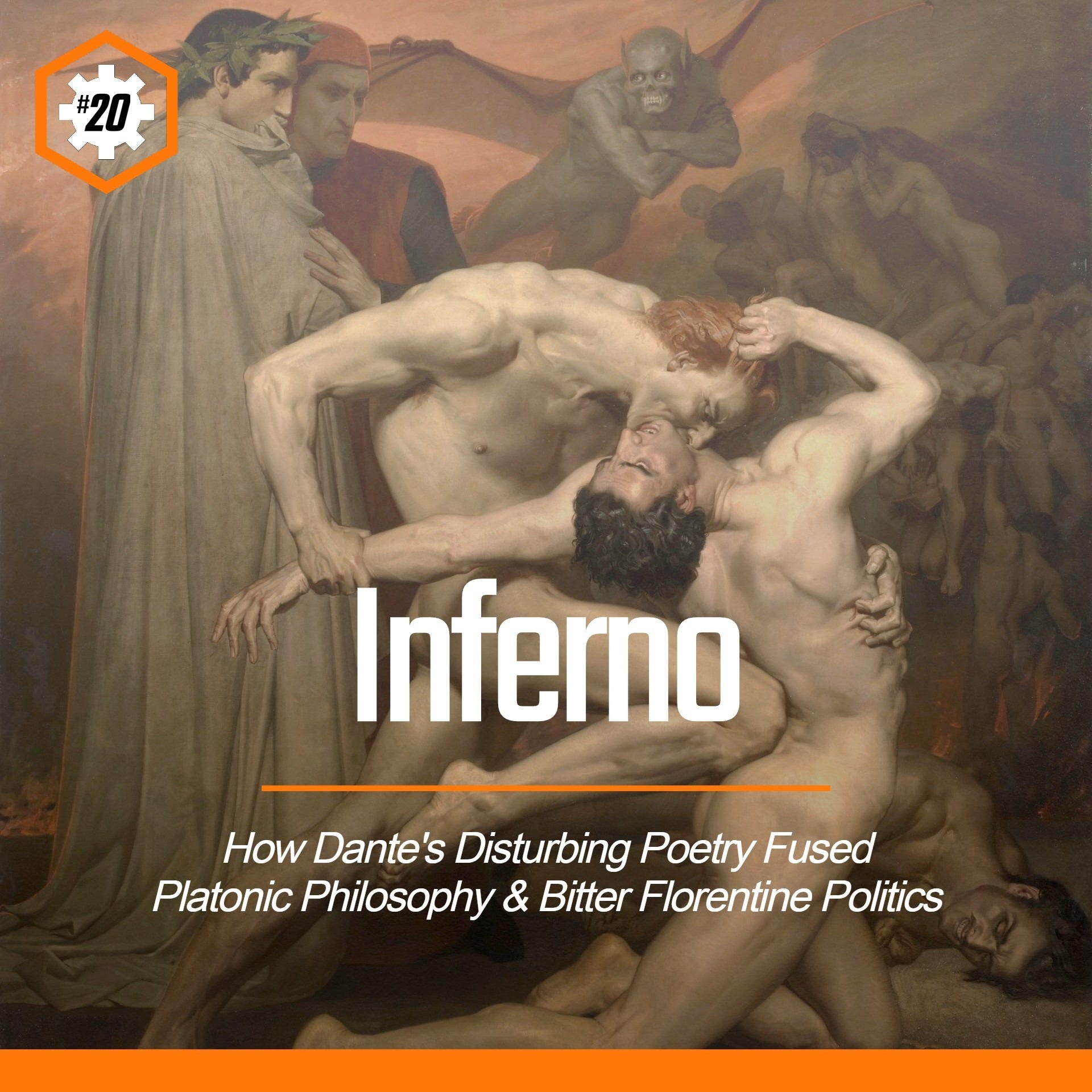
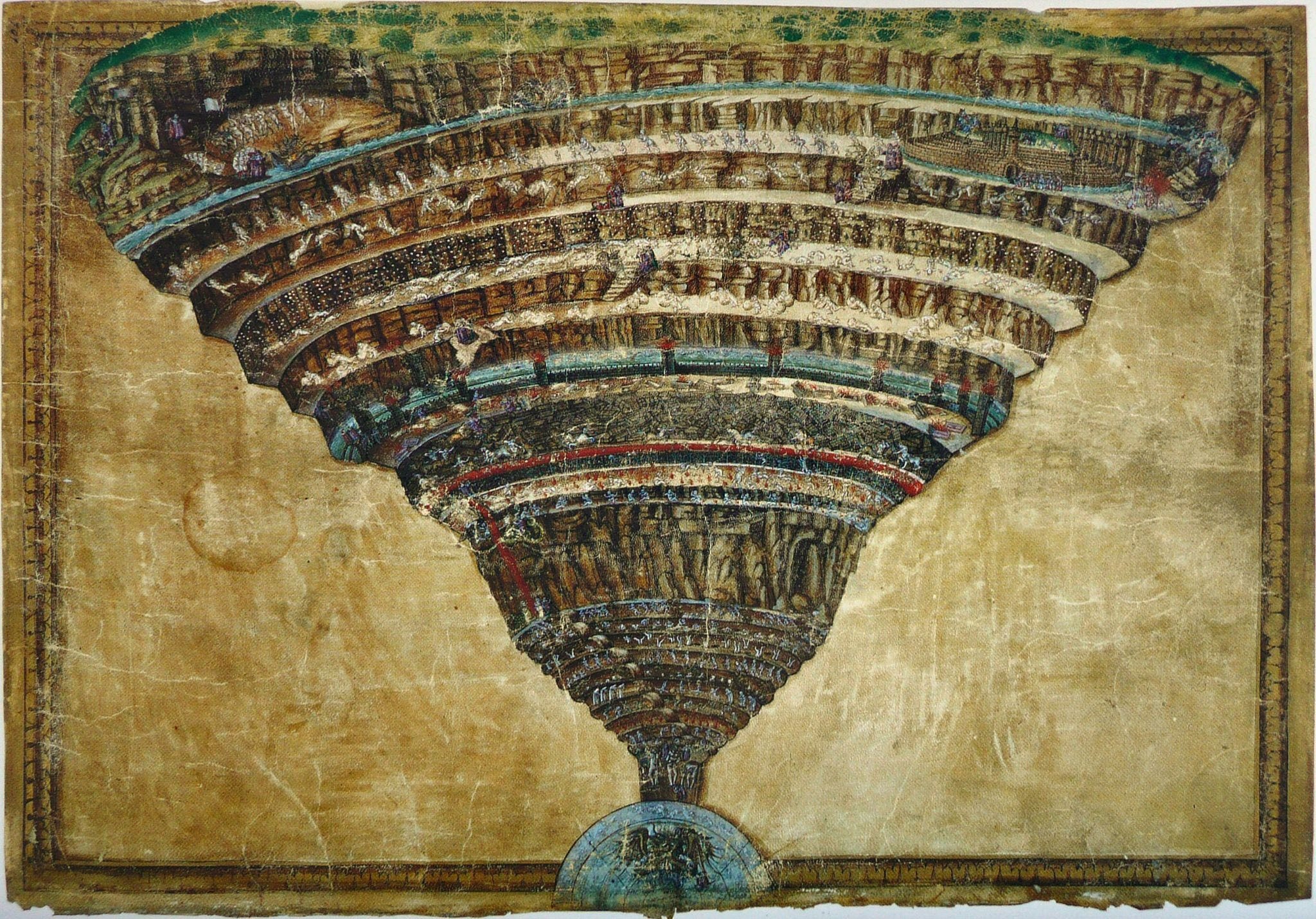
Dante’s Inferno recounts a disturbing journey into hell, chaperoned by none other than the ghost of the Roman poet Virgil. According to Dante, hell is funnel-shaped and comprises nine levels, with the worst sinners confined to the narrow lower levels. His language is chilling, and the torments suffered by the damned are vividly described. Dante populated hell with his political enemies, inventing horrific fates for those responsible for banishing him from Florence.
Filippo Argenti, for example, moved into Dante’s old home after his banishment. Dante avenged himself by condemning Argenti to a gruesome fate on the fifth level of his Inferno. There, the wrathful bite and scratch at each other for all eternity in the filthy waters of the River Styx. Canto VIII 58-60 describes the scene:
“Come get Filippo Argenti!” they all cried,
And crazed with rage the Florentine spirit bit
At his own body. Let no more be said.
Sandro Botticelli began painting an illustrated manuscript of The Divine Comedy in the 1480s. Though he never completed all the illustrations, Botticelli’s Map of Hell remains an iconic visual depiction of the funnel-shaped Inferno described by Dante.
Mythic Ascent in The Divine Comedy
The Greek philosopher Plato organized his cosmology into horizontal planes of reality with vertical routes of access. Platonism in the ancient world emphasized an archetypal ascent between these levels. Early Church Fathers seized upon Platonism as their framework for Christian conceptions of heaven and earth. 19th-century philosopher Friedrich Nietzsche famously called Christianity “Platonism for the ‘people’.”
For its part, the Roman Catholic Church went on to become the chief political power during the Middle Ages, and the old Platonic cosmology became the Christian cosmology of Europe during that time. Dante’s epic poem is a compelling illustration of that cosmology, with its horizontal planes and vertical routes of access. That’s how people conceived of reality in the centuries before we had astronomers to tell us that each scattered star is really another sun.
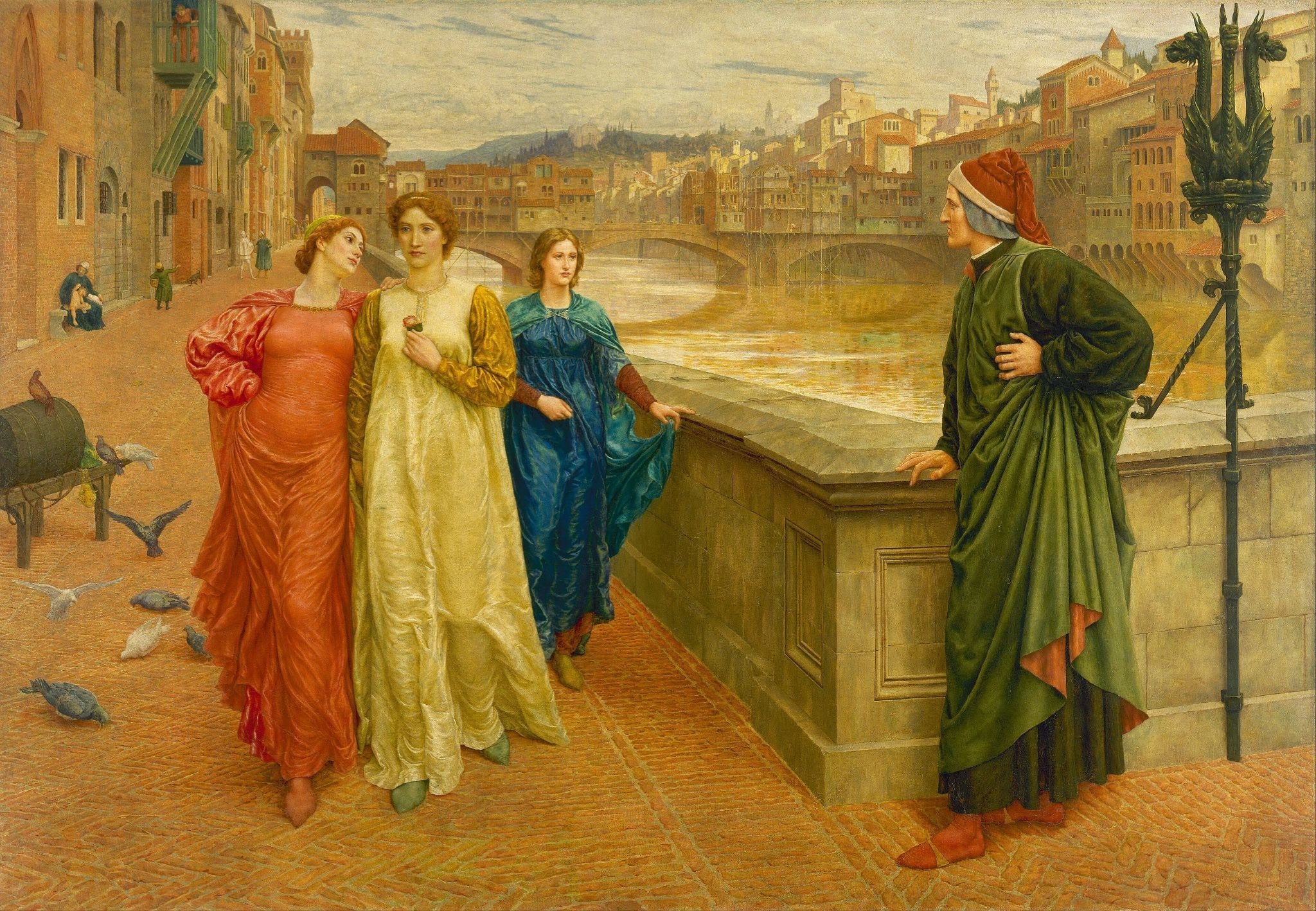
After escaping the Inferno, Virgil and Dante continue their Platonic ascent up the nine levels of Mount Purgatory, where the unrequited love of Dante’s real life, Beatrice, takes over as his tour guide. Beatrice and Dante then ascend through the nine concentric celestial spheres of Paradise together. Each of these is themed by a particular planet, the sun, the moon, or the stars. The Divine Comedy directly reflects the Medieval geocentric model of the solar system, with Earth at the center, which was ultimately displaced by the modern heliocentric solar system model, with which we are familiar.
Dante’s geometry implied that only by going through the Inferno could he hope to climb Mount Purgatory, and eventually ascend into the celestial spheres of Paradise. The format of The Divine Comedy insists that the journey itself is every bit as important as the final destination. Through Dante’s enunciation, Plato’s ancient notion of a Mythic Ascent found its definitive form during the late Middle Ages. His epic poem has become the quintessential Medieval version of Plato’s ascent out of a cave and into divine light.
Conclusion
Virgil bound Greek and Roman mythology together through poetry. Dante created a similar literary bridge between the Roman Empire and Medieval Italy by summoning the ghost of Virgil for The Divine Comedy. This reference to the distant past anticipated the Italian Renaissance, which revived Classical Greco-Roman art and literature to stunning effect. Dante didn’t live to see the Renaissance, but his hometown of Florence became its epicenter about a century after he died in 1321. His epitaph reads, “Here I am shut in, Dante, exiled from my native shores, whom Florence bore, a mother of little love.”
Since you’ve made it this far, brave reader, kindly consider hitting the ❤️ button above or below; it really helps!
Further Materials
The Divine Comedy is the strangest and most difficult of all poems. No other, before yielding its treasures, makes such imperious demands. Its language is the most compact and concise this side of Horace and Tacitus; it gathers into a word or phrase contents and subtleties requiring a rich background and an alert intelligence for full apprehension; even the wearisome theological, psychological, astronomical disquisitions have here a pithy precision that only a Scholastic philosopher could rival or enjoy. Dante lived so intensely in his time that his poem almost breaks under the weight of contemporary allusions unintelligible today without a litter of notes obstructing the movement of the tale.
He loved to teach, and tried to pour into one poem nearly all that he had ever learned, with the result that the living verse lies abed with dead absurdities. He weakens the charm of Beatrice by making her the voice of his political loves and hates. He stops his story to denounce a hundred cities or groups or individuals, and at times his epic founders in a sea of vituperation...He promises to remove the ice for a moment from the eyes of Alberigo if the latter will tell his name and story; Alberigo does, and asks fulfillment-”reach hither now thy hand, open my eyes!”-but, says Dante, “I opened them not for him; to be rude to him was courtesy.” If a man so bitter could win a conducted tour through paradise we shall all be saved.
His poem is none the less the greatest of medieval Christian books, and one of the greatest of all time. The slow accumulation of its intensity through a hundred cantos is an experience that no thorough reader will ever forget. It is...the sincerest of poems; there is no pretense in it, no hypocrisy or false modesty, no sycophancy or cowardice; the most powerful men of the age, even a pope who claimed all power, are attacked with a force and fervor unparalleled in poetry. Above all there is here a flight and sustainment of imagination challenging Shakespeare’s supremacy: vivid pictures of things never seen by gods or men; descriptions of nature that only an observant and sensitive spirit could achieve; and little narratives...that press great tragedies into narrow space with yet no vital matter missed. There is no humor in this man, but love was there till misfortune turned it into theology.
What Dante achieves at last is sublimity. We cannot find in his epic the Mississippi of life and action that is the Iliad, nor the gentle drowsy stream of Virgil’s verse, nor the universal understanding and forgiveness of Shakespeare; but here is grandeur, and a tortured, half-barbaric force that foreshadows Michelangelo. And because Dante loved order as well as liberty, and bound his passion and vision into form, he achieved a poem of such sculptured power that no man since has equaled it. Through the centuries that followed him Italy revered him as the liberator of her golden speech; Petrarch and Boccaccio and a hundred others were inspired by his battle and his art; and all Europe rang with the story of the proud exile who had gone to hell, and had returned, and had never smiled again.
Will & Ariel Durant, The Age of Faith, 1950, page 1082

I read the INFERNO in university—I often wonder about the curriculum that had us read THE COMMUNIST MANIFESTO, CITY OF GOD, THEORY OF THE LEISURE CLASS, WEALTH OF NATIONS, and this, THE INFERNO. I liked the poem very much, especially seeing Lucifer frozen in ice, not burning in fire (but I liked all the reading in our mandatory History of Western Civilization class).
I never read the Aeneid, but I know that it linked the surly Romans to a more noble Trojan ancestry. Another mythical ideology that intrigues me (somewhat) is the Banderite Ukrainian mythos that they are descended from Vikings and are thus Aryan, not Slav. Do they have a poem articulating their Descendancy?