



Key Takeaways
The Codex Was a Powerful Weapon in a War of Ideas that Consumed the Dying Roman Empire
St. Jerome’s Latin Translation of the Bible Unified Western Christianity During the Fall of Rome
Books are Magical Artifacts that Facilitate Telepathy
The Codex Was a Powerful Weapon in a War of Ideas that Consumed the Roman Empire
The invention of the bound book during Roman times facilitated a momentous transition from a polytheistic conception of reality to a monotheistic one.
Before the advent of the bound book, papyrus scrolls were the most common medium for written language. But in the first century AD, some clever individual thought to slice a scroll into convenient pages. The Romans called this new invention a “codex,” and human civilization would never be the same.
The first surviving mention of a codex comes down to us from the Roman poet Martial, writing during the 80s AD. Almost 50 years later, the historian Suetonius suggested in his The Twelve Caesars that the clever person who invented the bound book was none other than Julius Caesar himself.
Initially, the Romans used codices alongside scrolls. But bound books quickly gained popularity because they were far more practical. Scrolls could be extremely lengthy when unraveled, but books permitted readers to instantly jump to any specific passage in a lengthy text.
Because Christians were early adopters of this remarkable innovation in communication technology, the rise of the codex coincides with the rise of Christianity. The power of the bound book spread Christianity to every corner of the Roman Empire with the speed of a raging wildfire.
Anyone who’s ever played a game of telephone knows that verbal transmission garbles any message beyond comprehension after just one or two iterations. But by referencing a common written text, Christians on opposite sides of the vast Roman Empire were able to present a cohesive challenge to imperial power.
According to his own autobiography Confessions, St. Augustine converted to Christianity after hearing a child’s voice repeating “take up and read.” He obeyed the ghostly voice, opened up a book of Paul’s epistles at random, and felt his doubts melt away. By using his finger to mark the spot, Augustine was able to share with others the passage that had converted him.
Though the Bible would not be demarcated into the chapters and verses we are familiar with until the 1500s, Augustine’s story illustrates the advantage that the codex granted early Christians in spreading their new faith.
Christians went from being thrown to lions in the Colosseum to running the Empire as its ruling class. The bound book was a decided advantage that allowed Christianity to overcome fearsome political repression and win a war of ideas. Over the course of just three centuries, all of Western civilization migrated from a polytheistic conception of reality to a monotheistic one.
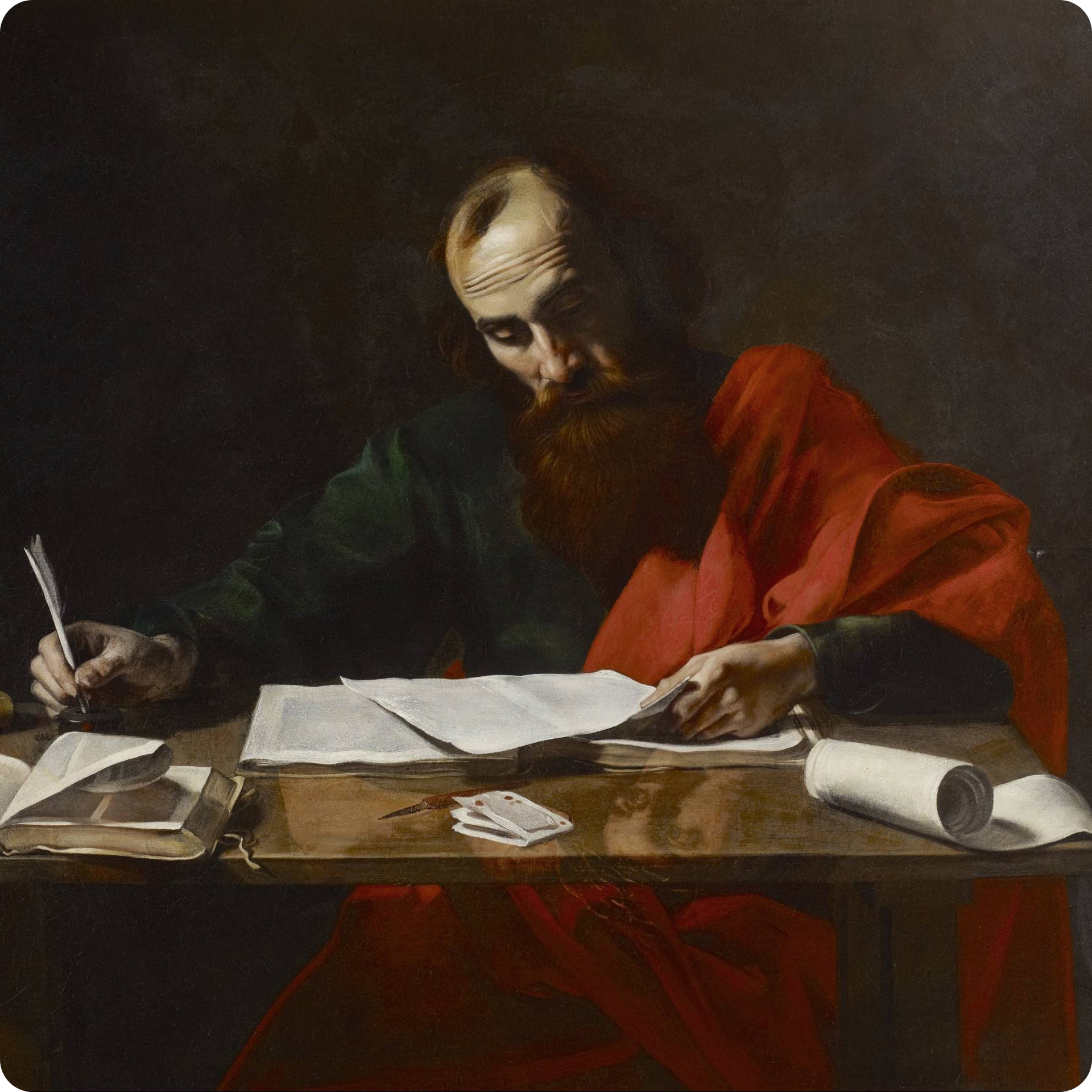
St. Jerome’s Latin Translation of the Bible Unified Western Christianity During the Fall of Rome
Jerome is the anglicized version of the Latin name “Hieronymus.” Saint Jerome was born in 347 AD somewhere on the Dalmatian coast in present-day Croatia. He spent his youth as a student in Rome before he single-handedly altered the course of human history.
Jerome discovered Christianity during the course of his studies. He also found that he was a brilliant linguist. St. Jerome’s colossal contribution to history was using this facility with letters to translate the Bible into Latin.
Rather than the stuffy, old-fashioned version of Latin that was standard among Roman scholars, Jerome instead wielded the vibrant, living version of his day. Because he used the “vulgar” Latin of common people, his inspired translation became known as the Vulgate.
Previous Latin translations of the Bible already existed before Jerome’s work. But these were the products of multiple copyists and varied greatly in quality. The result was a patchwork body of literature that sometimes contradicted itself.
Christianity had already won a war of ideas against the Roman political establishment by the time Jerome began translating the Bible. Nevertheless, his work stands as a remarkable achievement. He packaged Christianity for the Middle Ages that emerged out of Rome’s smoldering ashes.
Jerome’s Bible standardized the vocabulary and grammar that are still baked into the modern Romance languages such as French, Spanish, Italian, and Portuguese that are the modern descendants of Latin. Through loanwords and idioms, his translation also left a lasting mark on the English language.
St. Jerome’s Vulgate was a monumental scholarly achievement that unified the Western Church, influenced a dozen languages, and laid the groundwork for future biblical scholarship. It went on to become the definitive Bible of the Middle Ages, read by everybody from Saint Augustine in the 4th century to Saint Thomas Aquinas in the 13th century.
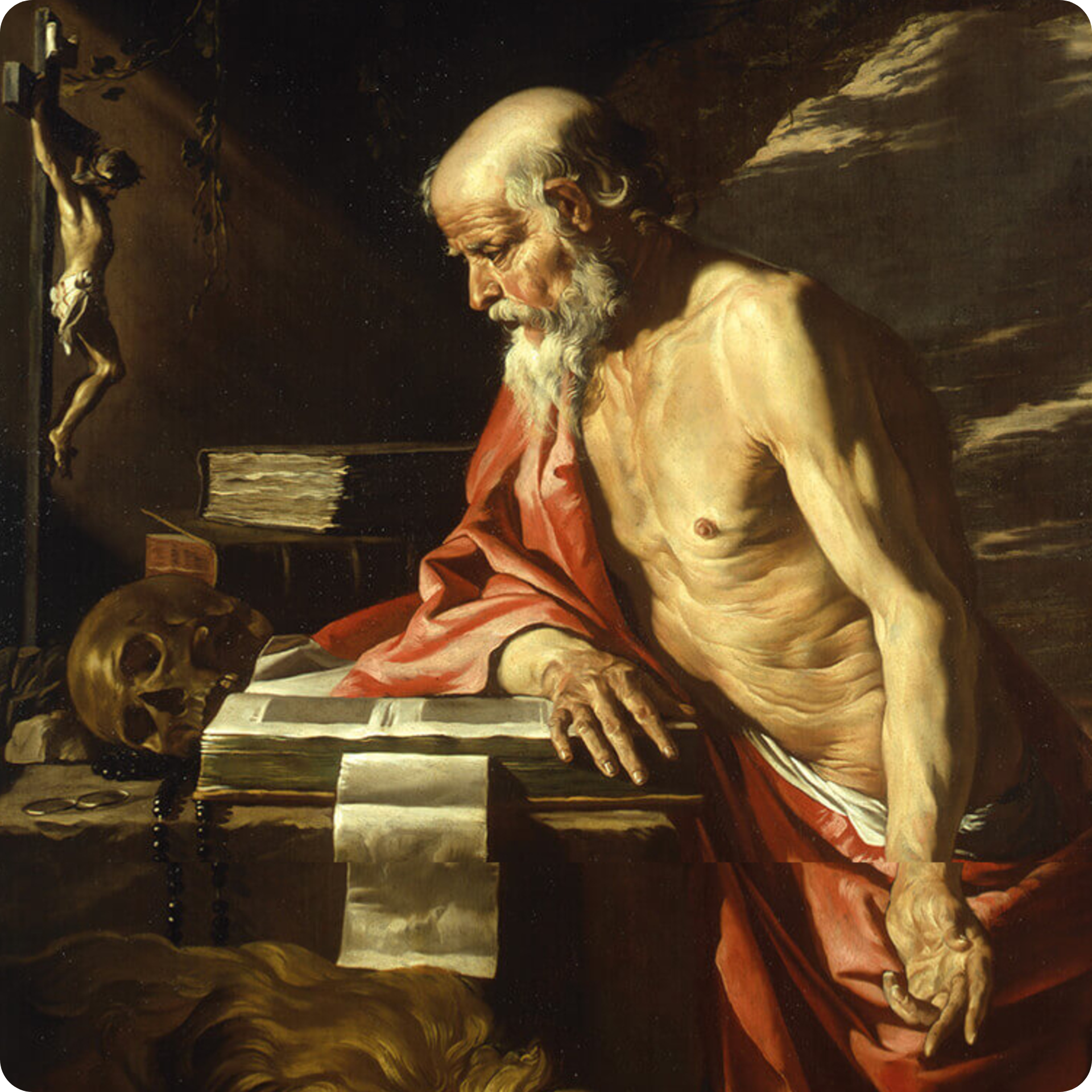
Books are Magical Artifacts that Facilitate Telepathy
Books are nothing short of magical. In modern times, their mass-production has made them so plentiful that we dismiss books as pedestrian and ordinary. It’s easy to forget how profoundly they’ve influenced the grand trajectory of human history.
For most of history, literacy was an arcane art peculiar to priests, scribes, and mystics. Physical books were objects of reverence, fear, and wonder. Modern depictions of witches and wizards still include books as ever-present accessories for these practitioners of magic.
The ancient technology of arranging words and sentences into linear progressions—like boxcars behind a locomotive—is the closest thing to telepathy humans have yet devised. Mark Twain once quipped, “In a good bookroom you feel in some mysterious way that you are absorbing the wisdom contained in all the books through your skin, without even opening them.”
Each of us is trapped within the chamber of our own mind. But words allow us to whisper to each other through the keyholes locking us out of each other’s consciousnesses. And when words are written down, they become time machines capable of reanimating the past.
Marcus Aurelius, for example, wrote Meditations while on a military campaign in Central Europe. His words have the power to instantly transport any reader directly into the mind of the Roman Emperor, as he was commanding the greatest army the world had ever known.
This transmission of language across time and space stitches together our individual consciousnesses into a single vast network, where ideas spread from person to person like a virus. The triumph of Christianity over the pagan authorities of Rome is the classic example of this phenomenon.
Because early Christians organized themselves around a definitive written text, the Christian God outcompeted a Pantheon of old Roman gods in the marketplace of ideas. This momentous transition from polytheism to monotheism is a hallmark of the Fall of Rome. And it could never have happened without the magical power of the book.
It’s no wonder Bibles are still held up before Christian congregations as direct objects of worship. Like the books commonly associated with practitioners of magic, this veneration of the bound book is an acknowledgement of the unique magical capacity of the written world to shape human destiny.
Conclusion
During the Fall of Rome, the bound book democratized the flow of information such that the Roman authorities lost control over the popular narrative. The use of the Bible as a common textual reference spread Christianity to every corner of the Empire, replacing polytheism with monotheism during Rome’s twilight. A thousand years later, the invention of the printing press undermined the authority of the Church in exactly the same way—propelling Europe into the Renaissance and beyond to the Scientific Revolution. Today, we are witnessing the internet democratize ideas all over again. If the historical pattern holds, we’re in for another revolution comparable to the transition from polytheism to monotheism that characterized the Fall of Rome and the shift from monotheism to science that resulted from the Renaissance. Buckle up!
Since you made it this far, sophisticated reader, kindly consider hitting the ❤️ button above or below; it really helps!

Further Materials
It has been suggested that it would have been much easier to locate a particular passage in a Biblical text written in codex form than it would be in a roll, and that this would have been a decided advantage in the cut and thrust of theological debate. Since a codex could be opened at a particular place much more quickly than a roll could be unrolled to find the same passage, this certainly appears to be a strong argument: one thinks of Augustine in the famous ‘Tolle, lege’ episode, when he kept a finger in the codex of the Pauline Epistles to mark the place of the providential passage he had found.
Roberts & Skeet, The Birth of the Codex, 1983, page 50
