


Key Takeaways
Platonism Led Sir Isaac Newton to Revolutionize the Sciences
Music Illustrates the Relationship Between Space & Time
Spacetime Suggests That Mortality is a Trick of Perception
Platonism Led Isaac Newton to Revolutionize the Sciences
According to his contemporary biographer, angels revealed to René Descartes that “the conquest of nature is to be achieved through measure and number.” Shortly thereafter, he single-handedly merged Western philosophy and science with the philosophical concept cogito ergo sum (which means “I think, therefore I am”).
But Descartes’ purely mechanical view of the universe was rejected by Isaac Newton. Newton was heavily influenced by Henry More, his mentor at Cambridge and the most famous of the “Cambridge Platonists.” Under More’s tutelage, Newton arrived at a Neoplatonic view of space and time as absolute aspects of God’s omnipresence.
Early mechanical philosophers argued that physical contact was necessary to move objects. But Newton’s revolutionary theory of gravity acting at a distance was inspired by Neoplatonic, Hermetic, and alchemical schools of thought. These traditions affirmed the existence of invisible, non-material forces operating in nature.
In his Allegory of the Cave, the Greek philosopher Plato compared our perception of the universe to shadows flickering on a cave wall. A shadow is a 2-dimensional projection cast by a 3-dimensional object. His use of shadows as an allegorical device invokes what we today call “dimensionality”.
Calculus was co-invented independently by Newton and Gottfried Wilhelm Leibniz. It is the mathematics of rates of change. The rate at which measurements along any particular dimension change can be compared to rates-of-change along other dimensions.
Calculus compares the rates-of-change over dimensions like space and time that describe real-world relationships. Distance over time (speed) might be measured with a simple rate, like miles per hour. The rate of change in speed over time (acceleration) is a compound rate, measured in miles per hour per second.
Though perceived wholly differently by our brains, calculus reveals that space and time fit together like interlocking Lego bricks. Whether measuring rates of change or of accumulation, that math is indispensable to modern physics. Without calculus, Einstein couldn’t have formalized his field equations, which fuse space and time into the dynamic geometry of spacetime.
And we wouldn’t have calculus if it weren’t for Plato. Like Newton, Leibniz was also obsessed with that Greek philosopher. He famously wrote, “If someone were to reduce Plato to a system, he would render a great service to the human race, and it would be seen that there is in him much more than is commonly thought.”
Music Illustrates the Relationship Between Space & Time
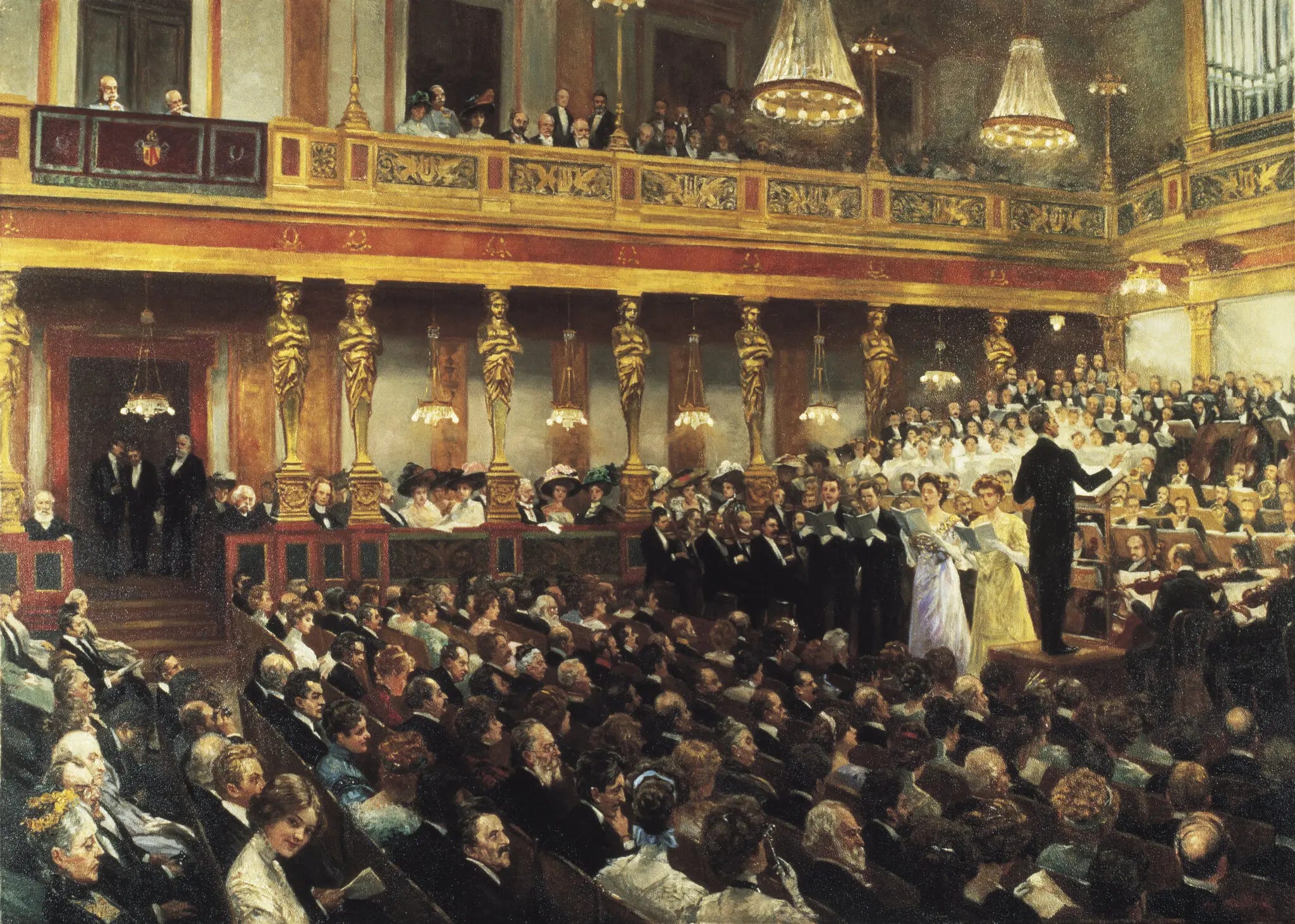
In 1824, Beethoven premiered his final 9th Symphony at the now-demolished Kärntnertor Theater in Vienna. In a cruel twist of fate, Beethoven had been stricken deaf. He was unable to hear the music that defined his life. As the bent figure took the stage for the very last time, a packed house waved their handkerchiefs furiously so that the great composer could see their appreciation—even if he couldn’t hear their applause.
Before the advent of recording equipment, all music was live. For most of the standing-room-only crowd packing the Kärntnertor Theater, it would be the first and only time they would hear Beethoven’s 9th Symphony. It’s easy to see why the spectacle of a hundred different instruments playing in concert used to be such a heady experience. And why riots sometimes broke out, as was the case with the premier of Stravinsky’s The Rite of Spring.
To explore the relationship between time and space, imagine you are sitting in a concert hall listening to Beethoven’s 9th. You’re stuck in the time signature with the rest of the audience, listening to each note in sequence. With no ability to rewind or fast forward time, audience members can hear only the current note being played in each moment. In the middle of the symphony, its very first and last notes are inaudible. But those notes haven’t ceased to exist. Rather, they’re hidden around a corner in time.
But reading Beethoven’s sheet music instead of listening to it frees us from the confines of the time signature. With enough space on the page, your eyes could take in the first and last notes of the symphony at the same time, along with every note in between, rather than having to experience those notes in sequential order.
Sheet music works by swapping out the temporal dimension—which we measure with a stopwatch—for a spatial one, which we measure with a ruler. One second might be represented by one eighth of an inch on the page. Once you see that the symphony can be expressed through both a temporal and a spatial medium, the deep correspondence between these two dimensions becomes clear.
Spacetime Suggests That Mortality is a Trick of Perception
The experience of hearing a symphony versus reading its sheet music offers a powerful metaphor for the philosophical idea that our linear experience of time is a trick of perception. Calculus describes a fundamental relationship between spatial dimensions and time. Our experience of that relationship is key to this perspective.
Evolution has outfitted the human brain with the capability to combine the 3 spatial dimensions of length, width, and height into a 3-D model. But these dimensions intersect at 90° angles, leaving nowhere to cram in a 4th dimension. So we evolved the trick of animating the 3 spatial dimensions along the 4th dimension of time.
We’re stuck in a time signature that we must experience sequentially, powerless to fast-forward or rewind when we listen to a symphony. But a glance at the sheet music confirms that the first and last notes of the symphony do exist in some sense of the word.
Similarly, we cannot fast-forward or rewind our lives. We’re stuck in the time signature along with everyone else. But though they may be hidden around a corner of time, this perspective suggests our youth and our old age still exist…somewhere, just like the first and last notes of a symphony.
When you begin to think in terms of this correspondence between distance and time, you become conscious of your ancestors stretching out behind you into the mists of the distant past. And of your descendants fanning out before you, proceeding into the uncertain future. Like the first and last notes of a symphony, these people, too, have an existence hidden from us by the way we perceive time.
Unlike other animals, humans are uniquely haunted by our mortality. We’re disturbed by the knowledge that we won’t exist after a certain point in time. But the experience of time is merely a trick of the brain. It’s just another way of apprehending another dimension like length, width, or height.
Conclusion
The grand trajectory of the human story has a geometry to it, sculpted in the medium of time. Dimensionality and calculus offer us a glimpse of that shape with our mind’s eye when we imagine the sheet music of the human symphony. We experience our lives as a fleeting melody, mourning the notes that have passed, and fear the silence to come. But calculus winks at us. It hints that reality is a robust multi-dimensional manifold, which the limited human brain interprets as a story with a beginning, middle, and end. The combined efforts of Plato, Newton, Leibniz, and Einstein afford us a peek at the divine sheet music of the human symphony.
Since you made it this far, conscious reader, kindly consider hitting the ❤️ button above or below; it really helps!
Further Materials
With his culminating masterpieces now complete, Beethoven longed for an opportunity to present them to the public. But Rossini had so captivated Austria in 1823, and Viennese audiences were now so enamored of Italian melody, that no local impresario dared risk a fortune on two compositions so difficult as the Missa solemnis and the Choral Symphony. A Berlin producer offered to present them; Beethoven was about to agree, when a combination of music lovers, led by the Lichnowsky family, alarmed at the thought of Vienna’s outstanding composer being forced to go to a rival capital for the premiere of his latest and most prestigious works, agreed to underwrite their production at the Kärntnerthor Theater. After hard bargaining on all sides the concert was given on May 7, 1824, before a crowded house, and with a stoic program: an overture (”The Consecration of the House”), four parts of the Missa solemnis, and the Ninth Symphony with a stentorian German chorus to crown it all. The singers, unable to reach the high notes prescribed, omitted them. The Mass was received solemnly, the symphony with enthusiastic acclaim. Beethoven, who had been standing on the platform with his back to the audience, did not hear the applause, and had to be turned around to see it.
Will & Ariel Durant, The Age of Napoleon, 1975, page 584

For not particular reason, Nathan's last segment reminded me of a Buddhist (or Hindu) painting I once saw. It was the Wheel of Life and depicted birth, growing up, adolescence, adult maturity, work, accomplishment, then old age, sickness and death. All then to begin anew with birth.
Nathan,
Epicycles were brilliant math and the basic fact remains. We are the center of our view of the universe. We still refer to the sun as rising in the east and setting in the west.
As mobile organisms, this sentient interface our body has with its situation functions as a sequence of perceptions, in order to navigate, so our experience of time is this narrative flow, from past to future.
As the basis of thought, it is foundational to knowledge and all of human culture. Much as the earth appears still and the heavens swirl overhead.
The evident fact though, is that activity and the resulting change turns future to past. Tomorrow becomes yesterday, because the earth turns. The physical process of determination turns potential to residual. Mathematical operators are verbs.
There is no dimension of time, because the past is consumed by the present, to inform and drive it. Causality and conservation of energy. Cause becomes effect.
The event of the batter swinging at the ball and the ball flying away cannot co-exist, because it was the same energy manifesting both and it is the transition of that energy, from cause to effect, that creates this flow of time.
So energy is conserved simply because it manifests this presence, creating time, temperature, pressure, sound, vision, as frequencies and amplitudes, rates and degrees.
Ideal gas laws correlate volume with temperature and pressure, similar to how GR correlates distance with duration, but we don't confuse them with space, even though they are as foundational to our emotions and body functions, as sequence is to thought.
The present goes past to future, as the patterns generated go future to past, because energy drives the wave, the fluctuations rise and fall. No tiny strings necessary.
Consciousness also goes past to future, while the perceptions, emotions and thoughts giving it form and structure go future to past. Suggesting consciousness manifests as energy.
As it is our digestive system processing the energy, feeding the flame, while the nervous system sorts the patterns, signals from the noise, there does tend to be this cognitive focus on the patterns, as these structured forms are what our mind rap around, yet take into account this relationship between energy and information.
In the higher ends of the spectrum, enormous amounts of information can be stored with very little energy, given effective mechanisms. Look at computers.
Yet in the lower ends of the spectrum, energy rules and models, systems, doctrines, disciplines, ideologies, etc. rule by being more dynamically powerful than the others. Diplomacy versus war.
So ask yourself, how intertwined is that symphony between frequency/time and amplitude/temperature?