


Key Points:
The Medici of Florence financed a revival of pre-Christian Greco-Roman culture that touched off the Italian Renaissance.
During the Renaissance, the Greco-Roman idea of a transformative journey evolved into the magical conception of Alchemy.
The Medici reflected the idea of the Alchemical Journey with a physical hedge maze, which can still be visited today.
The Medici of Florence
The Italian Renaissance was not a random flowering of artistic talent. It was systematically created by a family of wealthy bankers in the city of Florence, Italy. They used their vast wealth to rescue promising artists from a lifetime of toil in the fields, freeing them up to devote all their time to honing their skills. Renowned Renaissance artists like Michelangelo and Botticelli were bankrolled by the Medici clan.
The Medici couldn’t have known that their patronage would have a momentous impact on the course of human history. They were concerned with reviving the pre-Christian culture of classical Greece and Rome. Then, as now, evidence of Greco-Roman grandeur could be seen in the old ruins half-buried in the Italian countryside.
In addition to financing great artwork, the Medici also sought lost Greco-Roman literature. The last emperors of Rome had been Christians who bolstered waning political power by destroying intellectual competition to the Roman Catholic Church. Whether intentionally destroyed or lost in the chaos, most pagan literature was lost to the West during the Fall of Rome, including the works of the Greek philosopher Plato.
But by the 15th century, the intellectual monopoly enjoyed by the Roman Catholic Church for a millennium was beginning to crack. While agents of the Medici scoured the Mediterranean basin for lost scraps of Greek literature, the artists they patronized surpassed the quality and workmanship of the masters of Antiquity.
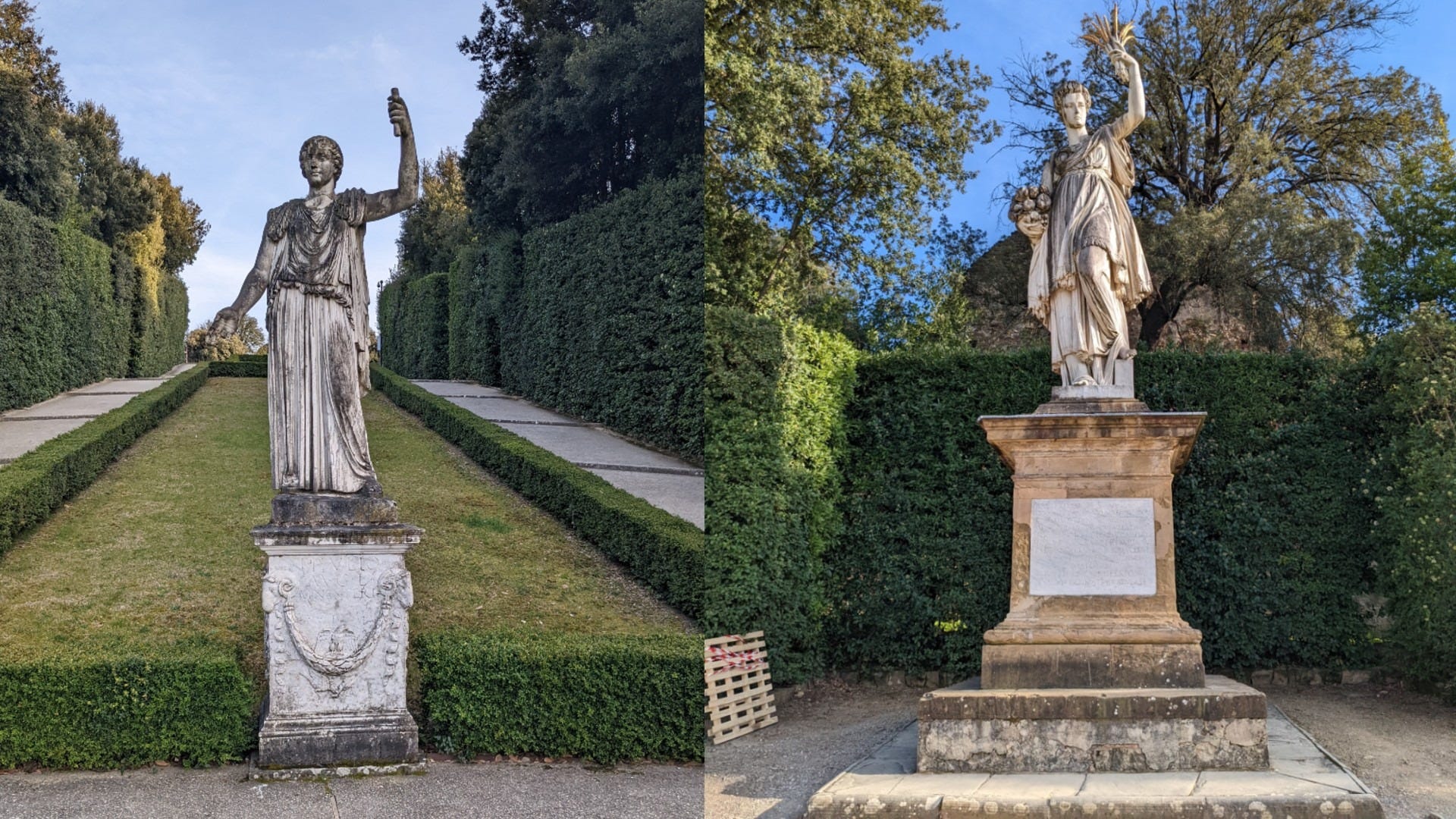
The Medici obsession with classical Greece and Rome was a major catalyst that caused the Italian Renaissance to blossom. That’s why, when the Medici designed a hedge maze for their Boboli Gardens, they chose authentic Roman statues of the grain goddess Demeter to mark both the start and the finish.
Alchemy
Magic is the notion that we are not mere observers of reality, but also creators of it. When we sleep, our brains simultaneously create and experience environments that seem every bit as real to us as our waking lives do. The magical view is that real life is like a dreamscape, where the act of observation is also an act of creation.
Some of the oldest suspicions about reality come from the ancient Greek Mystery Schools, where psychedelic drugs were once consumed. The most famous of these Mystery Schools was Eleusis, where, for a thousand years, the grain goddess Demeter was worshipped by initiates drinking a mysterious beer-like substance.
Recent archaeobotanical evidence suggests that psychoactive ergot was in the beer used in the rites of Demeter. Psychedelic substances perturb reality, like a stone dropped into a still pond perturbs the reflection on its surface. That’s why initiates into these Mystery Schools often came away with the impression that reality is a mutable product of the mind. They called this insight “being saved.”
Among the saved was the Greek philosopher Plato, who was an initiate into multiple Mystery Schools. It’s no coincidence that he wrote about reality as if it were an illusion, likening it to shadows on the wall of his famous allegorical cave. Plato’s pairing of an imperfect, observable universe with a perfect, hidden realm became immensely popular in the centuries after his death. During the late Roman Empire, his dualism informed the Christian conception of heaven.
The idea of an archetypal voyage is woven deeply into Greco-Roman culture. The epic poem The Odyssey is a story about an epic journey. The myth of the motherly grain goddess Demeter is about her descent into the underworld to rescue her kidnapped daughter. And in the twilight of the Roman Empire, the idea of an epic ascent between Platonic realms spawned a smorgasbord of competing dualistic philosophies.
From among this Platonic bouquet, the last emperors of Rome plucked Christianity as the state religion of their dying Empire. Rival Platonisms like Gnosticism and Hermeticism became heresies, and their literature was lost or destroyed in the violent crackdowns of the 4th century AD.
The Corpus Hermeticum is the literature associated with the Hermetic movement of that era. Much like the Christian Bible, the Hermeticum is a compilation of books. It contains quotes like the following:
If then you do not make yourself equal to God, you cannot apprehend God; for like is known by like. Leap clear of all that is corporeal, and make yourself grown to a like expanse with that greatness which is beyond all measure; rise above all time and become eternal; then you will apprehend God.
Though its language evokes the Greco-Roman archetype of a transformative journey, Hermeticism was wholly unpalatable to the Roman authorities. During Rome’s twilight, the Roman Catholic Church established a spiritual monopoly on access to the divine that endured throughout the Middle Ages. But the Hermetic injunction to become god-like posed a direct threat to that monopoly, whereas the Church preferred to keep its flock in a state of spiritual dependence.
But as the power and influence of the Roman Catholic Church began to wane a thousand years later, the works of Plato were reintroduced to European society by the Medici family’s Greek translator, Marsilio Ficino. And when Medici agents discovered a crumbling copy of the Corpus Hermeticum, the old patriarch of the Medici clan ordered Ficino to halt his translation of Plato. In the last years of his life, Cosimo de’ Medici wanted a crack at those curious old heresies before he died.
After his death, Cosimo’s descendants went on to develop an obsession with Alchemy, the magical art that sprang up around the Corpus Hermeticum during the Renaissance. Alchemy suggested that the mythic ascent could be achieved through technical improvement, in addition to the moral improvement emphasized by its Platonic cousin, Christianity. This concept became the Magnum Opus, or the “Great Work” of the alchemist, and it is reflected in the great artwork of the Italian Renaissance.
Palazzo Pitti
The Medici kept cabinets full of strange alchemical artifacts, like hairballs and narwhal tusks. They ground up gemstones and drank the powder for magical health benefits. And they designed a vast hedge maze as a physical homage to the Greco-Roman notion of a transformative voyage, or “alchemical journey.”
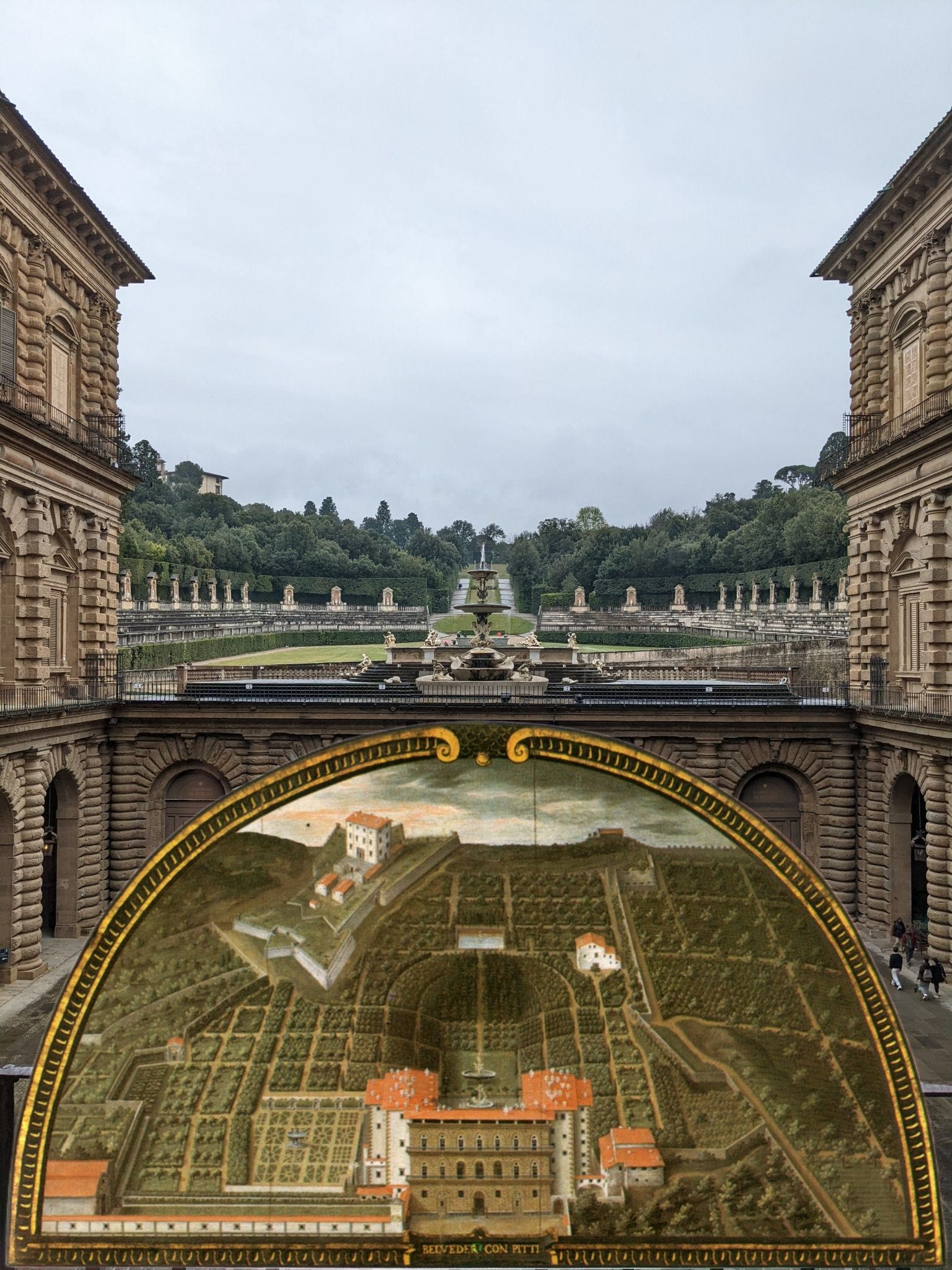
The Medici hedge maze is located behind Palazzo Pitti, one of Florence’s most imposing addresses. The palazzo served as the grand ducal palace of Cosimo’s descendants. Visitors to Florence can still enter through its towering facade, make their way through the courtyard (where the very first opera was staged in the year 1600), and finally emerge into the Boboli Gardens where the hedge maze is located.
Though the power of the Roman Catholic Church had declined considerably by the time the later Medici constructed the maze, magical arts like alchemy remained dangerous heresies, especially during the dark days of the Inquisition.
Legend has it that the Medici used this hedge maze to test the fluency of visitors to Palazzo Pitti in the heretical ideas of Alchemy. A certain level of facility with magical arts was needed to understand the geometry of the hedge maze’s layout. But most visitors to Palazzo Pitti still admire its lush gardens without ever understanding their titanic historical significance.
Conclusion
The Medici gained their position of prominence within Florentine society by being exceptionally clever. It was they, for example, who popularized the double-entry bookkeeping method that remains the gold standard in accounting to this day. But the hedge maze they built at Palazzo Pitti was their cleverest stroke of all. It’s a subtle celebration of the decline of Church power and the introduction of refreshing new intellectual currents into European society that had lain dormant since the Fall of Rome. The Boboli Gardens are commemorative not only of the broader Italian Renaissance, but also of the forgotten role of magic in the Scientific Revolution that later displaced Church authority and drove the Industrial Revolution.
Since you’ve made it this far, bold reader, kindly consider hitting the ❤️ button above or below; it really helps!
Further Materials
It was under the Medici, or in their day, that the humanists captivated the mind of Italy, turned it from religion to philosophy, from heaven to earth, and revealed to an astonished generation the riches of pagan thought and art.
Will & Ariel Durant, The Renaissance, 1953, page 77

Nice essay, Nathan. Much to know, and I appreciate your scholarship. Clearly, too much of Roman Catholic religion is in truth anti-religion.
I understand that Islam preserved much of Classical literature, and Renaissance scholars were able to access it in the Caliphate of the time.
Also, Muslim science was astounding in its time as we know from 'algebra' and 'algorithm' and 'alcohol', all Arabic words that passed into European languages along with their practices.