The words of children held mystical significance to the ancient Egyptians; their sun god Horus the Child (Har-pa-khered) points to his own mouth. The Greeks later adopted Harpocrates as their God of Silence, and that gesture came to mean “hush”. Aphrodite created roses as a gift to this god, persuading him to keep her many amorous indiscretions a secret. The Romans hung roses in banquet halls to remind revelers that utterances made “under the rose” (Latin: sub rosa) were strictly confidential. In the Middle Ages, roses were carved into the ceilings of council chambers, government meeting rooms, and Christian confessionals for the same reason. And now the SUBROSA CLUB is an exclusive space for paid System Failure subscribers…

Mystery Schools
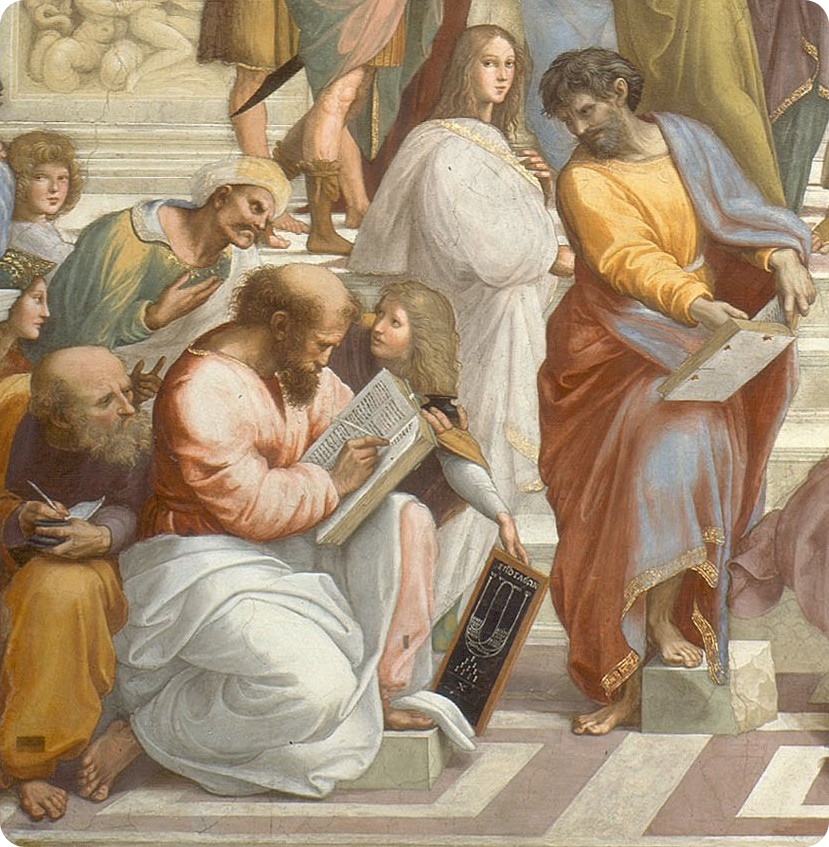
The notorious Pythagorean Theorem every child learns about in school wasn’t actually invented by Pythagoras. That Greek philosopher spent most of his life traveling, and would have been exposed to the concept at far-flung ports-of-call in Egypt, India, and Babylon.
The Babylonian tablet Plimpton 322 is located at Columbia University and dates back 3,800 years. It lists 15 rows of Pythagorean triples, proving that the Babylonians understood his theorem a thousand years before Pythagoras was born on the Greek Isle of Samos around 570 BC.
After traveling for some 30 years, Pythagoras finally settled down in the Greek colonies that were thriving in Italy during his time. There, he set up a school and began imparting to eager students the wisdom he’d picked up on his extensive travels.
The mathematics for which Pythagoras is principally known today was a foundation upon which his mystical ideas rested. These ideas were reserved for his top students, because Pythagoras structured his institution as a “mystery school”.
Mystery schools are hierarchical organizations where secret knowledge is withheld from new initiates until they rise to a certain level in the hierarchy. The Freemasons are a modern case-in-point.
Two centuries after his death, the mystery school run by Pythagoras went to on have a major impact on the most famous Greek philosopher, Plato. Modern music theory is also derived from Pythagoras’ teachings. But his most famous idea of all—that there is a soul that survives the death of the body—came from the inner sanctum of the Pythagorean mystery school.
For the students in general Pythagoras established rules that almost turned the school into a monastery. The members bound themselves by a vow of loyalty, both to the Master and to one another. Ancient tradition is unanimous that they practiced a communistic sharing of goods while they lived in the Pythagorean community. They were not to eat flesh, or eggs, or beans. Wine was not forbidden, but water was recommended—a dangerous prescription in lower Italy today. Possibly the prohibition of flesh food was a religious taboo bound up with the belief in the transmigration of souls: men must beware of eating their ancestors.
Will & Ariel Durant, The Life of Greece, 1939, page 238