


Key Takeaways:
The Idea of Selling One’s Soul to the Devil Was Based on Real Life
Scientific History is Rife with Angelic Visitations, Fever Dreams and Co-Discoveries
Science Leverages Empiricism but its History Suggests Platonism
The Idea of Selling One’s Soul to the Devil Was Based on Real Life
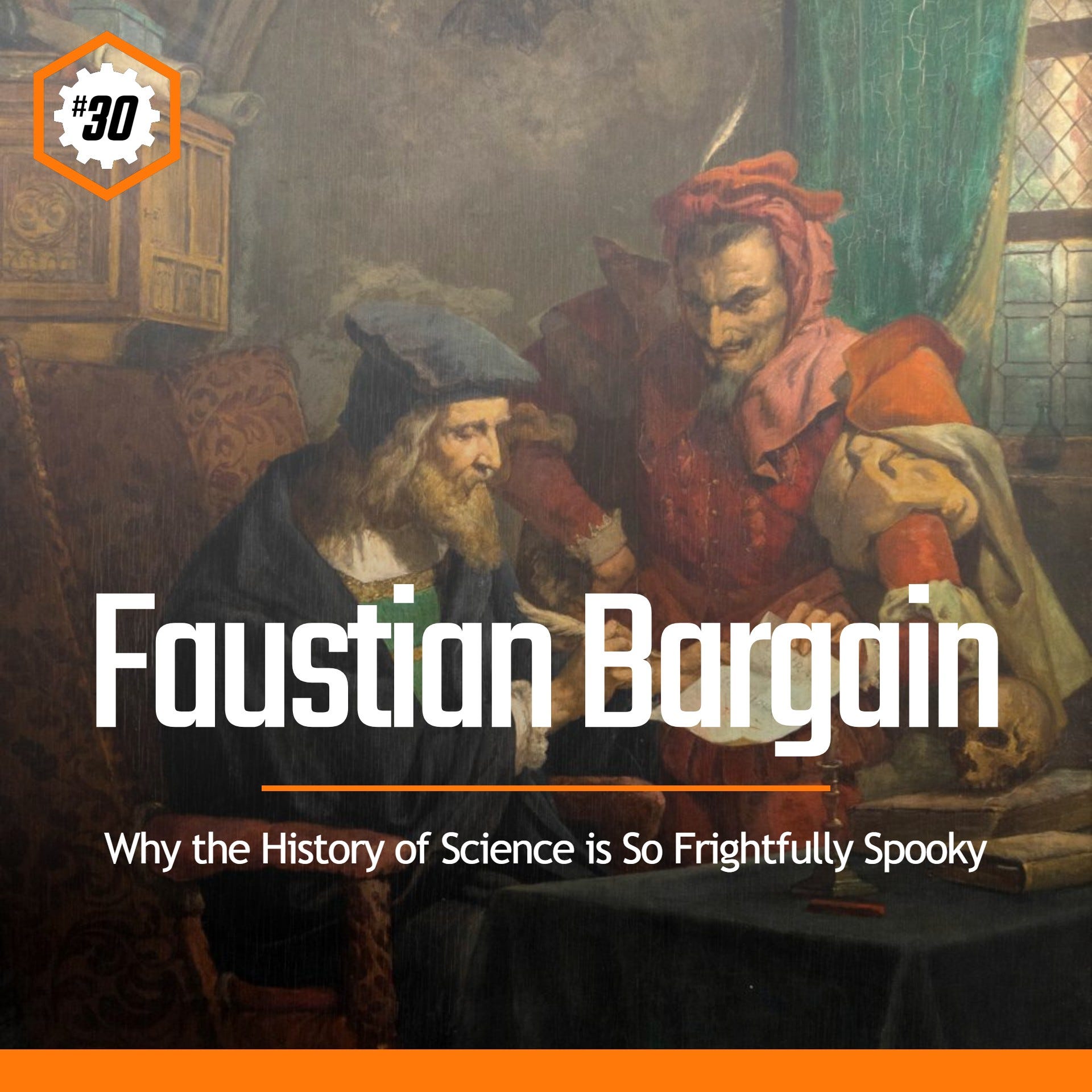
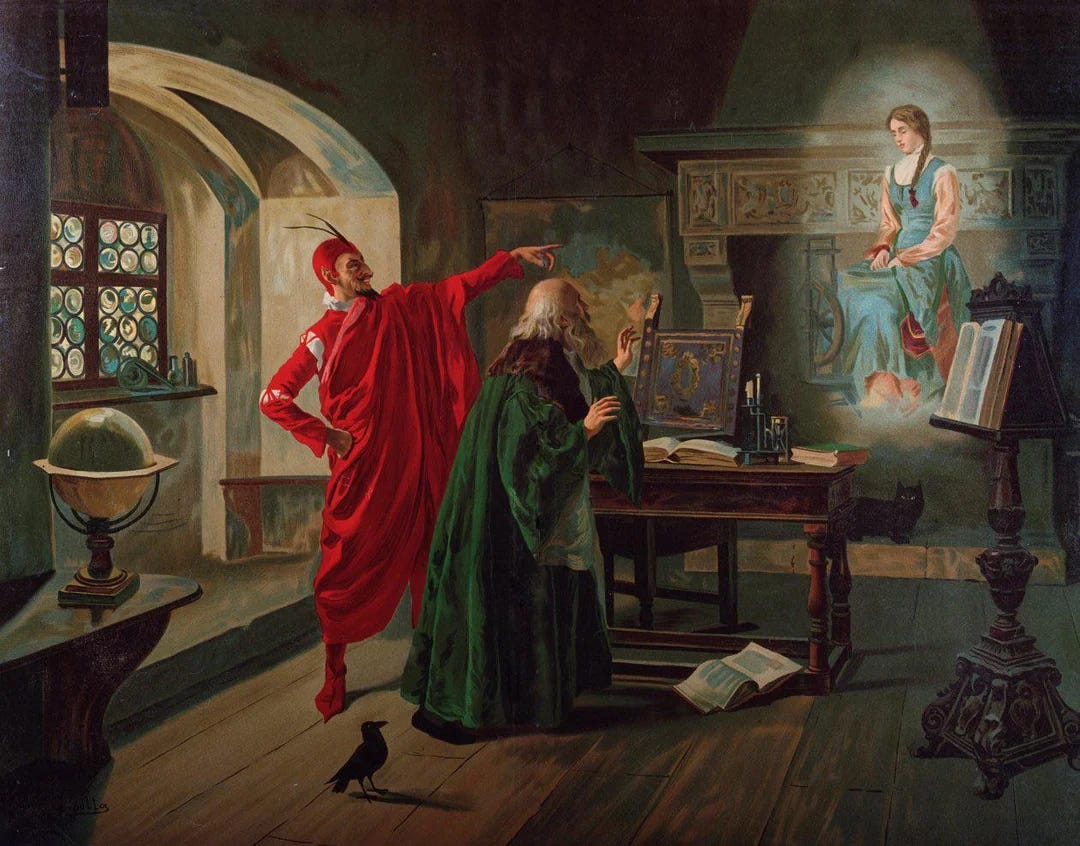
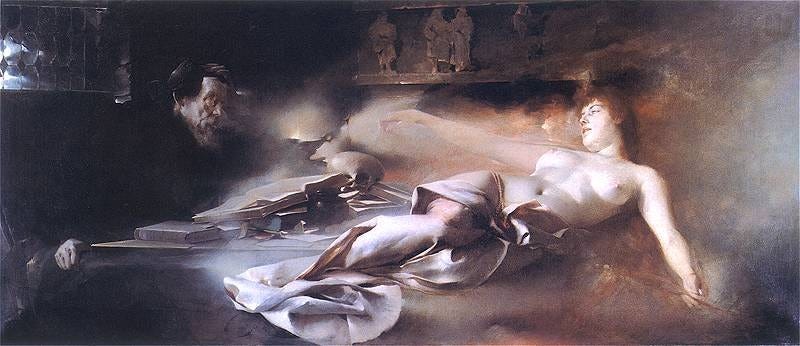
Johann Wolfgang von Goethe was a polymath and history’s most influential German writer. He lived from 1749 to 1832, and his magnum opus was a drama called Faust. The story is about a man who sells his soul to the devil in exchange for magical powers, which he then uses to seduce the lovely Margarete. But like all deals with the devil, Faust’s bargain ends in tragedy for everyone involved.
Goethe was inspired by the legend of a Dr. Faust or Faustus that was ubiquitous during the Enlightenment period. This legend lives on today as our modern trope of the mad scientist.
The infernal tale of Faust was inspired by the real-life figure of Johann Georg Faustus, who was an itinerant alchemist during the 1500s. He traveled from town to town convincing people that he could transmute their base metals into gold. But after he died suddenly in an alchemical experiment gone wrong, rumors circulated that the devil had finally come to collect his soul.
The Enlightenment-era legend of Faust was also burnished by the life of Johann Fust, who was a wealthy goldsmith during the 1400s. This Fust used his wealth to bankroll Johannes Gutenberg’s invention of the printing press, and famously sued him to take control of the apparatus.
The printing press plunged Europe into chaos. Mechanical presses began churning out pamphlets faster than Church authorities could confiscate them. The Church lost its monopoly over the public narrative, and as a direct result the Protestant Reformation engulfed Europe in an orgy of sectarian violence.
The printing press was undeniably a technological marvel. But it wasn’t obvious to the people who lived through the Reformation that unleashing this technology had been a good thing. Liberation from a corrupt Church orthodoxy had come at a terrible price of societal stability. Many who lived and died during that era wondered if the introduction of the printing press had been the work of the devil. These sentiments gave rise to the archetypical story of Faust, who shortsightedly trades near-term power and wealth in exchange for long-term damnation.
Scientific History is Rife with Angelic Visitations, Fever Dreams and Co-Discoveries
The only way to deliver electricity across vast physical distances involves the rapid alternating of voltage and current. Without alternating current, electricity would be lost to resistance as it travels over miles of power lines. After it was pioneered by famed inventor Nikola Tesla, this crucial method of energy delivery transformed society in the 20th century.
Tesla was struck by the epiphany about alternating current during a recitation of Goethe’s Faust, which he memorized in its entirety. This strange incident is typical of the history of science. Time and again, major breakthroughs have arisen from strange visions and angelic visitations. Or they were discovered simultaneously by people who could not have been in contact with each other.
René Descartes invented the Cartesian coordinate system of x and y axes. With his philosophical concept cogito ergo sum (“I think, therefore I am”), he single-handedly merged Western philosophy with science. And according to his contemporary biographer, Descartes owed it all to an angelic visitation where three divine spirits announced to him, “the conquest of nature is to be achieved through number and measure.”
The German chemist August Kekulé revolutionized the manufacture of pharmaceuticals, plastics, and explosives in 1865 when he discovered the ringed shape of the benzene molecule. The modern world would be unrecognizable without his contribution. Kekulé himself claimed that he discovered the structure of benzene during a reverie where he beheld the ancient magical symbol of a snake eating its own tail called the Ouroboros.
In addition to angelic visitations and magical visions, major discoveries in science also occurred simultaneously. Isaac Newton developed calculus independently from Gottfried Wilhelm Leibniz, who unknowingly formalized the same mathematics across the English Channel in Paris.
In 1858, Charles Darwin was astonished to receive a letter from a colleague proposing the same theory of evolution he was currently formulating. Alfred Russel Wallace had come down with malaria in Indonesia. During the sweaty, tortured fever dreams that ensued, the idea of natural-selection-driven evolution came to him all at once.
Later that year, the two scientists published a joint paper together on what was known for years as the “Darwin-Wallace Theory of Natural Selection”. But Wallace couldn’t put his strange experience with malarial fever out of his mind. He developed a keen interest in the occult that embarrassed the bewhiskered and stiffly-cravatted members of the Royal Society. As a result, we hear only about Charles Darwin today.

Science Leverages Empiricism but its History Suggests Platonism
Science presumes that our minds are housed within our bodies, while our bodies navigate a much larger external reality. This way of thinking is called empiricism, and it’s frequently associated with the Greek philosopher Aristotle.
The fundamental idea behind science is that we can empirically measure reality—despite flawed, subjective observations of it—through an emphasis on repeatability. If experimental results can be duplicated by disparate observers, the assumption is that they are measuring something objective.
But Aristotle’s mentor, Plato, had a very different view of reality. He suggested that ideas have an existence all their own. Plato believed that ideas come from a place he dubbed the “Realm of Ideals”, where they wait to shape our illusory physical reality through the lens of human consciousness.
Though science itself is built on an Aristotelian presumption of empiricism, the actual history of science lends much credence to Plato’s alternative view. He supposed that—like a record or CD not currently being played—ideas like calculus or natural selection exist independently of the thinker. Plato might have suggested that these ideas occurred at the same time to different people because their time had come.
The tale of Faust and his infernal contract with the devil is a story about hidden knowledge delivered into our physical reality from an external source. Though science itself embraces Aristotle’s empiricism, its history bears out the Platonic view. All too often, major scientific advances have come not from rigorous hypothesis-testing, but from angelic visitations, magical visions, fever dreams, and co-discoveries too bizarre to be coincidences.
Conclusion
In the Greek myth, Prometheus stole technology from the gods and delivered it to humankind. Similarly, the Faust that haunted the imaginations of the Enlightenment accepts a gift of otherworldly knowledge. Though they run counter to our modern, empirical sensibilities, both myths view technology as something injected into our world from an external realm. These legends mirror the real history of science, where major breakthroughs arrive via fits of madness or from strange coincidences. All this just goes to show that while our modern understanding of reality is an empirical one, the ancient debate between Plato and Aristotle rages on today just as it did in Classical Athens. The case is far from closed!
Since you made it this far, discerning reader, kindly consider hitting the ❤️ button above or below; it really helps!
Further Materials
The rainbow’s arch of colour, bending brightly,
Is clearly marked, and then dissolved in air,
Around it the cool showers, falling lightly.
There the efforts of mankind they mirror.
Reflect on it, you’ll understand precisely:
We live our life amongst refracted colour.
Johann Wolfgang von Goethe, Faust Part II, 1790, Act I, Scene I

I learned of a Buddhist Doctrine from my Zen Master, Kobun Chino Roshi that is much the same as Plato's “Realm of Ideals”. The Sanskrit term (this is a very old concept) is Alaya Vijñana, roughly translated as 'Storehouse Consciousness'. My understanding is that the Alaya Vijñana is the vast interconnected pyschic energy of all sentient beings—I mean all of them, from earthworms to elephants—constantly emerging and changing, always present. Tapping into the Alaya Vijñana yields insights that our collective metal is forming; all that is necessary is the hard work to realize the concepts. Thus, Newton, Leibnitz, and Joe the Butcher all conceived of the calculus, but Joe was too busy to formulate it.
Of course, the material world is only part of collective reality, but as Nathan notes, the evidence of scientific discoveries shows an adumbrated existence.
Keeping in mind we are the thin surface of a biology that has been bubbling up for billions of years and a physics for eternity. Sometimes peering into those depths is a sight to behold.
Our formalisms barely scratch the surface.