


Key Takeaways
Magic & Miracles Demonstrate That We Live in The Matrix
The Jesuits Were The World’s First Intelligence Agency
Faith vs. Science is a False Dichotomy
Magic & Miracles Demonstrate That We Live in The Matrix
The Greek philosopher Plato popularized the notion that we inhabit a false reality, just like the characters in the 1999 film The Matrix. 500 years after his death, that idea became all-the-rage within a collapsing Roman Empire.
As economic conditions deteriorated, a deep despair settled over the declining Roman Empire like a miasmal fog. But Plato’s assertion that the world confronting our senses is only an illusion was very comforting—along with his promise that an invisible realm of perfection lay beyond the chaos and pain of the observable universe.
Neoplatonism, Gnosticism, Hermeticism and Christianity were all brands of Platonic thought. Each emphasized Plato’s invisible realm of perfection in their own way as they competed in the marketplace of ideas. But after Christianity became the official state religion of the Empire, Roman authorities outlawed the other brands of Platonism as heresy.
A thousand years later—during the late Middle Ages—the supreme authority of the Roman Catholic Church began to wane. As Medieval society lapsed into chaos, underground schools of Platonic thought were revived and became the basis of Renaissance magic.
The same fundamental controversy marked the late stages of both the Roman Empire and Middle Ages: are human minds contained within the universe, or is the observable universe contained within the mind?
Both the miracles of Christ and the magic of the Renaissance were supposed to prove the latter, Platonistic view. Lucid dreamers can control their dreams because their minds create the dreamscapes they experience. Magic and miracles were meant to be demonstrations that the universe we observe when we are fully awake is similarly a product of the mind.
The Jesuits Were The World’s First Intelligence Agency
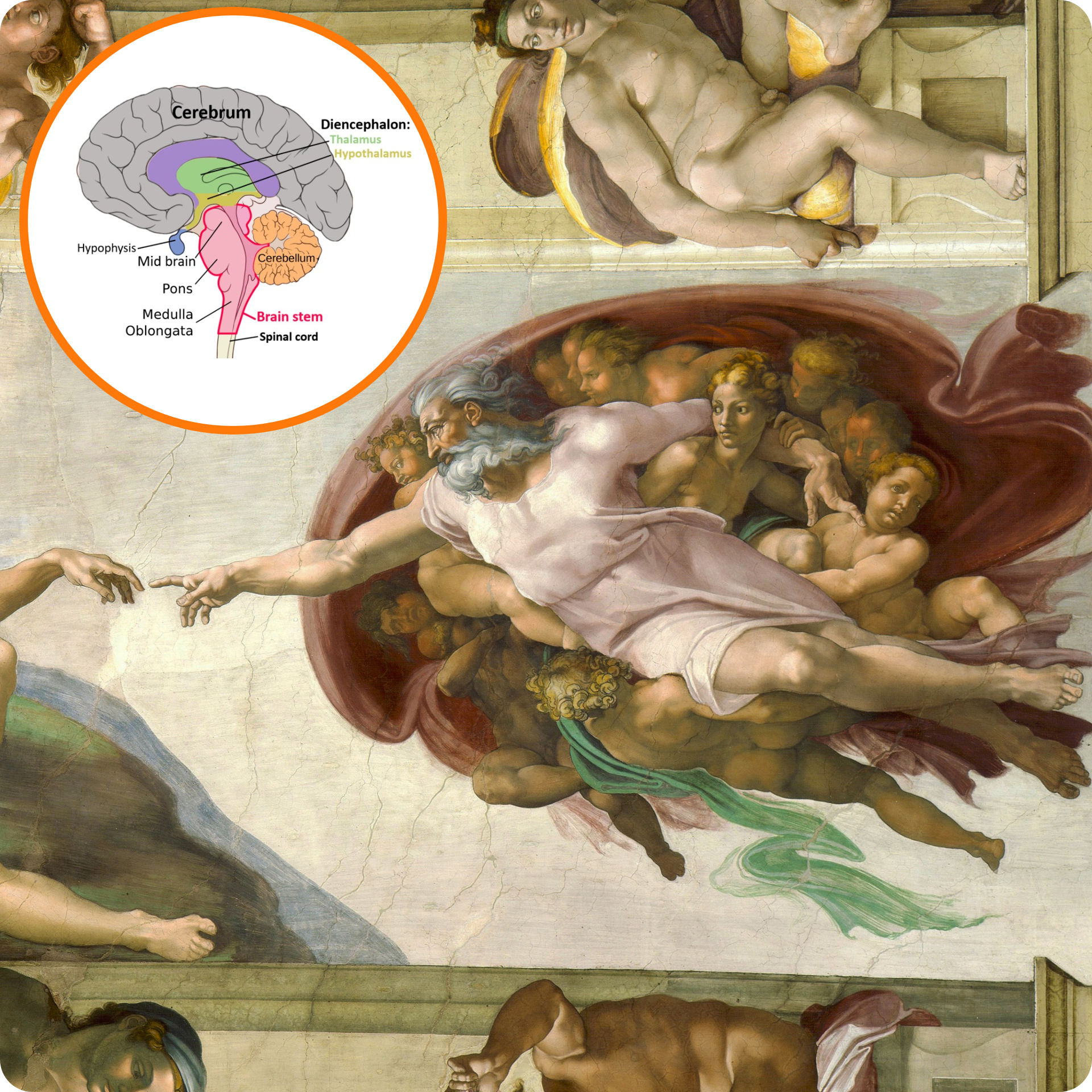
The Renaissance was an intellectual showdown between the long-dead Greek philosophers Plato and Aristotle. Where Plato considered the observable universe to be a mere illusion, his protégé reckoned that sense data is the only true reality.
Christianity got its start among the many competing schools of Platonic thought in the late Roman Empire. During the 4th century, St. Augustine persisted as a devoted Neoplatonist even after his conversion to Christianity. But in the 1200s, the Dominican Friar St. Thomas Aquinas reconciled the Church with Aristotle’s materialist conception of reality.
Two centuries later, Plato re-infiltrated Europe under the guise of Renaissance magic. As the credibility of the Roman Catholic Church withered after the Black Death, some Europeans began to seriously reconsider the Platonic possibility that the observable universe is a product of the human mind. And that it can therefore be manipulated by the human will.
The Spanish and Roman Inquisitions were violent reactions against this heresy. Among the very first groups persecuted by the Spanish Inquisition were the Alumbrados, or “Illumined Ones.” This group of mystics sought divine power through intense mental concentration and altered states of consciousness.
Ignatius Loyola was a Spanish street preacher with a following of female acolytes who were prone to fits and trances. These bizarre public spectacles landed him in front of the Inquisitors on suspicion of being an Alumbrado in 1526, and then again in 1527. He was cleared of charges of heresy both times, but fled Spain after his second acquittal.
In the fall of 1540, Loyola prevailed on Pope Paul III to issue an official papal bull approving the formation of a Society of Jesus. He became the first Superior General of this new Jesuit order, who were referred to as the “shock troops” of the Papacy.
Instead of trying to change minds through violence, the Jesuits printed pamphlets, made arguments, and infiltrated universities to combat the rise of Platonism. They reasserted a materialist view of reality in which humans are limited to observing God’s grand creation, which preserved the Church’s highly lucrative monopoly on communion with God.
The Jesuits were essentially the world’s first global intelligence agency. Figures like Marin Mersenne maintained a vast correspondence network with luminaries in the burgeoning Scientific Revolution like René Descartes. The two attended the Jesuit College of La Flèche together, and Descartes went on to become instrumental in establishing the mechanistic, Aristotelian framework upon which all of modern science is based.
Faith vs. Science is a False Dichotomy
Modern history books make much of a Renaissance conflict between faith and science. The replacement of the geocentric model of the solar system—with earth at its center—with the modern heliocentric model is represented as a momentous transition from religious faith to scientific rationalism.
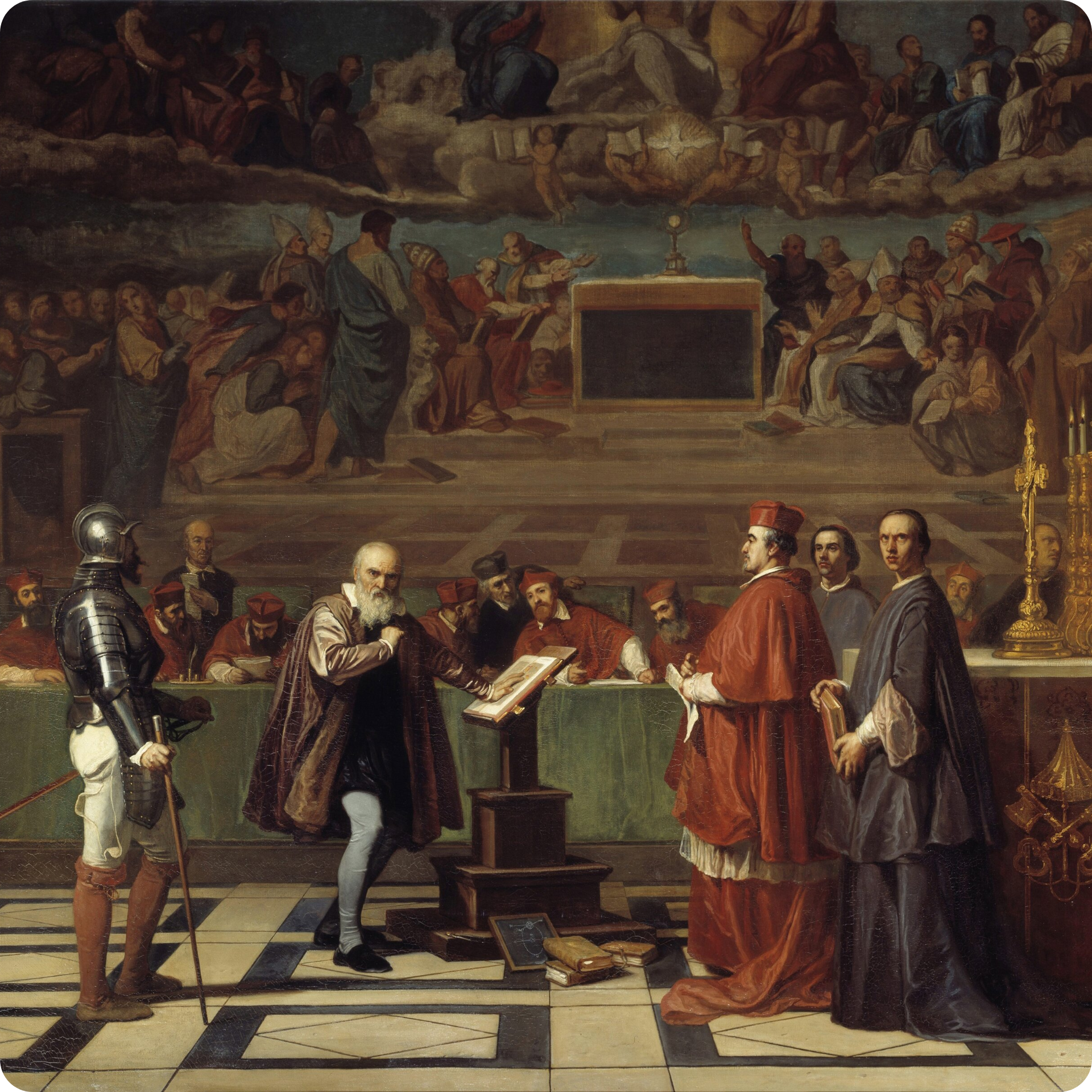
The Trial of Galileo is a famous case-in-point. Those proceedings were never about whether the earth or the sun sat at the center of space; Jesuit astronomers who worked for the Church also had access to the same telescopes and data sets. It was actually about Galileo’s intransigence on the question of which heliocentric model to adopt—and on certain scriptural interpretations—that condemned him to house arrest for the remainder of his days.
Both church and science were actually on the same side of the classic debate between the Plato and Aristotle. The real controversy was whether the human mind is contained within an objective universe, or whether the observable universe is contained within the human mind.
Church and science asserted the former view, while the alchemists and astrologers of the Renaissance opposed them at great peril. The experiments conducted in the bubbling retorts and smoldering alembics of the alchemists were supposed to reveal as much about the nature of the observer as they were about the observable universe.
White lab coats replaced the wizard’s robes of the Renaissance as the authorities installed an Aristotelian, empirical worldview into institutions of higher learning. Alchemy calcified into modern chemistry, astrology morphed into astronomy, and the Platonic insight vanished from popular consideration.
But today, quantum mechanics has reignited incandescent debate about the relationship between the observer and the observable universe. Hard data strongly suggests that there is no objective universe out there without an observer to construct it. Plato is overdue for a comeback.
Conclusion
Platonism is the idea that we live inside a Matrix-like false reality, and this way of thinking has historically exploded in popularity when major economic systems decay and crumble. Plato burst onto the intellectual scene during the calamitous Fall of Rome. And during the late Middle Ages, his ideas enjoyed a revival in the form of Renaissance magic. It’s no coincidence that the film The Matrix was released in 1999 during the late stages of the capitalist economic system that replaced the Medieval one. This historical pattern arises from the fact that authorities in all times and places don’t want their subjects thinking of reality as some sort of illusion. They want us waking up and reporting to work every morning, where we earn them money. If this fascinating historical pattern holds, we should expect a revival of Platonism in modern times as deteriorating economic conditions once again undermine the credibility of the authorities.
Since you made it this far, resilient reader, kindly consider hitting the ❤️ button above or below; it really helps!

Further Materials
Perhaps he felt now that though he was master of his body he was subject to his imaginations. He determined to chasten his mind with education. Though now thirty-three, he joined schoolboys in studying Latin. But the itch to teach is stronger than the will to learn. Soon Ignatius, as he was scholastically called, began to preach to a circle of pious but charming women. Their lovers denounced him as a spoil-sport, and beat him brutally. He moved to Alcalá (1526), and took up philosophy and theology. Here too he taught a little private group, chiefly of poor women, some of them prostitutes hungering for redemption. He tried to exorcise their sinful propensities by spiritual exercises, but some of his pupils fell into fits or trances, and the Inquisition summoned him. He was imprisoned for two months, but he finally convinced the inquisitors of his orthodoxy, and was released; however, he was forbidden to teach. He passed on to Salamanca (1527), and went through a similar sequence of teaching, trial before the Inquisition, imprisonment, acquittal, and prohibition of further teaching. Disappointed with Spain, he set out for Paris, always on foot and in pilgrim garb, but now driving before him a donkey loaded with books.
Will & Ariel Durant, The Reformation, 1957, page 907
But though the Reformation had been saved, it suffered, along with Catholicism, from a skepticism encouraged by the coarseness of religious polemics, the brutality of the war, and the cruelties of belief. During the holocaust thousands of “witches” were put to death. Men began to doubt creeds that preached Christ and practiced wholesale fratricide. They discovered the political and economic motives that hid under religious formulas, and they suspected their rulers of having no real faith but the lust for power—though Ferdinand II had repeatedly risked his power for the sake of his faith. Even in this darkest of modern ages an increasing number of men turned to science and philosophy for answers less incarnadined than those which the faiths had so violently sought to enforce. Galileo was dramatizing the Copernican revolution, Descartes was questioning all tradition and authority, Bruno was crying out to Europe from his agonies at the stake. The Peace of Westphalia ended the reign of theology over the European mind, and left the road obstructed but passable for the tentatives of reason.
Will & Ariel Durant, The Age of Reason Begins, 1961, page 571