


Quick Summary
The Mental Conception of Self is a Phantom
The Individuality of Our Physical Bodies is an Illusion
Mistaken Identification with Ego Drives Human History
The Mental Conception of Self is a Phantom
The Apology is Plato’s account of the speech Socrates gave in his own defense at his trial in 399 BC. Apology comes from the Greek word “apologia”, which means a formal, reasoned defense—not an admission of wrongdoing.
Plato recounts his mentor claiming to have an inner daimon, or oracle, whom he consults on matters of right and wrong. Socrates testified that he was in discourse with his conscience, just like Pinocchio consulting Jiminy Cricket.
Another Disney movie, the Pixar film Inside Out, portrays multiple inner voices personified. In the movie, characters representing a little girl’s competing emotions interact with each other inside her head. The movie works because we all have multiple voices like the one Socrates described riding around inside our mind.
When you ask yourself, “What did I just come into this room to get?”, to whom are you speaking?
Each of our minds is really a cluster of voices. But because we must interact with each other in physical space, we assume a convenient 1:1 ratio between minds and bodies. When we coordinate with others, we throw a tablecloth over these little committees of voices and regard the whole group as a single, discrete individual.
These tablecloths are frameworks that package a variety of subpersonalities into a single identity. It is the ego. Though it’s the most useful of fictions, your ego is entirely a mental construct. The late ethnobotanist Terence McKenna loved to define the ego as a tool we use to know which mouth to feed at the dinner table. It’s the mental reflection of your physical body. You walk around all day behaving as if this reflection is really you, but it’s actually just a phantom. You are no more your ego than you are your reflection in the mirror.
The Individuality of Our Physical Bodies is an Illusion
Beethoven’s symphonies are conventionally experienced in a concert hall as sound. But they can also be visually experienced as sheet music. Because sheet music represents time as a physical dimension, lengthy sequences of notes which take minutes to hear are instantly visible at a glance. Those who read music can identify different symphonies by listening OR by seeing.
This trick of swapping time (measured with a stopwatch) for distance (measured with a ruler) presents a fascinating thought experiment. If you swapped these dimensions in your own life, your body as it exists in each moment—from infancy to old age—would similarly be visible at a glance.
From that bizarre perspective, you’d appear to be bodily connected to both your ancestors and to any descendants you might have. That’s because, at some point in the past, every person on the planet shared a body with their mother. Motherhood is the forking of a single individual into two or more individuals, just as a tree trunk forks into multiple branches.
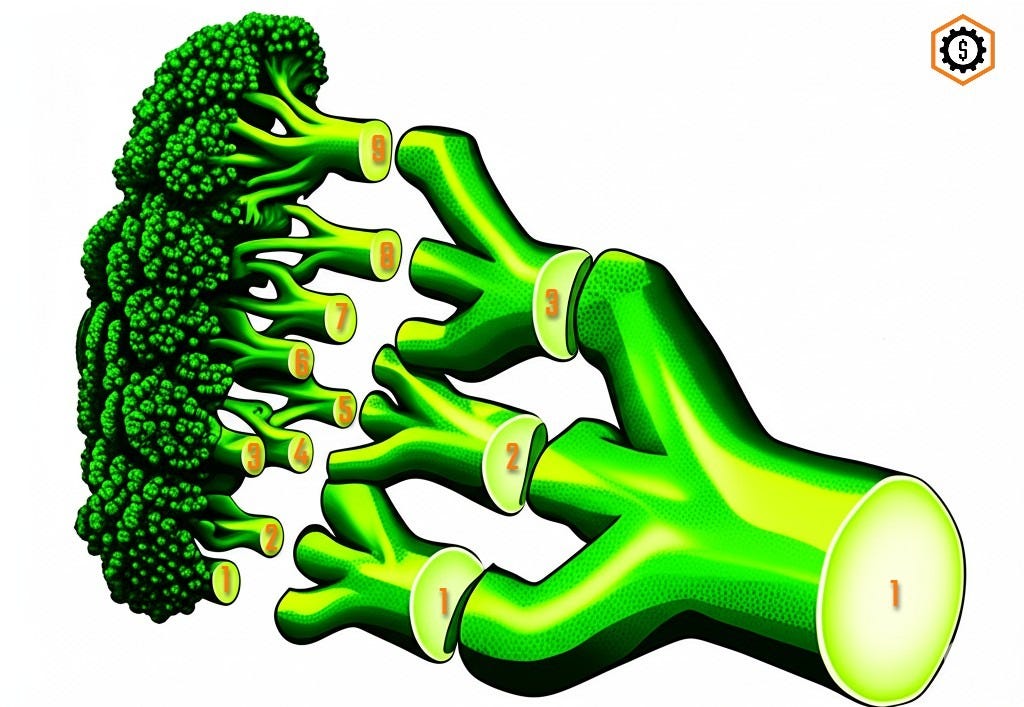
That’s what makes the family tree such a common metaphor. But we’ll take a head of broccoli for an analogy instead, because it’s the same shape but smaller. Stalks propagate along the length of a head of broccoli, just as generations of human families propagate over time. A single stalk divides into several branches, which then divides into still more branches.
Our broccoli metaphor is just like sheet music, where time is swapped out for distance. The length of our broccoli head represents the time signature, and cross-sectional slices along that length represent snapshots in time, like a single musical note.
If you take a cross-section near the florets, you’ll get a cross-section of many small stems. But if you chop the broccoli in the middle, you’ll get a cross-section of a few medium-sized stems. And if you slice it at the stalk, you’ll get a cross-section with only one large central stem.
Within each cross-section, each stem appears to be an individual circle, totally disconnected from other circles. Only in the fullness of 3 dimensions are these individual stems revealed to be part of one continuous whole. So it is with humankind. In the fullness of 4 dimensions, our sense of individuality—or our ego—is revealed to be an illusion.
Mistaken Identification with Ego Drives Human History
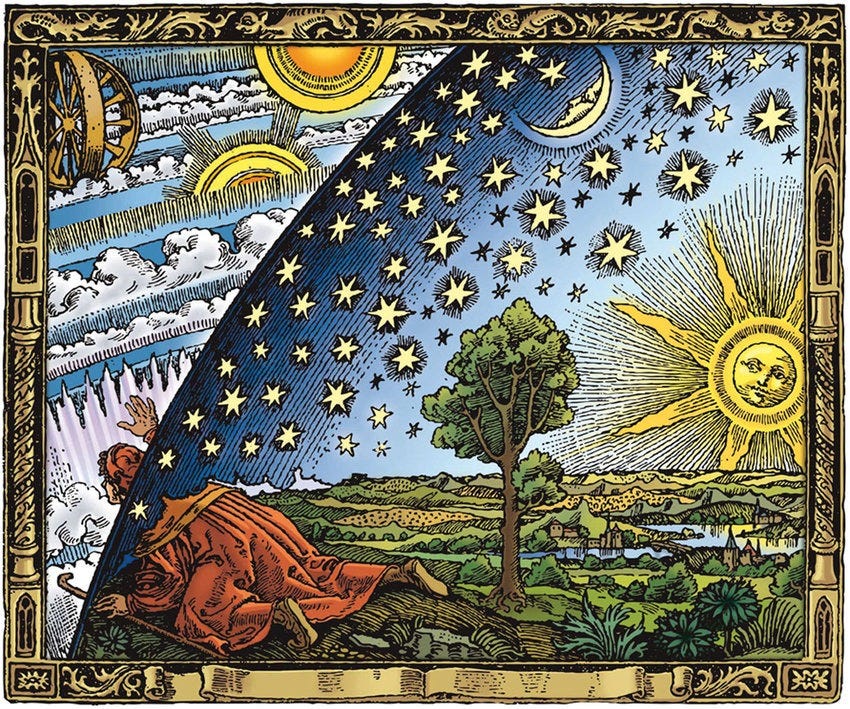
The famed Flammarion Engraving is a woodcut by an unknown artist that dates back at least to 1888. It’s probably much older. The cutting portrays an individual escaping from the narrow confines of spacetime, as if they’re climbing under the apron of a circus tent.
The thought experiment of swapping time for distance allows us to make a parallel escape into the fullness of 4 dimensions. If we imagine reading the sheet music of our lives instead of experiencing the symphony, the past and future would be hidden around a corner in time—like the first and last notes of a symphony appearing on the same page.
If we could take in the entire human story in a single glance, a particular geometry would become clear. Each successive generation sacrifices on behalf of the next. Some parents will always be neglectful, but the human species owes its evolutionary success to a broad strategy of heavy investment in our offspring.
This geometry suggests a particular moral imperative. When we operate “correctly”, parents make sacrifices on behalf of their children. Their children, in turn, do the same for the next generation. In this way, humankind bootstraps itself ever upward and onward into the future.
But what is the opposite of sacrifice? Instead of stocking the cupboard for the future, some of us have been known to steal from it. The ego motivates people to hoard resources for themselves or for an ingroup, forgetting that—in the fullness of 4 dimensions—there’s really only one human family. We make a grave error when we identify as our egos, rather than as the entire human species at large.
Conclusion
The Greek philosopher Plato identified pleonexia, or wealth addiction, as the driver of the great political and economic cycles of civilization. Human history is animated by an eternal tension between what’s good for the species as a whole, and what’s good for the individual ego. Evolution has provided us with the anatomy and the instincts to propagate our species over millions of years. But as a final modification, natural selection also outfitted each of us with an ego. Egos are indispensable tools for coordinating between people. But if they grow too large, a single ego can threaten entire human societies, like a cancerous tumor. Our interconnectedness as a species is hidden by our handicap of perceiving time as a series of snapshots, rather than as a contiguous whole. The result of this blindness is a tendency to wander through life, seeking to glorify our own individual egos instead of the human race as a whole.
Since you made it this far, curious reader, kindly consider hitting the ❤️ button above or below; it really helps!
Further Materials
One might compare the relation of the ego to the id with that between a rider and his horse. The horse provides the locomotor energy, and the rider has the prerogative of determining the goal and of guiding the movements of his powerful mount towards it. But all too often in the relations between the ego and the id we find a picture of the less ideal situation in which the rider is obliged to guide his horse in the direction in which it itself wants to go.
Sigmund Freud, New Introductory Lectures on Psychoanalysis, Lecture 31: The Anatomy of the Mental Personality, 1932

Very nice. I am reminded of a Zen lecturer once who referred to the "monkey mind" as what we call 'ego'.
Nodes and networks.
Humanity is in a bit of a phase transition, that has been ongoing for the last several thousand years, as we have moved beyond the tribal structures from which we originated, onto civilizations, as these cross cultural constructs.
Given we are a locus of this biosphere of planet earth, essentially a finite ecosystem, the eventual process is toward a global organism, possibly with humanity as its nervous system.
Which is evidently still a long way off.
It would seem our current social and cultural constructs and the elites they engender, have become a bit of a scab. Rigid, necrotic and slowly peeling away from the underlying organism.
What will the next stage encompass and how will it continue to grow and learn?
Multipolarity seems to be the direction.
More yin and yang, than God Almighty.
Understanding the coin has two sides and avoiding the polarizations resulting from not being able to comprehend that.