


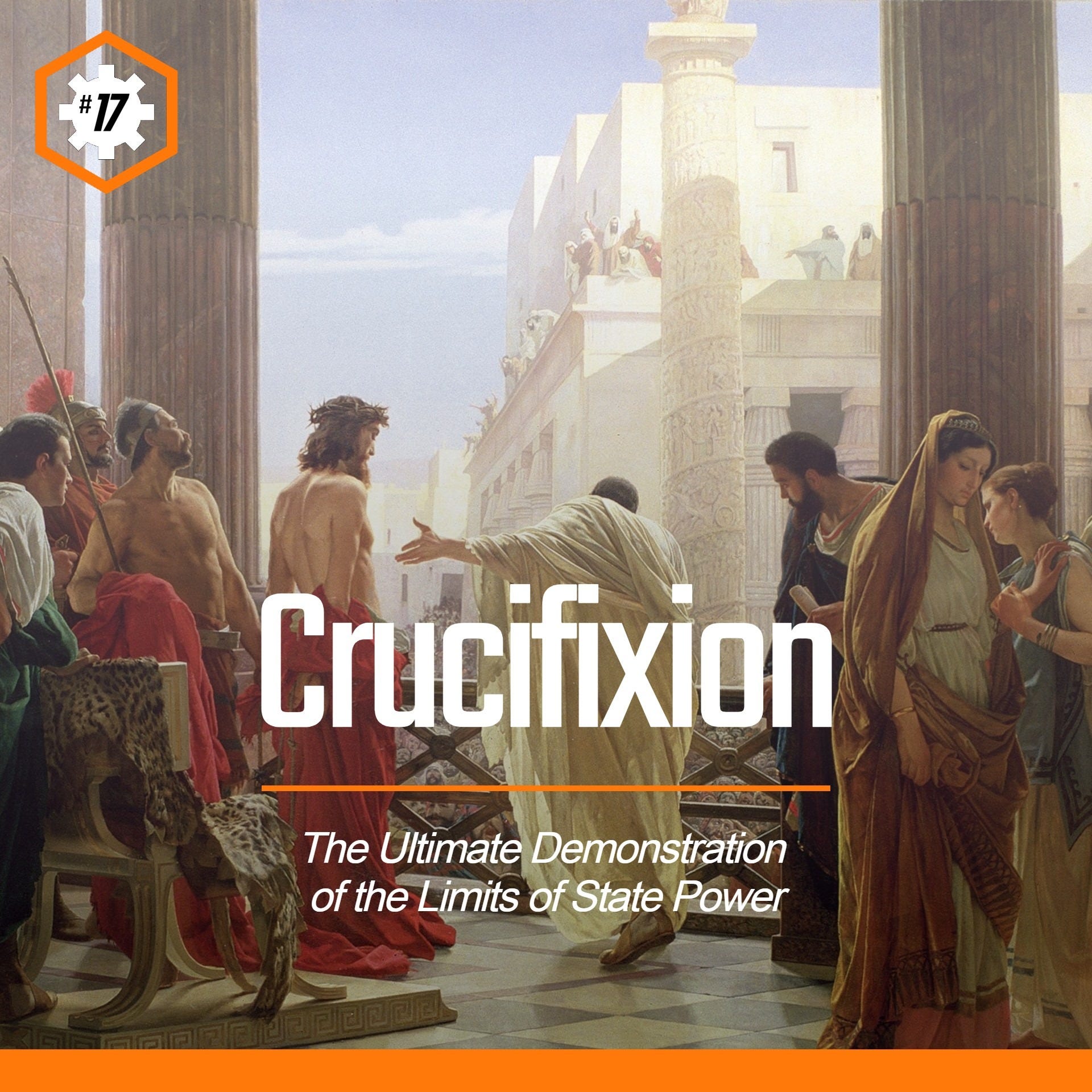
Quick Summary
The career of Julius Caesar illustrates the class war that gave rise to the Roman Empire and to Christianity.
The experience of “ego death”—where self is revealed to be an illusion—was a fixture in pre-Christian religion.
The Crucifixion was a public demonstration of the political power of self-transcendence that changed the course of history.
Julius Caesar
Roman society was history’s first great experiment in not forgiving debts. Across the Ionian Sea in Greece, Solon of Athens inaugurated a golden age for his city with a broad debt cancellation in 594 BC. But when rumors spread that the Roman king was considering a similar policy, Rome’s prominent families drove him out of town before he could cancel debts owed to them.
Thereafter, Rome was governed by a Senate populated by the wealthy. They established a social taboo against kingship so strict that the Latin word rex became an offensive pejorative. Under this guise of democracy, the Roman oligarchy eliminated the king, the only person with the power to protect the financial interests of the poor. So liberated, the Roman elite began amassing an unprecedented hoard of wealth through merciless exploitation.
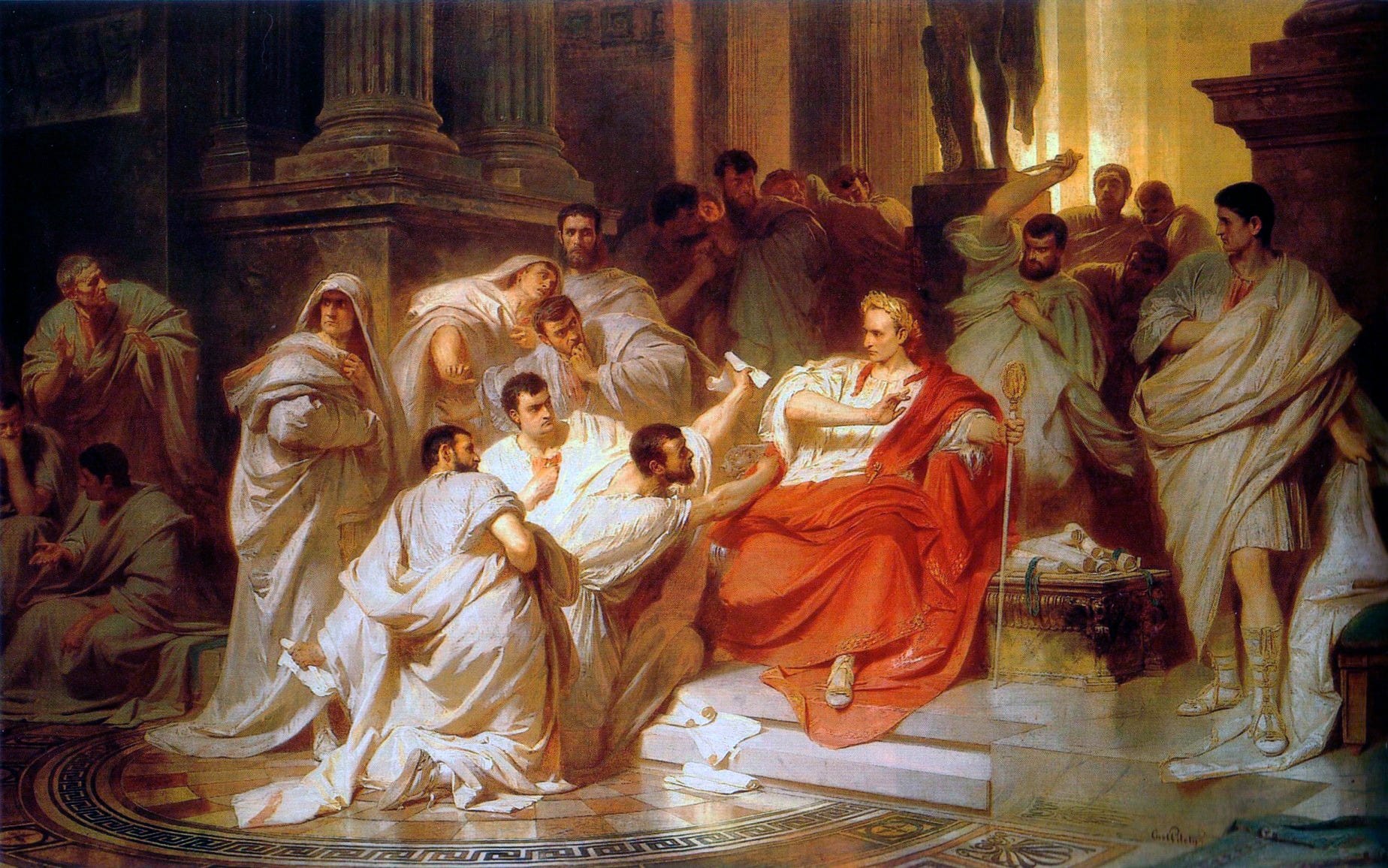
Predictably, the Roman working class responded to their economic exploitation and their political disenfranchisement with increasingly violent uprisings. A devastating civil war culminated in Julius Caesar marching on Rome as a popularis, or a political representative of the working class.
But the Senate conspired against him in one of the most infamous political assassinations of all time. Caesar’s best friend, Brutus, belonged to an ancient Roman family that had been ringleaders in the ouster of the Roman king five centuries before. Familial duty compelled him to betray his best friend. The conspirators claimed to have killed Julius Caesar because he violated the long-standing Roman taboo against kingship. But in reality, Caesar’s plan to stabilize the Roman economy through redistribution threatened to prune the fortunes of the oligarchy, and was therefore intolerable.
Ego Death
This raging class war was the historical stage onto which Christianity strode. It prescribed the debt forgiveness commanded in Jewish scripture as the only way to prevent an impending apocalypse. Forgiveness, preached Christ, is the only hope for salvation.
This rejection of Rome’s cruel economic hierarchy resonated mightily with the exploited Roman working class. In addition to Jewish scripture, the Christian movement also adopted the symbology of the old Greek mystery religions. For a thousand years, Greek initiates had ritualistically consumed hallucinogens from sacred chalices in Mystery Schools. Much as they did in American society during the Vietnam War era, these drugs came to symbolize resistance to Roman authority. That further bolstered the appeal of the new faith to potential converts.
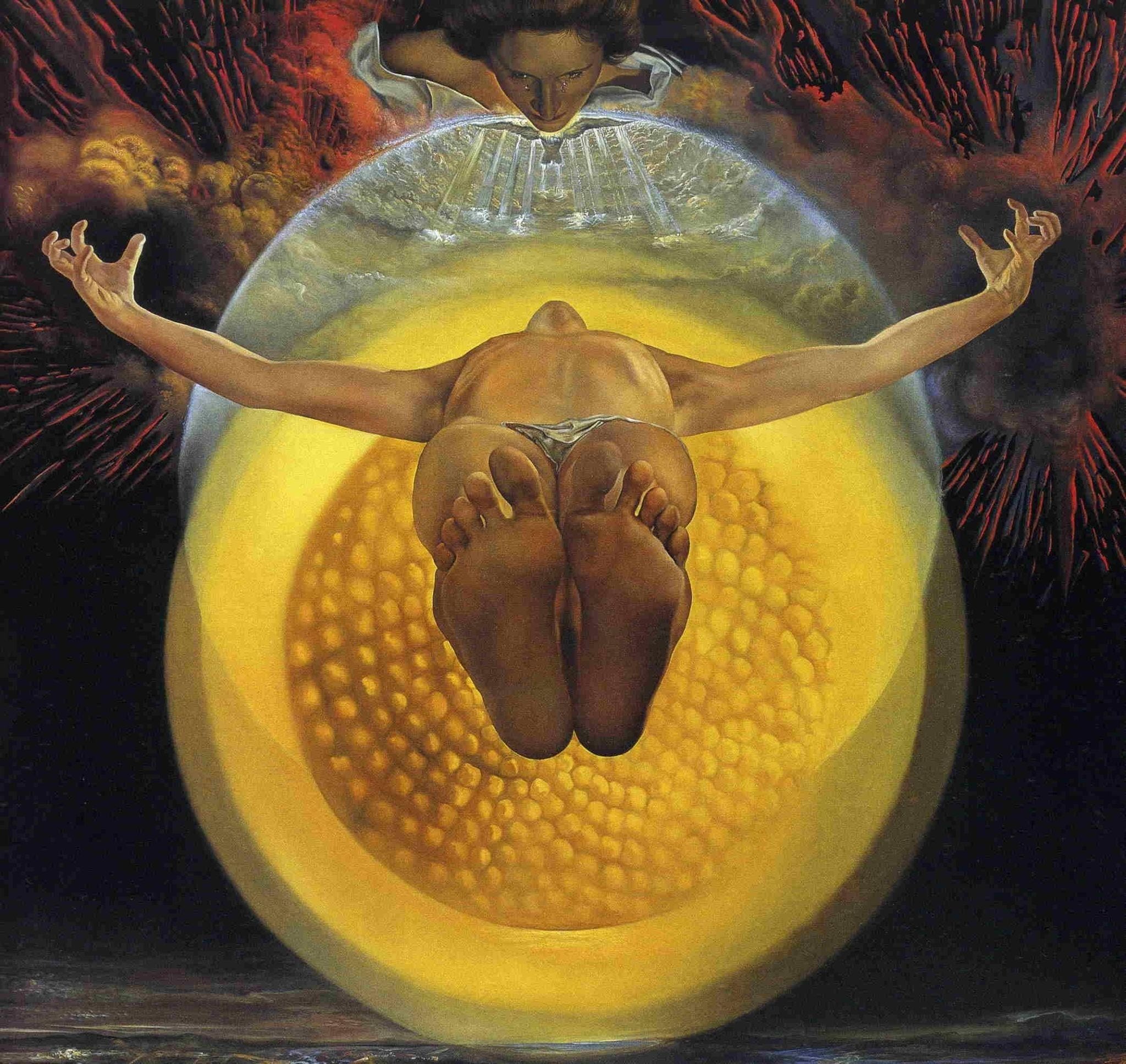
The psychedelic substances used in the Mystery Schools induced a profound experience known as “ego death”, where both the self and the physical world are revealed to be illusions. This insight profoundly influenced Greek culture. Democracy reflects it by canceling out egoic desires with collective decision-making. Greek drama embodies it with actors who adopt and discard multiple identities on stage. Even Plato’s philosophy, which holds that the physical world is illusory, seems to have been influenced by his initiation into several Mystery Schools.
These fruits of Greek civilization were shaped by the mystery religions that spiritually anchored that society. But in the crucible of a dying Roman Empire, Christianity took the concept of ego death to a shocking new extreme.
The Crucifixion
Ego death undermines the ability of political authorities to control their subjects. The ego is the basis of state power. The authorities can throw bodies in prison or torture bodies to death. But when we stop
identifying as our bodies, they have nothing more to threaten us with.
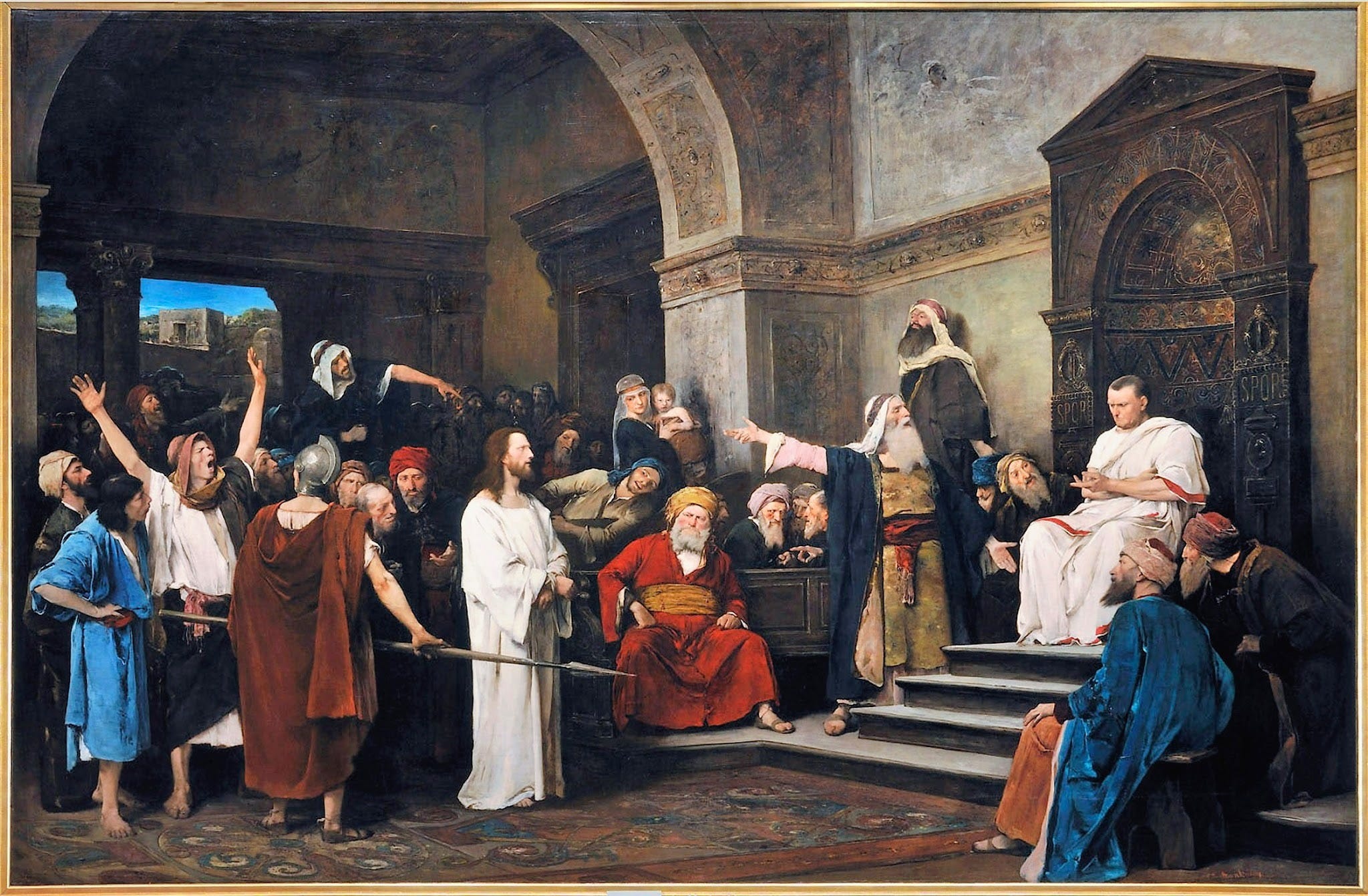
As Christianity spread, the story of the Crucifixion advertised this practical limit on state power to the entire Roman Empire. Jesus’s fierce advocacy for the poor and condemnation of the rich made his sermons so popular that local religious authorities felt threatened. They appealed to their Roman prefect, Pontius Pilate, to destroy the fledgling Christian movement by killing off its leader.
But his execution had the opposite of the intended effect. There exists a vast range of human experience beyond narrow individual identity. Jesus was so confident that he wasn’t just his body that he volunteered it for a gruesome public execution. Word of the equanimity with which Jesus bore his suffering as he died helped early Christianity spread like wildfire.
In the following centuries, Christians followed his lead by enthusiastically volunteering themselves for martyrdom. Though they could destroy the man himself and massacre his followers, the Roman state found that it was powerless to stop the story of Jesus from spreading to every corner of the Empire. Physical punishment is only effective when people are motivated to avoid the torture. When people volunteer for it, that threat of violence is drained of all its political power. The crucifixion was therefore a consummate demonstration of the limits of state power.
“And Pilate wrote a title, and put it on the cross,” says the gospel writer John in Chapter 19, “and the writing was, JESUS OF NAZARETH THE KING OF THE JEWS.” In depictions of the cross, Christian iconography often includes the letters INRI, which abbreviate that phrase in Latin: “Iesus Nazarenus Rex Iudaeorum.”
That sign is a fixture in Christian iconography because it’s pregnant with significance. Like Julius Caesar, Jesus stood accused of violating the Roman taboo of claiming kingship for himself. The untimely deaths of Julius Caesar and Jesus Christ—just a few decades apart—shows how kingship effectively meant advocacy for the poor. The Roman enforcement of a taboo against kingship was actually a taboo against political representation for people other than the wealthy elite.
Conclusion
A war of ideas ran parallel to the class struggle that defined the course of Roman history. The Roman establishment wielded vast political power the likes of which the world had never seen. But early Christians had a weapon of their own: egolessness, as demonstrated by Jesus during the Crucifixion. This weapon canceled out the political power of the oligarchy. Massacring Christians who volunteered themselves for martyrdom only served to increase the notoriety of the new faith. Ultimately, the Roman oligarchy couldn’t beat the Christian movement, so they joined it instead. As the Empire lapsed into decline and began to crumble, the Roman elite converted to Christianity en masse and, in its twilight, made it the state religion of their dying empire.
Since you’ve made it this far, adventurous reader, kindly consider hitting the ❤️ button above or below; it really helps!
Further Reading
Describing Tarquinius’s hostility to the aristocracy, Livy (1.54) interjects a version of the story related by Herodotus (above, Chapter 2, fn41) about Thrasybulus of Miletus advising Periander to cut off the highest stalks of grain with a scythe. In Livy’s version, Tarquinius takes a messenger from his son Sextus to his garden to reply to a message asking what to do about the town of Gabii that was resisting Rome. Tarquinius is reported to have cut down the tallest poppies—a symbolic gesture for cutting down the leading potential rivals in local aristocracies.
Reacting against public spending by the kings, Rome’s oligarchy embraced an anti-government ideology as passionately as do today’s anti-socialists. Much like the Greek oligarchs who accused reformers seeking popular support by cancelling debts and redistributing land of being “tyrants,” Roman patricians accused reformers of “seeking kingship” by proposing debt reform and assignment of public land to settle the poor instead of letting patricians grab it for themselves. Such advocacy led to the most progressive reformers from the leading families being assassinated in political killings over the ensuing five centuries.
In the republican period the very idea of a king was viewed with an almost pathological dislike. ... The tradition is very likely correct when it says that the first acts of the founders of the Republic were to make the people swear never to allow any man to be king in Rome and to legislate against anyone aspiring to monarchy in the future. What was truly repugnant to the nobles was the thought of one of their number elevating himself above his peers by attending to the needs of the lower classes and winning their political support.
This explains why all the serious charges of monarchism (regnum) in the Republic were leveled against mavericks from the ruling elite whose only offence, it seems, was to direct their personal efforts and resources to the relief of the poor.
This Roman fear of kingship is what Judea’s upper class played upon when they sought to have Jesus condemned after he incited the hatred of the Pharisees and the creditor class with his first sermon (Luke 4), when he unrolled the scroll of Isaiah and announced that he had come to proclaim the Jubilee Year of the Lord, cancelling debts as called for under Mosaic Law. They accused him of aspiring to be “king of the Jews,” that is, “seeking kingship,” the familiar epithet the Romans applied to leaders whom they feared might cancel debts, including Catiline and Caesar around Jesus’s time.
Michael Hudson, The Collapse of Antiquity, 2023, page 187

Nathan,
Why would it behoove a system of government to care for the entire society?
Because as states function as social super organisms, government, executive and regulatory, is the nervous system, as money and banking are analogous to blood and the circulation system.
We have come to understand government works best as a public utility, because it has to stay reasonably connected to the entire organism.
While the upper classes might not care for the well-being of everyone, their greatest tool is the fact this circulation mechanism remains private "enterprise."
Though when the medium enabling markets is a player in those markets and not a utility, the rest are tenant farmers to the banks. So rather than a mechanism to allocate value where it would be most productive for the entire society, much is siphoned off to feed large egos.
Not that this even serves any greater purpose than a game of oneupmanship among this cohort. They simply do it because they can. It's like the heart telling the hands and feet to go suck dirt, as it is keeping the blood for itself.
Making banking a public utility would serve as a check on the rest of the oligarchy, as they would have to store assets far more in tangibles, than accounting devices and public debt.
It should be noted that the federal debt began to grow with the New Deal, so not only was Roosevelt putting unemployed labor back to work, but unemployed capital, as well.
"The real money is in bonds."
The secret sauce of capitalism is public debt backing private wealth.