


Key Points:
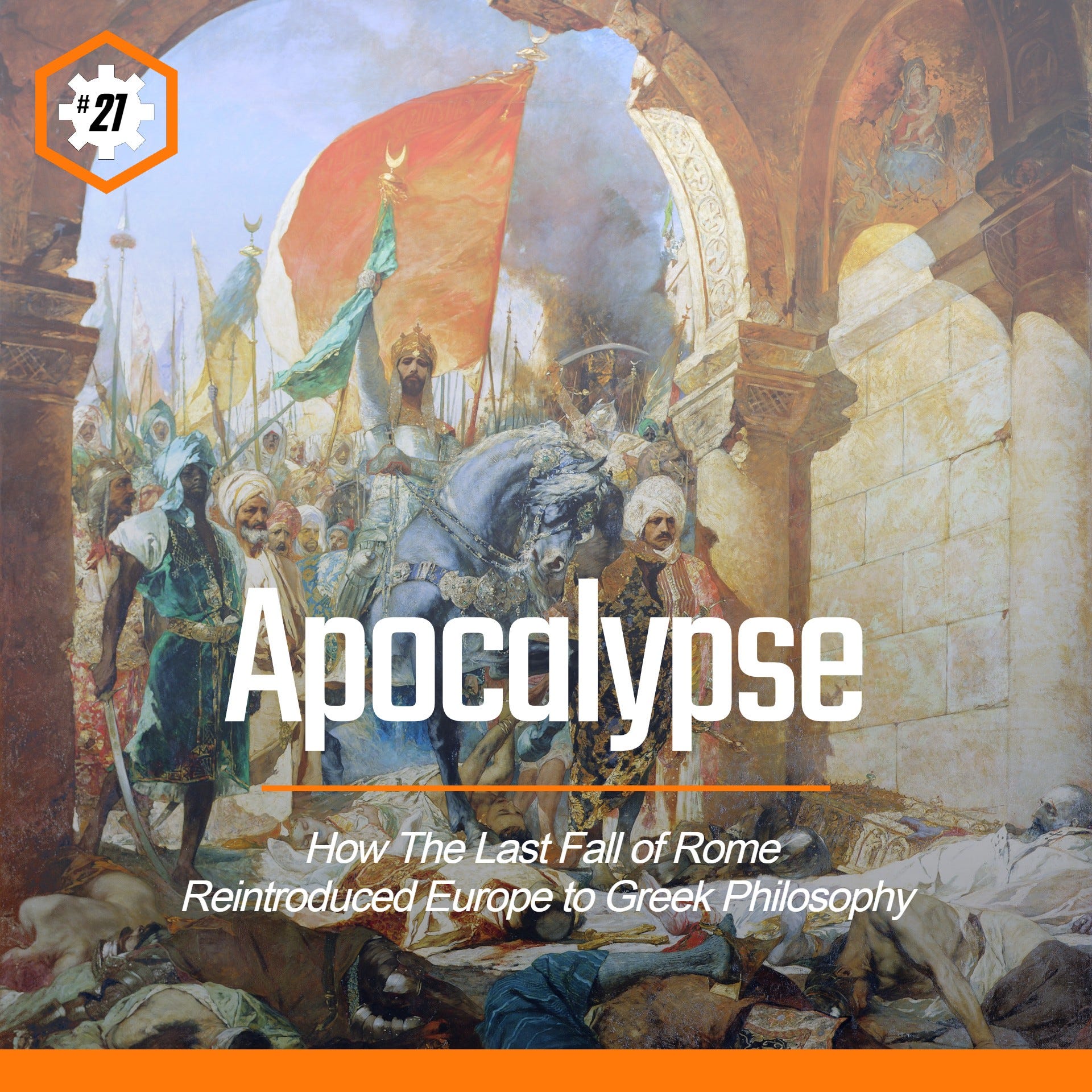
The most recent date given for the Fall of Rome is neither AD 410 nor AD 476; it’s actually 1453, after the advent of gunpowder.
The Last Fall of Rome touched off the Renaissance by reacquainting Italy with Greek philosophy.
The Fall of Constantinople severed the old Silk Road, forcing Christian merchants to sail westward in search of an alternate trade route.
The Last Fall of Rome
The Fall of Rome was a slow-moving cataclysm that lasted for centuries. That fact makes it difficult to assign a particular date to that momentous historical event.
Some consider the key moment to have been in 410 AD, when Alaric the Visigoth sacked the Eternal City. Others believe the year to be 476 AD, when the German Odoacer finally deposed an 11-year-old Romulus Augustulus, the very last Roman Emperor in Italy. His name appropriately meant “Little Augustus.”
But the Eastern half of the Roman Empire endured for another thousand years after these dates, with Constantinople as the capital. The Greek-speaking population of that city thought of themselves as living at the administrative seat of the old Roman Empire. Meanwhile, Roman civilization all but vanished from Italy.
Their city was sometimes called Byzantium, and their version of the Roman Empire is occasionally referred to as the “Byzantine” Empire. But they thought of themselves as Roman subjects.
Constantinople is today called Istanbul, the largest city in Türkiye. It’s a bustling port that sits on the edge of the Sea of Marmara, sandwiched between the Bosphorus Strait and an estuary called the Golden Horn. These geographical features create an easily defensible peninsula that resisted conquest for centuries after Rome fell in the West.
Three years after Alaric the Visigoth pillaged Rome in 411, the Christian Emperor Theodosius II completed a curtain of thick double walls that sealed off Constantinople’s peninsula from the rest of Europe. He didn’t want the new capital to suffer a similar fate as the old one.
The Walls of Theodosius and the Greek-speaking version of the Roman Empire endured throughout the Middle Ages. It would take the advent of gunpowder and the cannons of the Turkish Sultans to finally render them obsolete in 1453, when the final Fall of Rome took place.
Gemistos Plethon Goes to Florence
Sultan Murad II laid siege to Constantinople in 1422. But to confront a sudden uprising back home, his forces were compelled to withdraw prematurely. The Greek-speaking population of Constantinople gave thanks, believing the Roman Empire had been miraculously delivered from destruction by the Theotokos, or the Virgin Mary.
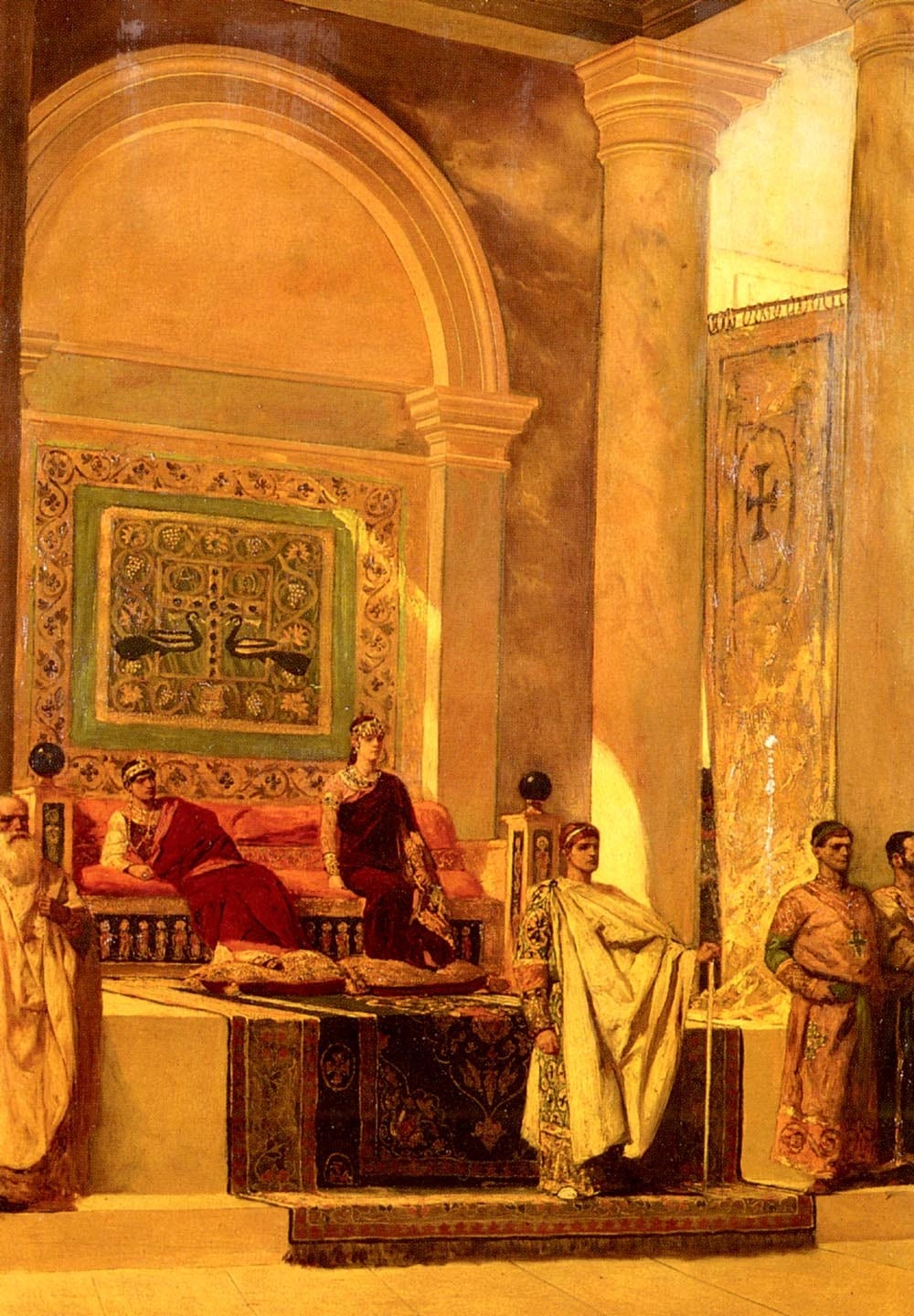
The Emperor John VIII Palaiologos soon departed from his capital on a diplomatic mission to mend fences with the Roman Catholic Church. His own Greek Orthodox Church had observed mutual excommunication with its Latin cousin since the Great Schism of 1054.
But in the 1430s, the situation was desperate. The Emperor thought he could save his people by uniting the estranged Greek and Latin Churches against the Muslim Turks. So the Emperor brought the aging Patriarch of Constantinople with him to what would become the Council of Florence. Tragically, Patriarch Joseph II died during the Council and was buried in that city.
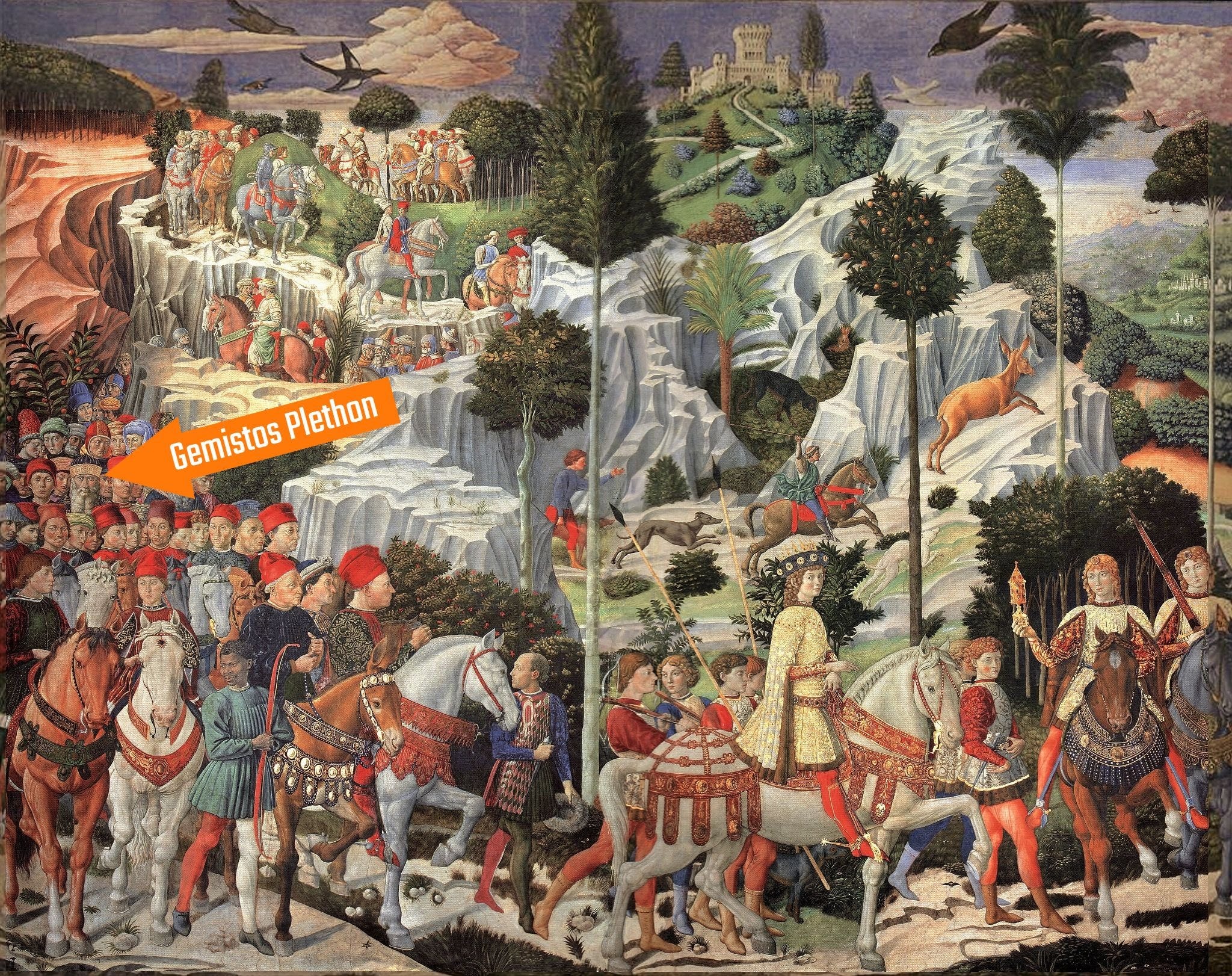
The Emperor also brought with him a scholar named Gemistos Plethon, who was neither a clergyman nor a statesman. But Plethon’s command of pre-Christian Greek literature found receptive ears among the Florentines.
Most pre-Christian Greek and Roman literature had been lost to Western Europe since the 5th century crackdowns of the Christian Roman Emperor Theodosius. That’s why Plethon’s lecture series on the Greek philosophy of Plato had a major impact on Cosimo de’ Medici, the patriarch of the ascendant Florentine banking family. Exposure to these lost works inspired Cosimo to found a new version of Plato’s Academy right there in Florence.
Cosimo’s descendants took this reintroduction to Plato even further. As part of their attempt to realize Platonic ideas, the Medici family went on to patronize promising artists. They sought to match the artistic skill evident in old Greek and Roman artifacts that predated Christianity.
The artists bankrolled by the Medici not only succeeded, but also surpassed the masters of Antiquity. Today, we recognize their collective efforts as the Italian Renaissance. At the Council of Florence, Gemistos Plethon became a conduit through which lost Classical knowledge was retransmitted from the Greek East to the Latin West. It was a key moment that ultimately gave birth to the Renaissance.
In 1464, Benozzo Gozzoli created a three-piece series of paintings that still adorn a chapel in the old Medici palace in Florence. The paintings superficially celebrated the three kings who observed the birth of Jesus. But Gozzoli commemorated the Council of Florence by rendering its major figures in his work. A portrait of John VIII Palaiologos stands in for King Balthasar, and the deceased Patriarch Joseph II played the part of King Melchoir. In the third painting, Cosimo’s grandson Lorenzo sits astride a white horse as King Caspar. Gozzoli also added the face of Gemistos Plethon to his third painting, in acknowledgement of the role he played in igniting a Florentine fascination with Greek philosophy.
Though the Council of Florence was an intellectual confluence that became a major historical turning point, it failed to save the Byzantine Empire. The Orthodox and Latin Churches remain unreconciled to this day, and—31 years after his father abandoned the siege—Sultan Mehmed II arrived at Constantinople to finish the job.
The Siege of Constantinople
The failure of Emperor John VIII Palaiologos to save his empire ruined his mental health. His attempt to reconcile the Greek East and the Latin West turned out to be deeply unpopular amongst his own subjects. As his failure became clear, the mental health of John VIII collapsed and he died a broken man at the young age of 55.
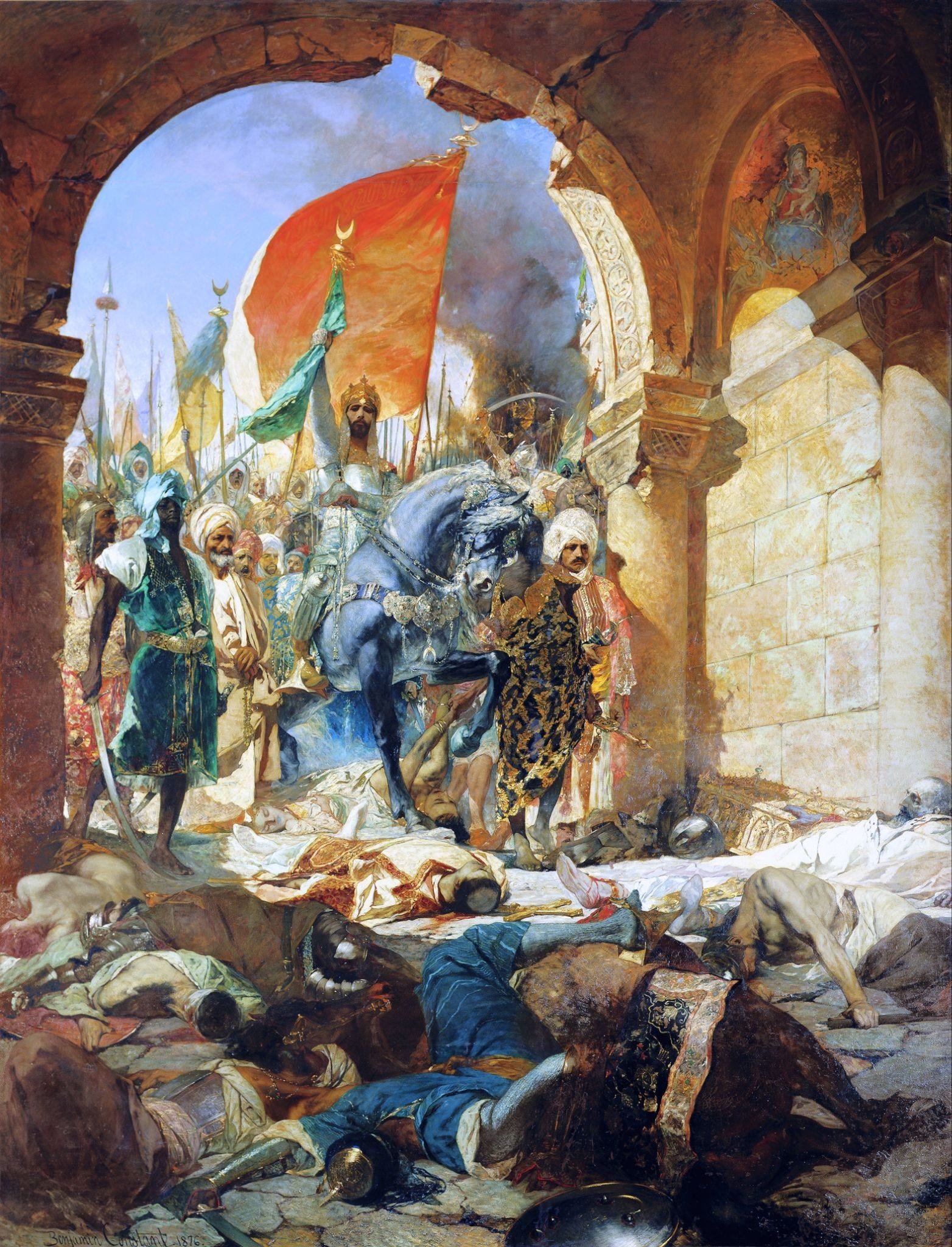
It fell to his brother, Constantine XI Palaiologos, to muster a futile defense of the old Walls of Theodosius. But the walls that had stood for a thousand years were no match for the cannons of the Sultan. His armies poured into the city and began their rape of Constantinople on May 29, 1453.
Tradition entitled the Sultan’s soldiers to three days of unrestricted plunder when a city refused to surrender. But Mehmed cut them off after only a single day. He planned to make Constantinople his new capital, and he needed to preserve as much of its infrastructure as possible.
Sultan Mehmed II renamed the city Istanbul and slapped prohibitive taxes on Christian merchant ships. This action effectively severed the old Silk Road of Marco Polo. It incentivized the crowned heads of Christendom to finance expeditions westward across the Atlantic Ocean, searching for an alternate sea route to the Orient. Christopher Columbus set sail on his fateful voyage just 39 years after Constantinople fell.
Conclusion
The Greek-speaking people who called Constantinople home lived through a Fall of Rome in 1453, when their city fell and they were dispersed to the four corners of the compass. It seemed like the end of the world. But counterintuitively, this apocalypse birthed our modern world in two important ways. It led to the Age of Exploration and the discovery of two new continents. But more importantly, that historical episode revived intellectual currents that began flowing again after the Council of Florence, as if a great frozen river had finally started to thaw. The siege of Constantinople prompted a cross-pollination of ideas between the Catholic West and the Orthodox East. Pre-Christian ideas from Antiquity that had lain dormant under the intellectual winter of the Medieval Church began to bloom like flowers before the spring of the Italian Renaissance.
Since you’ve made it this far, inquisitive reader, kindly consider hitting the ❤️ button above or below; it really helps!
Further Materials
Constantine led the defense with desperate resolution. He equipped his 7,000 soldiers with small cannon, lances, bows and arrows, flaming torches, and crude firearms discharging leaden bullets of a walnut’s size. Sleeping only by snatches, he supervised, every night, the repair of the damage done to the walls during the day. Nevertheless the ancient defenses crumbled more and more before the battering rams and superior artillery of the Turks; now ended the medieval fortification of cities by walls. On May 29 the Turks fought their way across a moat filled with the bodies of their own slain, and surged over or through the walls into the terrorized city. The cries of the dying were drowned in the martial music of trumpets and drums. The Greeks at last fought bravely; the young Emperor was everywhere in the heat of the action, and the nobles who were with him died to a man in his defense. Surrounded by Turks, he cried out, “Cannot there be found a Christian to cut off my head?” He threw off his imperial garments, fought as a common soldier, disappeared in the rout of his little army, and was never heard of again.
Will & Ariel Durant, The Reformation, 1957, page 182

What will arise from our current stumble into the abyss?