


Quick Summary
The last Emperors of Rome endorsed a narrow definition of Christianity, to the violent exclusion of rival versions of that faith and its Platonic precursors.
Platonism enjoyed an intense revival during the late Middle Ages, when it inspired the Renaissance.
Hermeticism is the specific branch of revived Platonic philosophy that gave rise to Renaissance Alchemy.
Platonic Ascent
During the first few centuries AD, theological differences like the Arian Heresy splintered Christianity into factions. Because it came directly out of Plato’s Greek philosophy, the concept of a holy trinity seemed sensible to the Greek-speaking inhabitants of the Roman Empire. But for German-speakers living in the Empire’s northern reaches, the notion that Jesus could be both God and his son simultaneously was impossible to fathom.
During the late Roman Empire, multiple schools of thought descended from Plato’s famous assertion that there exists a hidden realm of idealized perfection beyond the flawed world we experience directly. Christianity—with its concept of heaven—is just one example of Platonic thought. Neoplatonism, Gnosticism, and Hermeticism were other examples. Each was organized around the notion of a Platonic Ascent out of a fallen reality and into a higher plane of existence. These schools of thought are Christianity’s cousins in the ideological family tree of Platonism.
As the Roman Empire spiraled into economic decline, its ruling class attempted to shore up waning political power by embracing Christianity. They enshrined a narrow brand of trinitarian Christianity as their new state religion, thereby establishing a singular authoritative body.
So it was that the Roman Catholic Church was born from the Fall of Rome. Largely intolerant of backsliding into old ways, the last emperors engaged in an orgy of destruction and censorship. Along with heretical Christian practices that had not received state sanction, they also suppressed Neoplatonist, Gnostic, and Hermetic schools of thought. Plato’s writing presented intellectual competition to Roman Catholicism, so his work was lost to Christendom as the Church enforced a spiritual monopoly that endured throughout the Middle Ages.
Ad Fontes
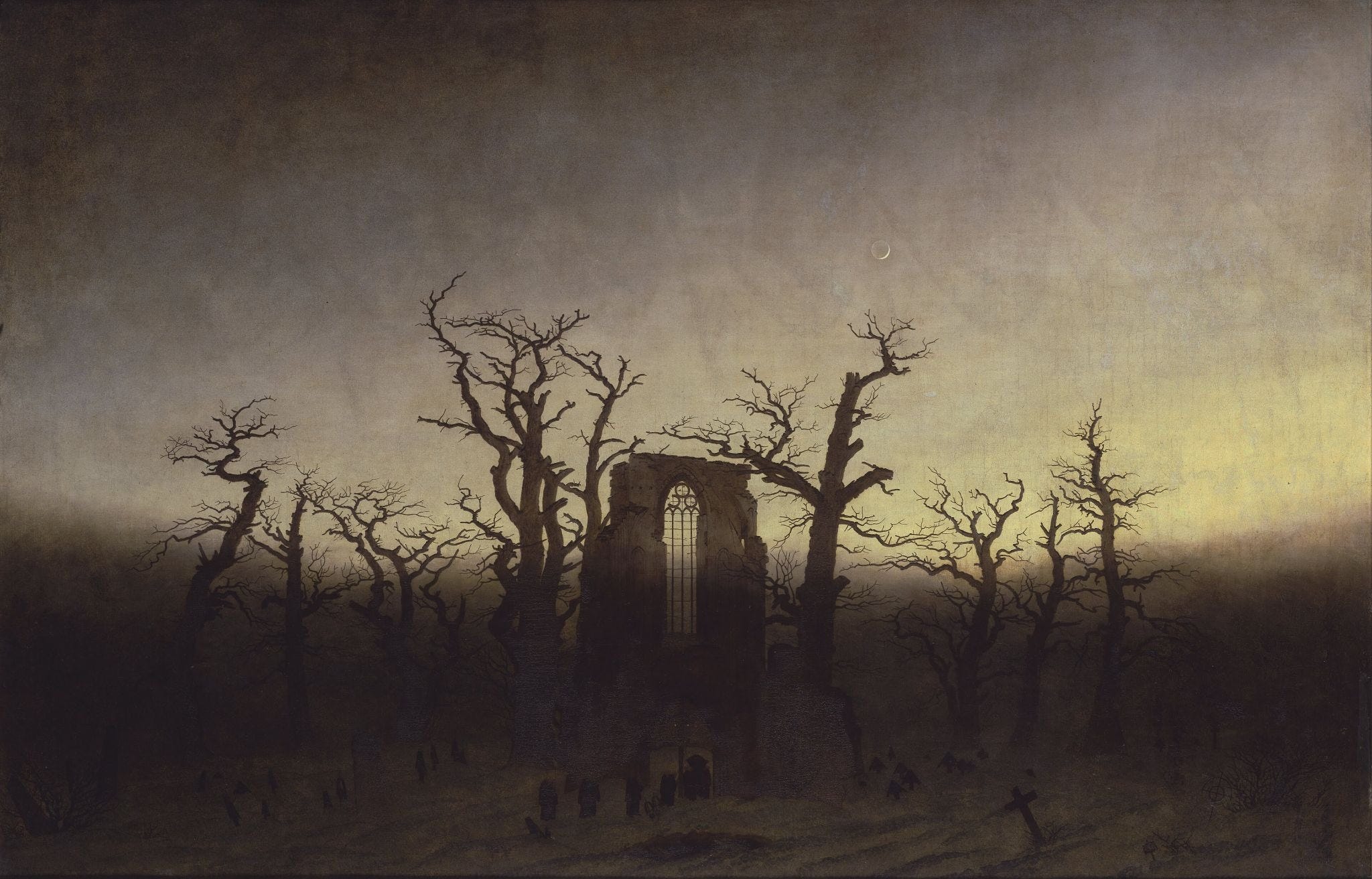
During the Middle Ages, miracles not sanctioned by the authorities were known as “magic.” As Europe’s dominant ideological and institutional authority, the Church claimed a monopoly on miracles, sacred knowledge, and divine intervention. Miracles performed by saints or attributed to God through the Church were considered legitimate, while similar phenomena outside its control were condemned as heresy.
But as the Middle Ages wore on, the Roman Catholic Church began to shamelessly monetize their spiritual monopoly by selling the invisible product of sin remission. This naked corruption—along with the Church’s conspicuous inability to stop the Black Death—fueled a renewed public interest in pre-Christian thought.
Ad fontes means “back to the source,” and it was the Latin motto of the Renaissance. In Plato’s original writings, a mythic ascent out of his allegorical cave and into divine light is achieved through dialectical improvement.
This Platonic Ascent is the hallmark of all philosophical traditions descended from Platonism. In Christianity, the mythic ascent out of a fallen world and into a realm of idealized perfection is achieved through moral improvement. And in Hermeticism, a similar ascent is supposed to be achieved through a great work, or a magnum opus.
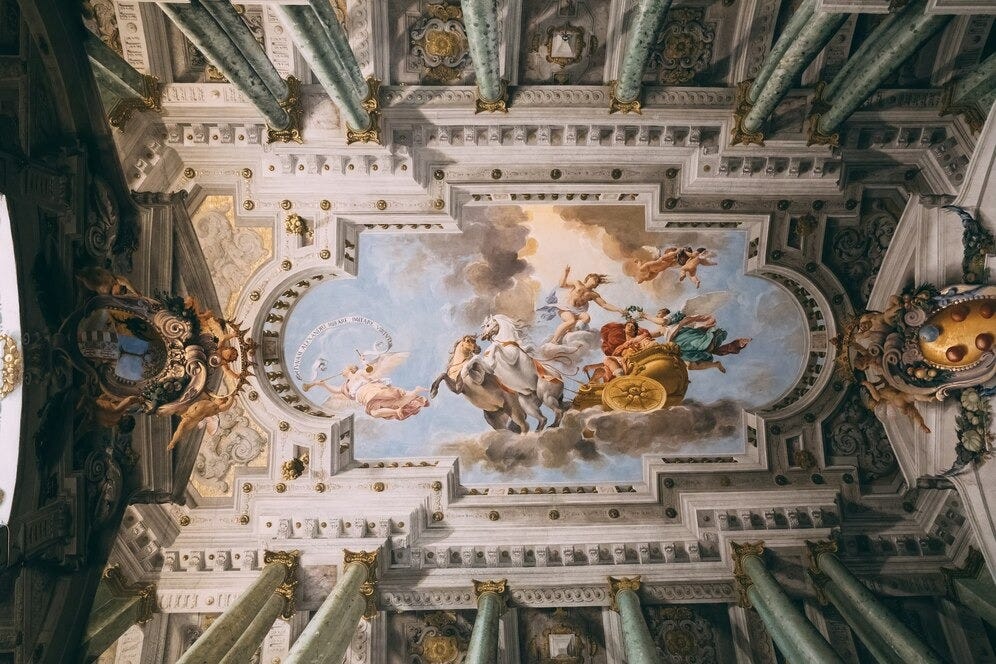
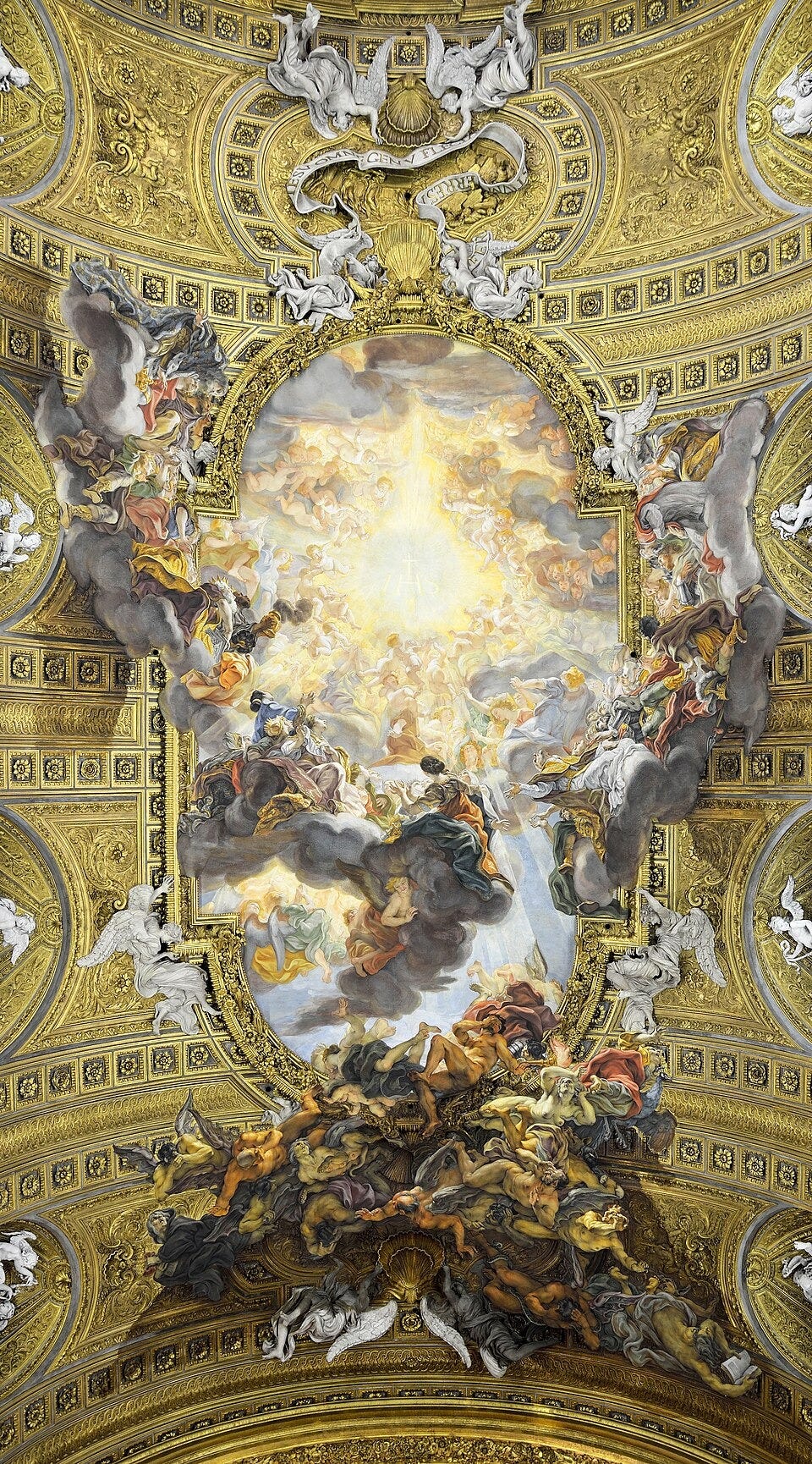
It was this philosophy that inspired the great flourishing of artwork that defined the Renaissance. The artists of that era devoted decades of their lives to studying and eventually surpassing pre-Christian techniques. One such technique is trompe l’oeil, in which a realistic 3-dimensional illusion is painted onto a 2-dimensional surface. Examples of this technique are usually found on ceilings, where they create illusions of breathtaking verticality.
In his original Allegory of the Cave, Plato used shadows flickering on a cave wall to allegorize the illusion of the senses we’re all trapped inside. His invocation of a 2-dimensional illusion emanating from a 3D source matches the stunning dimensionality of trompe l’oeil illusions achieved by the artists of the Renaissance.
Alchemical Journey
The Medici of Florence almost single-handedly bankrolled the Italian Renaissance. That banking family rescued potential artists from endlessly toiling in the fields by paying their bills, which freed them up to devote themselves entirely to magna opera. The Medici also played a major role in the revival of Plato by scouring the Mediterranean Basin for any scraps of his writing that survived the purges of the late Roman Emperors.
The Medici went so far as to establish a new version of Plato’s Academy in Florence. But when Medici agents discovered a copy of the Corpus Hermeticum, the old patriarch of the Medici clan ordered an immediate halt to the translation of Plato. Cosimo de’ Medici was far more interested in translating the contents of that crumbling old book of magic than he was even in Plato.
Much like the Bible, the Hermeticum is a collection of books dating back to the late Roman Empire. These volumes ignited a Renaissance fascination with alchemy. While Hermeticism had been lost to the West between the Fall of Rome and the Renaissance, its transfiguration into alchemy occurred within the Muslim societies of the East. The translation of the Hermeticum was Europe’s pivotal introduction to that magical art.
Renaissance alchemists conceived of the Platonic Ascent as an “Alchemical Journey,” where the soul returns to its divine origin. They emphasized the transformative power of the journey itself as the true goal of any quest.
Paolo Coelho’s 1988 novel The Alchemist vividly illustrates the point. It’s the story of a young man seeking treasure under the Great Pyramids, only to finally discover it buried in the village where his story began. The plot of The Alchemist mirrors the Ad fontes motto of the Renaissance, which was a journey back in time to recover something lost during the crackdown of Late Antiquity.
In alchemy, the magnum opus is the means to complete the Alchemical Journey. Where Christianity stresses ascension through moral improvement, Renaissance alchemists and artists alike conceived of ascent through technical improvement. They saw the gradual refinement in skill that comes with relentless repetition of a craft as a ramp they could use to climb between parallel realms of existence.
The Medici could never have imagined how successful they would be. The artists they patronized dramatically surpassed the lost techniques of Antiquity. Names like Michelangelo, Botticelli, and Leonardo Da Vinci are even more famous today than the Medici bankers who once patronized them. The Renaissance, in all its glory, epitomized a great changing of the age from the Medieval to the Modern.
Conclusion
In addition to financing the flowering of Renaissance artwork, the Medici also played a major role in popularizing alchemy in Europe. That family engaged in bizarre alchemical practices, like grinding up and drinking gemstones to benefit from their magical properties. They kept bizarre cabinets filled with alchemical oddities, such as hairballs or narwhal tusks. Neither practice yielded much in the way of actual results. But from these and a thousand other strange alchemical experiments, modern chemistry was born during the Scientific Revolution. That revolution displaced a stalwart Church authority that had persisted since the Fall of Rome. Chemistry traces its intellectual heritage all the way back to the schools of Platonic thought that were banned by the last Emperors of Rome. It is a rich historical irony that the Platonic idea of an Alchemical Journey comes down to us after having undergone a journey strikingly similar to the one it preaches about.
Since you’ve made it this far, cordial reader, kindly consider hitting the ❤️ button above or below; it really helps!
Further Materials
Chemistry as a science was almost created by the Moslems; for in this field, where the Greeks (so far as we know) were confined to industrial experience and vague hypothesis, the Saracens introduced precise observation, controlled experiment, and careful records. They invented and named the alembic (al-anbiq), chemically analyzed innumerable substances, composed lapidaries, distinguished alkalis and acids, investigated their affinities, studied and manufactured hundreds of drugs. Alchemy, which the Moslems inherited from Egypt, contributed to chemistry by a thousand incidental discoveries, and by its method, which was the most scientific of all medieval operations. Practically all Moslem scientists believed that all metals were ultimately of the same species, and could therefore be transmuted one into another. The aim of the alchemists was to change “base” metals like iron, copper, lead, or tin into silver or gold; the “philosopher’s stone” was a substance—ever sought, never found—which when properly treated would effect this transmutation. Blood, hair, excrement, and other materials were treated with various reagents, and were subjected to calcination, sublimation, sunlight, and fire, to see if they contained this magic al-iksir or essence. He who should possess this elixir would be able at will to prolong his life. The most famous of the alchemists was Jabir ibn Hayyan (702-65), known to Europe as Gebir. Son of a Kufa druggist, he practiced as a physician, but spent most of his time with alembic and crucible. The hundred or more works attributed to him were produced by unknown authors, chiefly in the tenth century; many of these anonymous works were translated into Latin, and strongly stimulated the development of European chemistry. After the tenth century the science of chemistry, like other sciences, gave ground to occultism, and did not lift its head again for almost three hundred years.
Will & Ariel Durant, The Age of Faith, 1950, page 244
