


Key Takeaways
The human tendency towards wealth addiction figured heavily into the Fall of Rome and the rise of feudalism.
A thousand years later, feudalism also succumbed to wealth addiction, giving rise to capitalism.
To sweep away the last vestiges of feudalism, the foundation thinkers of capitalism proposed heavy taxes on property.
The Fall of Rome
In his classic work, Republic, the Greek philosopher Plato presented justice (dikē) and greed (pleonexia) as warring opposites in a lively debate over the nature of a good person and a just society. He suggested that wealth accumulation is the most dangerous of all addictions because there is no hangover period. Where addicts of food and wine are limited by the capacity of their stomach, indulgence in wealth instantly creates the desire for more wealth, without ever satisfying the appetite. Plato noted that, when societies die, chronic wealth addiction is usually the diagnosis.
500 years after his own death, the Fall of Rome vividly illustrated Plato’s point for him. Chief among its causes was an unwillingness on the part of Rome’s ruling class to share the spoils of conquest. The slaves and land won by the military were claimed by the already wealthy. They put their slaves to work on their vast tracts of new land.
The resulting slave plantations, called latifundia, flooded Roman markets with slave-grown produce. Prices collapsed, ruining Rome’s small farmers en masse. Citizen farmers couldn’t hope to compete with slave labor. They were forced to either sell their farms, or to see them foreclosed upon by creditors.
Either way, small familial plots were systematically consolidated into the hands of the already-wealthy. A rigid Roman legal system blindly enforced contract terms, with no mechanism for promoting social stability over the narrow financial interests of the oligarchy. Spiraling wealth inequality suffocated Roman society. As fewer and fewer people had any incentive to defend the borders of the Empire, it began to shrink.
Christianity arose as a powerful force within the dying Empire as a rejection of this cruel economic hierarchy. Broad-scale debt forgiveness, as advocated for by Jesus, might have slowed the rate at which the ruling class gobbled up the land of small farmers. Instead, St. Augustine made Christianity friendly to the financial interests of the ruling elite by reinterpreting the forgiveness commanded by Jesus to instead mean forgiveness for personal moral failings.
As unchecked waves of foreclosures delivered the vast majority of Rome’s agricultural lands into the hands of a few wealthy families, many small farmers found themselves working—alongside slaves—on lands they previously owned.
Over the course of a few centuries, Roman society gradually receded from Europe until it disappeared completely. The few wealthy Roman families who owned everything retreated into fortified homes at the centers of their vast estates, while the workers who tilled their fields became attached to the land as tenant farmers, or peasants.
That’s how the feudal system of lords and peasants was born from the wealth addiction of Rome’s ruling class. This arrangement became the dominant economic system in Europe during the ensuing Middle Ages.
The Triumph of Capitalism
Besides the nobility living behind castle walls, the other major authority in Medieval feudalism was the Roman Catholic Church. That institution had adopted Augustine’s version of Christianity and became the state religion of the Roman Empire during its twilight. The Church reinforced the notion of the “Divine Right of Kings”, in which half the produce grown by peasants was owed to the feudal lord who owned the land.
But over the course of a thousand years, as Plato might have predicted, the Church succumbed to pleonexia. People believed that it possessed a special connection to God, and the Church began monetizing that perceived monopoly by charging money for the invisible product of sin forgiveness. The so-called “Sale of Indulgences” went on to become a major flashpoint in a brewing Protestant Reformation.
The first seeds of the Church’s political downfall were sown in the mid-1300s, when the Black Death discredited the Church and cast grave doubts upon its claimed special connection with God. And in the early 1400s, the Reformation became inevitable after Johannes Gutenberg’s invention of the printing press destroyed the Church’s real monopoly: control over the flow of information.
After the Black Death wiped out a third of Europe’s peasants, the survivors realized that they could capitalize on the labor shortage. Instead of swearing fealty to any particular feudal lord, they instead began playing one lord off another in bidding wars for their labor.
As the Renaissance and the Reformation broke over Europe like tidal waves, more and more labor was performed by employers and employees, rather than by peasants and lords. Where the Roman slave system had been replaced by feudalism, the Medieval feudal system was, in turn, displaced by modern capitalism.
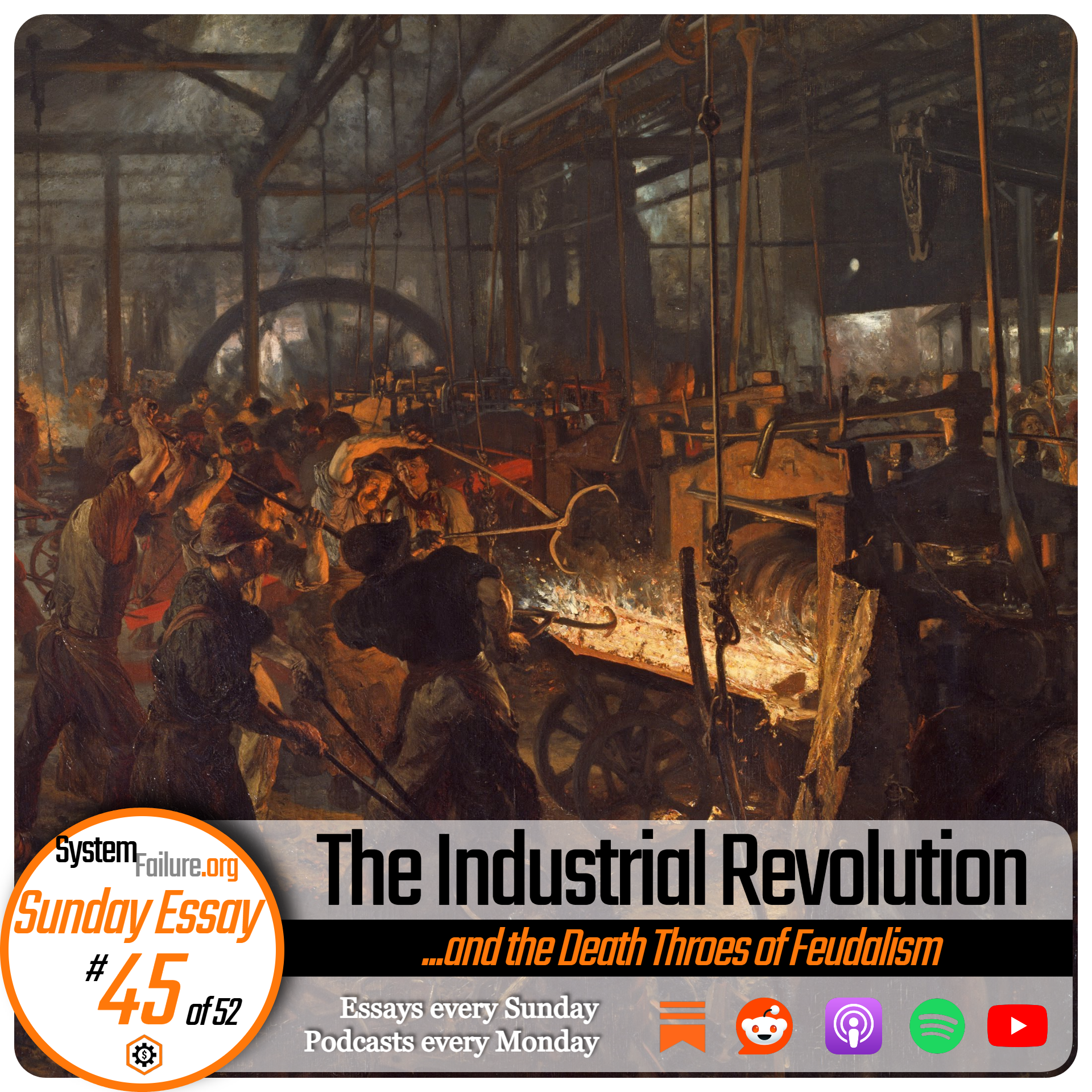
The Industrial Revolution
The Industrial Revolution started in England, where the claim stubs of English goldsmiths first circulated as paper currency. Gold is heavy and cumbersome. The English public found it much more convenient to instead trade amongst themselves the paper receipts for the deposits they’d made at their local goldsmith.
Over time, fewer and fewer people bothered to redeem their paper deposit tickets for actual metal. Most gold just sat in goldsmith’s vaults collecting dust. Meanwhile, commerce continued apace, with pieces of paper as its basis.
Goldsmiths soon realized they could get away with loaning out deposit tickets worth many times the actual holdings in their vaults. Fractional reserve lending was born, and English goldsmiths became the first bankers of the capitalist era. They began loaning their paper money to entrepreneurs, who then repaid the loans by setting up the English factories that epitomized the early Industrial Revolution. These factories attracted great masses of former peasants, who moved from the countryside into the cities and began working as employees.
But contemporary economists like Adam Smith, David Ricardo, and John Stuart Mill noticed a problem. The families of the old feudal lords still owned vast tracts of land after the Middle Ages. And they were helping themselves to the profits of the entrepreneurs setting up the new factories of the Industrial Revolution.
Landlords could simply jack up the rents of the employees who lived on their land. Because homeless employees don’t make for very reliable workers, employers ultimately had to pay their workers enough to afford rent, whatever the cost. When landlords raised the rent, capitalists ultimately paid that price in reduced profits.
To combat this pleonexia, classical economists like Smith, Ricardo, and Mill proposed heavy taxes on the old feudal landlords, who made their living by owning property, not by providing actual goods or services. They proposed to hammer the propertied class with enough confiscatory taxes to motivate them to sell assets, thus driving down rent prices.
Conclusion
The taxation schemes envisioned by classical economists Smith, Ricardo, and Mill did not fully come to pass. Just as the feudal system succumbed to wealth addiction during the Middle Ages, the capitalist system began going down a similar road during the late 1800s. That’s when classical economics was displaced by “neo-classical” economics. Like Augustine’s reinterpretation of Christianity, neo-classical economics serves the financial interests of a propertied class. It does this by demolishing the classical distinction between earned and unearned income. Modern economists make no distinction at all between money earned by dint of owning property, and money earned through the provision of actual goods and services. Our modern taxation schemes reflect this blindness. And as a result, modern capitalism is being parasitized by too many free riders (what classical economists called rentiers). Once again, as Plato could have predicted, pleonexia is hollowing out a formerly high-functioning system of economics.
Since you made it this far, patient reader, kindly consider hitting the ❤️ button above or below; it really helps!
Further Materials
As soon as the land of any country has all become private property, the landlords, like all other men, love to reap where they never sowed, and demand a rent even for its natural produce. The wood of the forest, the grass of the field, and all the natural fruits of the earth, which, when land was in common, cost the labourer only the trouble of gathering them, come, even to him, to have an additional price fixed upon them. He must then pay for the licence to gather them, and must give up to the landlord a portion of what his labour either collects or produces. This portion, or, what comes to the same thing, the price of this portion, constitutes the rent of land, and in the price of the greater part of commodities, makes a third.
Adam Smith, An Inquiry into the Nature and Causes of the Wealth of Nations, 1776, Book I, Chapter 6
Landlords grow rich in their sleep without working, risking or economizing. The increase in the value of land, arising as it does from the efforts of an entire community, should belong to the community and not to the individual who might hold title.
John Stuart Mill, Political Economy, 1848, Book V, Chapter 2
The key feature of industrialism is automation, creating a machine to do something over and over. For non-technical types, a good example is the automobile, a machine created to provide transportation (and replace horses). Note that the automobile engine is described in terms of "horsepower". Automobiles have been further automated into computer networks, so that the automobile mechanics who replaced the carriage makers have now been deskilled to plug in a computer to diagnose a malfunction, which might be fixed by downloading software.
The technology to start industrialism was available for 1,000 years before, but the labor saving aspect was the deal killer. You aren't going to be interested in using a combine to harvest wheat if you then have to deal with 1,000 idle farm workers. It was only after the Black Death killed off half of the labor force that Europeans saw the value in labor saving technology.
The reason the Black Death killed so many people in Europe is the AMOC, the ocean current that provides Europe with lots of rain so that it doesn't resemble Siberia or Canada. Lots of rain means lots of grain to support lots of people and rats. History is geography. Now the AMOC is slowing because glaciers are melting, and if it stops Europe will become like Siberia. Perhaps the glaciers will then start growing again.
During the Bronze Age governments were much more involved in managing the economy, and they developed Jubilees in order to maintain social stability. But an outbreak of the Black Death in the Mediterranean area caused population collapse and ended the Bronze Age. Currency was invented in the ensuing Iron Age, which speeded up economic activity so that markets and armies and cities got larger. This made managing the economy more complex, because now you needed to keep track of money supply and velocity. Criminalizing usury was an attempt to control this new technology, but the European Black Death pandemic ended that in Christendom.
Finance capitalism has evolved to manage the conflict over labor. It got a boost when the US finally abolished slavery. But finance capitalism causes booms and busts at a much higher rate than previously. The US is dominated by finance capitalism.
But enough about the West. East Asia created the Silk Road in order to sell their manufactured goods to the West. In exchange East Asia got Western gold and silver, which caused the warring kingdoms period. The Mongols eventually created China (and sent the Black Death to Europe). The Ming dynasty turned in on itself, only to discover that the West had replaced their gold and silver by stealing it from the New World, and now they had gun ships. This led to the current government, which is communist with Chinese characteristics. Which means the Chinese government dominates finance capitalism. China has moved 800 million people out of poverty, while becoming a global hegemon (that dares to call the US a reckless hegemon).
Now, China is looking at population collapse this century due to the one child policy. The US has been growing in population due to immigration, but the current administration is ending that. The last time people had to deal with shrinking populations was the Black Death, which kicked off industrialism, which led to finance capitalism. What will shrinking populations lead to now?
If global human population drops to one billion, we can go back to riding horses.